I arrived in New Orleans at 10 PM on a Sunday with a carry-on and the optimistic plan to eat dinner before midnight. By 10:05 PM I had a hurricane in my hand that a man named Beaumont had pressed on me outside a bar on Frenchmen Street, insisting that "welcome to the city" was sufficient explanation. By midnight I was eating a bowl of red beans and rice that cost $7 and tasted like it had been simmering since the Jazz Age. I did not sleep until 3 AM. I was fine with this.
The Perfect New Orleans Itinerary (2, 3, 4 & 7 Days)
Two days in New Orleans is a blur and a blessing. French Quarter in the morning (before the tour groups). Frenchmen Street at night (where the actual musicians play). One café au lait with a beignet at Café Du Monde. One completely unnecessary cocktail. You will leave fundamentally altered.
Frenchmen Street — not Bourbon Street. This is the whole game. Write it on your hand.
72 Hours: The Garden District Earns Its Name
Three days adds the Garden District, the St. Charles Avenue streetcar, and a morning at the Ogden Museum of Southern Art, which will rearrange your understanding of American culture in about ninety minutes. The food gets more interesting as the city trusts you more.
4 Days: Bayou Country and the Real Creole Table
Four days means a bayou swamp tour (the wildlife is genuinely astonishing), a proper meal at Dooky Chase's (the restaurant that fed the Civil Rights Movement and still makes the best fried chicken in the United States), and at least one long lunch in the Bywater that turns into the evening.
7 Days: New Orleans Has No Interest in Being Convenient
A week means you find the second-line parade schedule and follow one. It means lunch at Galatoire's on a Friday (the entire city goes — wear something). It means a morning at the Tremé, the oldest African American neighbourhood in the US, understanding what this city is actually built from. You will eat too much. This is not a problem. This is the plan.
Estimated budget:$280–$480 est. (budget–mid, incl. 1 hotel night)
Estimated budget:$420–$720 est. (2 hotel nights + Garden District streetcar + meals)
Estimated budget:$580–$980 est. (swamp tour + 3 nights + Commander's Palace)
Estimated budget:$1,050–$1,900 est. (full week, mid-range hotels, Galatoire's Friday lunch)
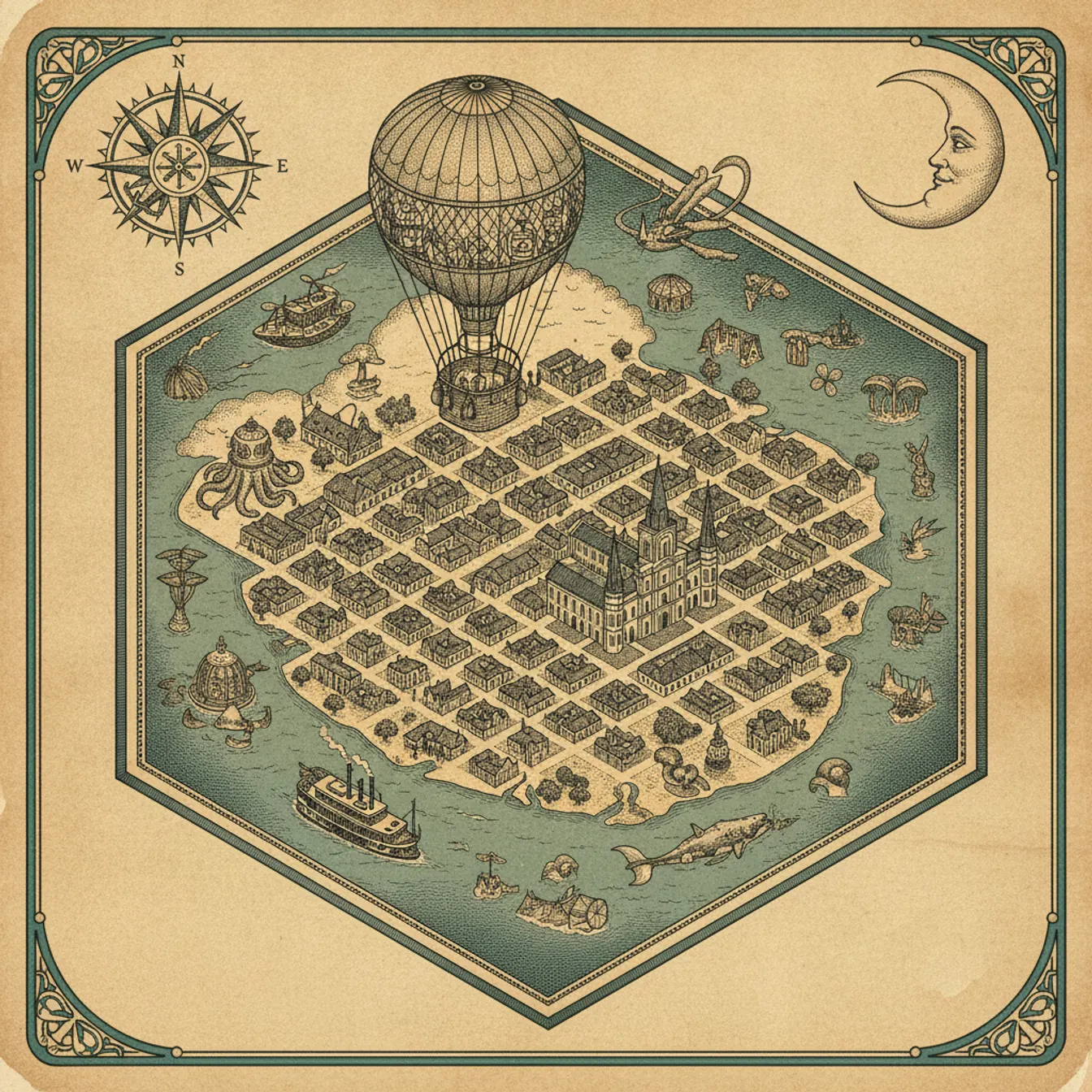
[ THE DISPATCH · FIELD MAP ]
A tilted, hand-drawn dispatch of New Orleans. Click a quarter to explode it open.
0 / 6 quarters explored
[ FRENCH QUARTER (VIEUX CARRÉ) ]
Old stones, older stories.
Café Du MondeBeignets, café au lait, and powdered sugar on your shirt. Always.
Jackson Square + St. Louis CathedralThe oldest continuously operating Cathedral in the US, in the square that gave New Orleans its identity.
[ FRENCHMEN STREET ]
Stays up later than you do.
French Quarter — Central Grocery + CasamenThe muffuletta and the oyster po'boy. Both. In the same city block.
Frenchmen Street — the clubs open at 8 PMThree blocks, twelve clubs, one of the best live music scenes on earth. Free entry at most venues.
[ GARDEN DISTRICT ]
Old stones, older stories.
St. Charles Avenue Streetcar (Canal St to The oldest continuously operating streetcar line in the world, $1.25 each way.
Lafayette Cemetery No. 1The above-ground tombs that made Anne Rice write vampire novels. You will understand immediately.
[ WAREHOUSE ARTS DISTRICT ]
Grand squares and big ideas.
Commander's Palace — the 25-cent martini lSince 1893. The turtlesuit of New Orleans dining. The 25-cent martini is real.
Ogden Museum of Southern ArtThe South's story, told in painting, sculpture, and photography. Surprisingly moving.
[ BYWATER ]
Stays up later than you do.
Bywater — coffee and neighbourhood walkThe neighbourhood where every building is interesting and nobody explains why.
Bacchanal Wine — BywaterA wine shop with a kitchen, a courtyard, and live music at 6 PM. The perfect New Orleans evening.
[ TREMÉ ]
Old stones, older stories.
Backstreet Cultural MuseumMardi Gras Indian suits, second-line culture, and the history nobody else tells. Unmissable.
Congo Square (Louis Armstrong Park)The square where jazz began. Where enslaved people were permitted to gather, and created everything.
Day 1
French Quarter + Frenchmen Street Night
The city introduces itself. It does not do this quietly.
The French Quarter in the morning is a different place than the French Quarter at night. Morning: wrought-iron balconies, jasmine, locals getting coffee. Night: an experience that will require some processing. Frenchmen Street — not Bourbon Street — is where you go for music. Write this down before you forget it.
Slow morning. Café Du Monde opens at 7 AM and closing beignet-duty is non-negotiable. Walk the Quarter before 9 AM when it belongs to the delivery trucks and the cats. Everything opens eventually.
Café Du Monde
Beignets, café au lait, and powdered sugar on your shirt. Always.
Café Du Monde has been open since 1862, serves exactly three items (beignets, café au lait, and orange juice), and does all three perfectly. The beignets arrive in threes, buried under powdered sugar. The café au lait is half coffee, half scalded milk, and requires no modification. The outdoor terrace faces Jackson Square and the river. You will get powdered sugar on every surface you own. This is tradition. Eat here once in the morning and once at midnight, which is when the real clientele arrives.
Jackson Square + St. Louis Cathedral
The oldest continuously operating Cathedral in the US, in the square that gave New Orleans its identity.
Jackson Square is the historical heart of the French Quarter — the Cabildo (where the Louisiana Purchase was signed), the Presbytère, and the triple spires of St. Louis Cathedral anchoring the north side. The Cathedral is free and open to visitors; the interior is painted pale blue and gold and is considerably more beautiful than its brick exterior suggests. Fortune tellers, portrait artists, and musicians set up in the square by 10 AM. The river is directly behind you.
French Quarter — Central Grocery + Casamento's lunch
The muffuletta and the oyster po'boy. Both. In the same city block.
Central Grocery on Decatur Street invented the muffuletta sandwich in 1906 — a round Italian bread piled with Genoa salami, ham, provolone, and a olive salad that makes the sandwich. Order a half (it's enormous). The original owner's descendants still run it. If the line is long, Casamento's on Magazine Street does the definitive oyster po'boy — freshly shucked gulf oysters, fried in a light cornmeal batter, in a French loaf with mayo and hot sauce. This is the taxonomy of New Orleans sandwiches. Learn it.
Three blocks, twelve clubs, one of the best live music scenes on earth. Free entry at most venues.
Frenchmen Street in the Marigny neighbourhood, three blocks east of the French Quarter, is what Bourbon Street was before it became a theme park. The Spotted Cat Music Club, d.b.a., the Maison, Blue Nile — most have no cover charge, you buy a drink and stand in rooms where serious jazz, funk, Cajun, and brass band music is played by musicians who are this good by choice. The Art Market at the Frenchmen Art Market (outdoor, Thursday–Saturday) adds vendors selling New Orleans art while the music bleeds out of the clubs. Start at the Spotted Cat and walk east. Let the sound pull you.
Day 2
Garden District + Ogden Museum + Warehouse Arts
The city's other face: antebellum mansions and the South's best art museum
Last day — the St. Charles Avenue streetcar to the Garden District (the most charming $1.25 you will spend in the US), Lafayette Cemetery for thirty contemplative minutes, Magazine Street for lunch, and the Ogden Museum before your flight. Do not skip the Ogden.
Full day. Start with Commander's Palace for their famous 25-cent martini lunch (book ahead — this is serious advice). Afternoon in the Warehouse Arts District; evening back in the Quarter or the Bywater.
St. Charles Avenue Streetcar (Canal St to Carrollton)
The oldest continuously operating streetcar line in the world, $1.25 each way.
The St. Charles Avenue streetcar has run since 1835 and is the most civilised way to reach the Garden District. Take it from Canal Street to Washington Avenue — the route passes Loyola University, Tulane, Audubon Park, and the Garden District's most extravagant antebellum mansions, all visible through the open windows. Buy a Jazzy Pass ($3 for 24 hours) if you're riding more than twice.
Lafayette Cemetery No. 1
The above-ground tombs that made Anne Rice write vampire novels. You will understand immediately.
New Orleans buries its dead above ground because the water table makes in-ground burial impractical (coffins float). Lafayette Cemetery No. 1 dates from 1833 and has the marble and brick above-ground tombs that the city is famous for — family mausoleums the size of small rooms, covered in Spanish moss, inscribed in French, German, and English. It is the most atmospheric free attraction in the city. The cemetery is open 8 AM–3 PM Monday through Saturday.
Commander's Palace — the 25-cent martini lunch
Since 1893. The turtlesuit of New Orleans dining. The 25-cent martini is real.
Commander's Palace has been the finest restaurant in New Orleans since 1893. The Brennan family who own it also invented brunch as a cultural institution (in the 1970s, at Brennan's on Royal Street). The weekday lunch at Commander's is famous for a specific reason: martinis, manhattans, and sazeracs at 25 cents each with the prix-fixe (limit 3 per customer, which is already a lot). The turtle soup is mandatory. Book ahead. The turtleneck dress code on the sign means nothing — they have loaned jackets since the 1970s.
The South's story, told in painting, sculpture, and photography. Surprisingly moving.
The Ogden Museum is the finest collection of Southern American art anywhere — the full range from the Antebellum era through the Civil Rights Movement to contemporary work by artists from New Orleans, the Mississippi Delta, and Appalachia. The Clementine Hunter paintings alone (folk art by a woman born into slavery on a Louisiana plantation) are worth the trip. Thursday evening is Ogden After Hours — live music from 6 PM.
National World War II Museum
The finest museum in the American South. Budget most of a day if you are serious about it.
The National WWII Museum in New Orleans is the most-visited museum in the South and among the finest in the US. The Road to Berlin and Road to Tokyo pavilions are exceptional — immersive, emotionally honest, and technically sophisticated. Tom Hanks narrates the 4D film. Budget 3–4 hours minimum. The Soda Shop restaurant inside does a genuinely good lunch in a period-accurate 1940s diner setting.
The neighbourhood that the artists moved to when they couldn't afford the Marigny
Bywater is the neighbourhood that defines cool in New Orleans in the 2020s — a former working-class river neighbourhood between the Marigny and the Lower Ninth Ward, now dense with galleries, plant shops, and restaurants that don't take reservations because they don't need to. Bacchanal Wine in the evening is the specific destination: a wine shop with a courtyard and a kitchen that does charcuterie boards until midnight.
Same structure. Add a detour to the St. Roch Market — a food hall in a 19th-century covered market that was originally a butcher district and now houses some of the best independent food vendors in the city.
Bywater — coffee and neighbourhood walk
The neighbourhood where every building is interesting and nobody explains why.
Bywater's main drag is Royal Street — the same Royal Street as the French Quarter, just further east, now lined with galleries, plant shops, and the kind of coffee shop where the barista has three tattoos and is writing a screenplay between orders. Morning coffee at Startea or Cherry Coffee Bar on Chartres Street. Walk south toward the river levee at Crescent Park — the elevated park built on the old wharf has a view back at the French Quarter skyline that's worth the walk.
Bacchanal Wine — Bywater
A wine shop with a kitchen, a courtyard, and live music at 6 PM. The perfect New Orleans evening.
Bacchanal is a wine shop on Annunciation Street in Bywater where you select a bottle from the shop floor (at retail price, no markup), pay a €15 corkage at the counter, collect a charcuterie board from the kitchen window, and take both to the courtyard or the rooftop deck. A jazz or blues duo starts at 6 PM. There are cats. You will stay until 10 PM without intending to, having talked to strangers from three different countries and eaten two boards.
Zydeco on Tuesdays. The Rebirth Brass Band plays here. This is a fact.
The Maple Leaf Bar on Oak Street in the Uptown neighbourhood has hosted the Rebirth Brass Band every Tuesday night since 1983 — a second-line brass band that has recorded with Juvenile and played Obama's inauguration. The bar is dark, slightly sticky, absolutely perfect. The Rebirth shows up around 10 PM and plays until 1 AM. The oak tree that grew through the bar's roof in the 1970s is still there.
Day 4
Tremé + Congo Square + Dooky Chase's Lunch
The oldest Black neighbourhood in America and the restaurant that fed a movement
The Tremé is the neighbourhood where jazz was invented — where free Black musicians gathered in Congo Square (now Louis Armstrong Park) every Sunday, maintaining African musical traditions that eventually fused with European instrumentation to create jazz. Backstreet Cultural Museum tells this story. Dooky Chase's, four blocks north, has been feeding the Civil Rights Movement (and everyone else) since 1941.
Same stops, more time. The Tremé rewards wandering — the side streets between St. Philip and Ursulines have the best examples of Creole cottages and shotgun houses in the city. The musical clubs here are smaller than Frenchmen Street and more local.
Backstreet Cultural Museum
Mardi Gras Indian suits, second-line culture, and the history nobody else tells. Unmissable.
The Backstreet Cultural Museum is a small, extraordinary collection in the Tremé — founded by Sylvester Francis, who spent his life photographing second-line parades, Mardi Gras Indian gatherings, and the neighbourhood funerals that are also parades. The Mardi Gras Indian suits on display (hand-beaded, taking a full year to make, worn once) are some of the most spectacular objects in American folk art. The museum is run on donations; pay what you can afford and then a bit more.
Congo Square (Louis Armstrong Park)
The square where jazz began. Where enslaved people were permitted to gather, and created everything.
Congo Square is the specific site where enslaved people in New Orleans were permitted to gather on Sundays to drum, dance, and maintain West African musical traditions. This weekly gathering — unique in North America — is the direct origin of jazz, blues, and by lineage, rock and roll. The park around it was renamed for Louis Armstrong in 1980. The square itself is now a performance space. Stand in the middle and understand what this means.
Dooky Chase's Restaurant
The restaurant that fed the Civil Rights Movement. The fried chicken that ended any debate.
Dooky Chase's opened in 1941. Leah Chase, who ran the kitchen for nearly 70 years, fed every major figure of the Civil Rights Movement — Thurgood Marshall, Martin Luther King Jr., the Freedom Riders — during an era when Black Americans couldn't eat in white-owned restaurants. She died in 2019 at 96. The restaurant continues. The fried chicken, the gumbo z'herbes, and the Creole bread pudding are as good as they have ever been. Book ahead for lunch service.
The oldest African American Catholic church in the US. The choir on Sunday is extraordinary.
St. Augustine Catholic Church on St. Claude Avenue was founded in 1841 as the first interracial parish in the US (freedmen and enslaved people worshipped alongside whites). The Sunday jazz mass at 10 AM is a New Orleans institution — the choir performs gospel and jazz arrangements of the liturgy in a historic church that has survived everything the city has thrown at it. Non-Catholic attendance is welcomed; the collection plate comes around regardless.
Day 5
Bayou Swamp Tour + Cajun Country
The wetlands that make Louisiana incomprehensible and irresistible
The Atchafalaya Basin swamp tours depart from various points west of the city — most operators offer hotel pickup. You are going to see alligators. You are going to see herons, egrets, cypress trees draped in Spanish moss, and bayou channels that look exactly like every Louisiana film you have seen because most of them were filmed here. The tour guide will be named something like Boudreaux and will put a baby alligator in your hands. You will accept this.
Atchafalaya Basin Swamp Tour
American alligators, cypress trees, and the ecosystem that built Louisiana.
The Atchafalaya Basin is the largest wetland in the US — 1.4 million acres of bayou, swamp, and bottomland forest between Baton Rouge and Morgan City. The swamp tours run in flat-bottomed airboats or pontoons through channels under cypress draped in Spanish moss. Wildlife: American alligators (some enormous), great blue herons, snowy egrets, roseate spoonbills, nutria (enormous swamp rats that are not native but have been here long enough to be forgiven for it). Most tour operators offer baby alligator encounters. The guides are fifth-generation Cajun and know every inch of the basin.
Breaux Bridge or Henderson — crawfish étouffée lunch
The Cajun crawfish capital of the world. It is not being modest.
If the tour passes near Breaux Bridge (self-styled Crawfish Capital of the World), stop at Café des Amis — live Cajun music on Saturdays, crawfish étouffée that is the correct temperature and consistency, and community tables where you will end up talking to the person next to you for longer than you planned. Crawfish étouffée: butter-braised crawfish tails in a roux, on rice, with a cold Abita beer. Mandatory.
Oak Alley Plantation — honest history
The most photographed plantation in Louisiana. Now also one of the most honest about what it was.
Oak Alley Plantation has been famous since the 1930s for its alley of 300-year-old live oaks. Since 2010 it has been equally committed to telling the full history of the enslaved people who built and maintained it — the slave quarters tour is unflinching and necessary. The main house tour is beautiful and uncomfortable, as it should be. The combination is a more complete picture of Louisiana plantation history than most sites provide.
City Park is New Orleans's answer to Central Park, except it's larger and has live oaks that predate the city. The New Orleans Museum of Art (NOMA) inside the park has the finest collection of French and Southern American art outside of major coastal museums. Mid-City neighbourhood for lunch — Café Maspero or the pizza at Midway. Evening at a bar on Magazine Street where nobody is performing for tourists.
City Park — live oaks and morning quiet
1,300 acres of live oaks, some of which are 600 years old. Nobody mentions this.
City Park is 50% larger than Central Park and has been largely unchanged since the 1930s WPA project that shaped it. The live oaks here — Quercus virginiana — are extraordinary: massive, spreading, draped in Spanish moss, some of them planted before the city existed. The park has a botanical garden, a train museum, a carousel (the second oldest in the US), and the Louisiana iris garden. Morning walkers, joggers, and egrets. No rush.
New Orleans Museum of Art (NOMA)
French Impressionists, Fabergé eggs, and the finest collection of Louisiana art anywhere.
NOMA's permanent collection is three floors of serious work: the French Impressionist gallery rivals anything in a mid-size European museum. The photography collection (including Walker Evans's Depression-era South) is exceptional. The Sydney and Walda Besthoff Sculpture Garden behind the museum is free and extends along the park lagoon — 90 sculptures in 11 acres of live oaks, open until dark. The café is genuinely good.
The six-mile shopping street that is actually just the neighbourhood with good coffee.
Magazine Street runs from the CBD through the Garden District and Uptown — six miles of antique shops, independent bookstores, coffee shops, and restaurants that replaced the ones that closed. Octavia Books on Octavia Street is the independent bookshop of record. The antique shops between Louisiana and Napoleon Avenues have genuine finds for people who know what they're looking at. The restaurant at Apolline for dinner, which does Creole small plates from local farmers at prices that make you feel like the city is doing you a favour.
Day 7
Galatoire's Friday Lunch + Final Hours
The goodbye you won't see coming until it's already happened
If your last day is a Friday, there is one instruction: Galatoire's on Bourbon Street at 11:30 AM. The entire city has lunch there on Fridays. Not metaphorically — politicians, journalists, restaurateurs, old-money Creole families who have been coming since 1905. You will stay until 3 PM and understand, finally, what the city is actually about. If it's not Friday, substitute dinner at Clancy's (Uptown) or Brigsten's (Riverbend) and accept that you need to come back in better timing.
Galatoire's — Friday lunch (the whole city, apparently)
The French Creole restaurant since 1905 where New Orleans eats Friday lunch. Every Friday.
Galatoire's does not take reservations for the ground floor dining room (the good room) on Fridays — you queue, and a maître d' seats you when space appears. The rule is to arrive by 11:30 for a good chance of being in before noon. Order the godchaux salad, the trout meunière, the lamb chops, and the soufflé potatoes. Order sazeracs (the New Orleans cocktail, invented in this city in 1838: rye whiskey, absinthe, Peychaud's bitters). Tip generously. Stay as long as they let you.
Final French Quarter walk — Royal Street galleries
The galleries that explain why artists choose cities that refuse to be ordinary.
Royal Street in the French Quarter is the antique and gallery district — different from Bourbon Street by about thirty emotional years. Stevens Fine Art, M.S. Rau Antiques (extraordinary, even if you buy nothing), the independent watercolour studios. Walk it from Canal to Esplanade and back. Buy something small. A piece of New Orleans is not sentimental — it is evidence.
Bourbon Street — once, briefly, for the education
The tourist strip every New Orleanian rolls their eyes at. Go once. You will understand why.
Bourbon Street is loud, neon, and smells of very specific regrets. The daiquiri shops and strip clubs and people with 32oz go-cups are real and are exactly what they look like. Walk it from Iberville to St. Peter's once — it's three blocks and takes seven minutes. Then turn left onto St. Peter and walk to Frenchmen Street, where you know the good version of this city lives. The last drink should be at the Spotted Cat, where a trumpet player is in the middle of a solo that will conclude exactly when you need it to.
New Orleans is the one American city that operates by rules it invented for itself and has never felt obliged to explain. The food is a collision of West African, French, Spanish, Cajun, and Native American traditions that somehow became a coherent cuisine. The music is the origin of everything. The above-ground cemeteries, the Mardi Gras Indians, the second-line parades, the cocktail culture that predates the republic — none of it maps onto any other American experience.
This itinerary sequences New Orleans around the principle that the city reveals itself in layers. The French Quarter is the surface — beautiful, rowdy, and for tourists in the best sense. Frenchmen Street is the first layer down. The Tremé is the layer below that, where the history that makes this all make sense lives. The Bywater and the bayou are the city’s future and its ecosystem, respectively. Go deep if you have the days.
The 2-day version is a sensory event. The 7-day version is a conversion.
What
New Orleans Take
Getting around
Walk the Quarter and Marigny. St. Charles streetcar for the Garden District. Uber for further distances. The city is flat; cycling is easy and bike shares are available.
Safety
The Quarter and main tourist areas are heavily policed and broadly safe. Stay aware in the Tremé after midnight. Don’t walk alone in unfamiliar areas at 2 AM, even in New Orleans.
Drinking culture
Open container laws allow drinking on the street (in a plastic cup) throughout most of the city. The go-cup is a genuine institution. Sazerac, the oldest cocktail in America, was invented here in 1838.
Music etiquette
At small venues, tip the musicians. At the Spotted Cat or the Maple Leaf, the hat goes around during the set — this is how they are paid. $5 minimum. $20 if they played a song that made you feel something.
Food lexicon
Étouffée (butter-braised shellfish), jambalaya (rice dish, various proteins), gumbo (roux-based stew with filé), grillades and grits (beef medallions, weekend brunch standard), beignets (fried dough squares, always with powdered sugar).
This article contains affiliate links marked with rel="sponsored". We may earn a commission at no extra cost to you.