I went to Bali slightly cynical about Bali. I had read the essays. I knew about the retreat industry, the Eat Pray Love tourism economy, the $4 smoothie bowls. I lasted approximately forty-five minutes before a woman at a temple ceremony in Ubud handed me a flower she'd been carrying and smiled at me like I was exactly where I was supposed to be. Reader, I bought a smoothie bowl. It was excellent.
Two days in Bali means you are going to Ubud and you are not going to the beach, and that is fine, because Ubud in two days is already more than most destinations offer in a week. Rice terraces, temples, a cooking class, a sunset. Don't chase the rest.
Hire a driver for both days — around $50/day, and the roads make self-driving inadvisable on a short trip.
72 Hours: Ubud + One Beach Day
Three days opens up the south coast. We spend two days in Ubud (Tegallalang, Tirta Empul, the Monkey Forest, a sunset at Tanah Lot), then move to Seminyak or Canggu for Day 3 — beach, warung dinner, and a sunset that the photos will not capture.
4 Days: Ubud + Coast + Nusa Penida
Four days is when Bali reveals its second act. Add a Nusa Penida day trip — the island off the southeast coast with cliff pools and the manta ray snorkelling that makes every other snorkelling sound modest. Get there by fast boat from Sanur.
7 Days: Bali on Bali's Terms
A week lets you stop planning. You find the temple ceremony that was not on any itinerary. You rent a scooter and follow a road for an hour. You discover that the north of Bali — Munduk, Lovina, the water temples of Tirtagangga — is emptier and stranger and more beautiful than everything you were told to visit first.
Estimated budget:$180–$320 est. (1 villa night, driver, temple entries)
Estimated budget:$270–$480 est. (2 nights Ubud + 1 night coast, driver all days)
Estimated budget:$380–$650 est. (Nusa Penida fast boat + 3 nights)
Estimated budget:$700–$1,300 est. (full week, mix of villas and beach stays)
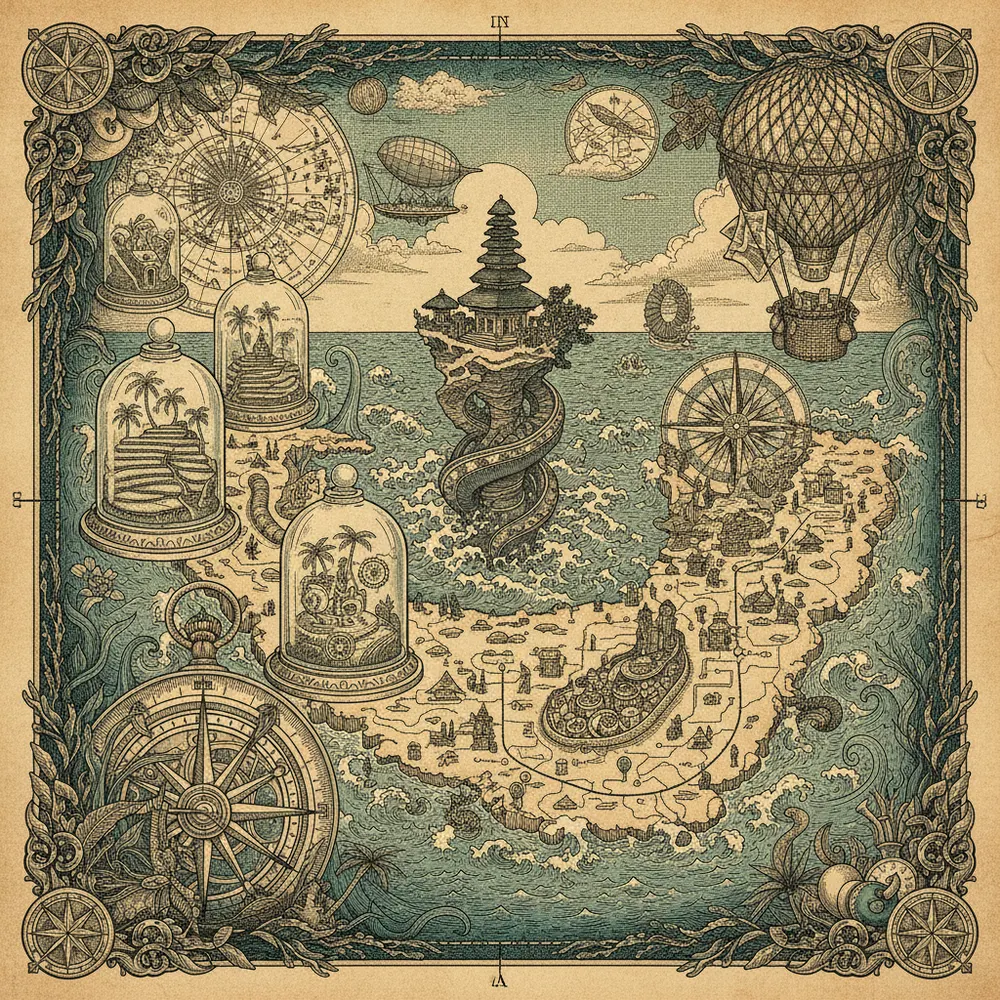
[ THE DISPATCH · FIELD MAP ]
A tilted, hand-drawn dispatch of Bali. Click a quarter to explode it open.
0 / 6 quarters explored
[ UBUD ]
Green breathing room.
Tegallalang Rice Terraces (early morning)The terraces everyone photographs. Better before 8 AM than the photos suggest.
Sacred Monkey Forest Sanctuary700 Balinese long-tailed macaques who have figured out the visitor economy.
[ SEMINYAK / CANGGU ]
Where the city meets the water.
Seminyak Beach (afternoon)The beach that knows it's beautiful and has made its peace with that.
Pura Tanah Lot (temple at sea, sunset)A Hindu temple on a rock in the ocean. At sunset. On Bali. It's a lot.
[ NUSA PENIDA ]
Boats, bridges and reflections.
Kelingking Beach ViewpointThe T-Rex cliff. The most dramatic viewpoint in Indonesia.
Manta Point — snorkelling with manta raysA cleaning station for manta rays. You float above them. They don't notice you.
[ ULUWATU / BUKIT PENINSULA ]
Where the city meets the water.
Pura Luhur UluwatuA 6th-century temple on a 70-metre cliff. The monkeys here are worse than Ubud.
Padang Padang BeachThe beach through the crack in the rock. In the Eat Pray Love film.
[ MUNDUK / NORTH BALI ]
Green breathing room.
Pura Ulun Danu Beratan (lake temple)The temple on the crater lake. When misty, it floats on nothing.
Munduk Waterfall + Coffee Plantation WalkTwenty minutes of jungle path to a 20-metre waterfall. Worth every minute.
[ EAST BALI / TIRTAGANGGA ]
Green breathing room.
Tirtagangga Water PalaceA raja's swimming pool from 1948. Still open. Still beautiful.
Taman Ujung Water PalaceAbandoned, overgrown, and more beautiful for it.
Day 1
Ubud — Tegallalang + Sacred Monkey Forest + Cooking Class
The Bali that every photograph is actually of
One morning only, so we start at 7 AM at Tegallalang before the tour groups arrive, move to the Monkey Forest by 9, and spend the afternoon in a cooking class — the best way to understand Balinese food without speaking Bahasa. Sunset from Campuhan Ridge Walk.
Take Day 1 slowly. Don't try to see everything. The rice terraces at dawn without a single other tourist is a thing that is possible if you leave at 6 AM.
Tegallalang Rice Terraces (early morning)
The terraces everyone photographs. Better before 8 AM than the photos suggest.
The Tegallalang rice terraces 10km north of Ubud are tiered down a river gorge in bright green steps that change colour as the light moves. By 9 AM there are swing operators and tourist cafes and it becomes a slightly different experience. At 7 AM, with mist in the valley and a handful of farmers working, it is one of the most beautiful things in Southeast Asia.
700 Balinese long-tailed macaques who have figured out the visitor economy.
The Monkey Forest is a temple complex and nature reserve in the middle of Ubud — three Hindu temples surrounded by ancient trees and inhabited by approximately 700 macaques who will attempt to steal your sunglasses, hat, water bottle, phone, snacks, and any loose item you are visibly carrying. Do not carry loose items. The temples themselves are beautiful and the monkeys are genuinely entertaining if you're not attached to your hat.
Balinese Cooking Class (afternoon session)
Market first, kitchen second, feast for yourself third.
The best Ubud cooking classes start with a market visit — Ubud's produce market on Jl Raya Ubud at dawn, or Pasar Malam (night market) if you're doing an evening class. You learn to make basa genep (the Balinese spice paste that underlies everything), satay, lawar, and black rice pudding. You eat all of it. This is the meal that will make you resent every approximation of Indonesian food you've had at home.
The one walk in Ubud that the Instagram crowd hasn't completely ruined.
A 2km ridge walk from the Campuhan Bridge at the edge of Ubud, following a spine of land between two rivers through rice fields and jungle. The path is mostly flat, ends at a small café, and at sunset you have golden light coming through the palms at a low angle that makes everything look like it's been lit for a film. Bring mosquito spray for the return.
Sacred water, fire at sunset, and the best dinner of the trip
Last morning in Ubud. Tirta Empul at 8 AM (the purification temple — you can participate in the water blessing if you're respectful and have a sarong). Then the Kecak fire dance at Uluwatu or Pura Tanah Lot at sunset. Final dinner at a warung on Jl Dewi Sita.
More time today — add Goa Gajah (Elephant Cave temple) between Tirta Empul and the dance. It takes 90 minutes and is strange and beautiful and almost nobody lingers long enough.
Tirta Empul Water Temple (purification ritual)
Sacred spring water flowing through carved spouts since 962 AD.
Tirta Empul is a Hindu water temple built around a natural spring with a bathing pool fed by 30 carved spouts. Balinese Hindus come to purify themselves under each spout in sequence. Visitors are welcome to participate in appropriate dress (sarong provided at entrance). The act of standing in the water with it flowing over you in a temple that is over a thousand years old is unexpectedly moving, regardless of your spiritual position.
A carved demon mouth you walk into. Eleventh century. Still alarming.
The entrance to Goa Gajah is a carved stone face of a demon — wide open mouth, you walk through the mouth. Inside is a T-shaped cave with niches for meditation, Hindu and Buddhist iconography carved into the walls, and a spring courtyard outside. It dates to the 11th century. It is 20 minutes from Ubud and astonishingly un-crowded for what it is.
Warung dinner — Jl Dewi Sita or Jl Hanoman
Nasi campur on a low table in a garden. This is the meal.
A warung is a family-run restaurant — usually open-air, candles in the evening, menu handwritten. Nasi campur is the dish: a mound of rice surrounded by small portions of six or eight different things — lawar, satay, sautéed water spinach, curried jackfruit, fried tempeh. It costs $3–$5. It is the definitive Balinese meal. Jl Dewi Sita has a dozen excellent warungs in 200 metres.
Kecak Fire Dance (Pura Uluwatu or Pura Tanah Lot)
A hundred men chanting in rhythm, and then someone walks on fire.
The Kecak dance is performed at several Balinese temples at sunset — a circle of shirtless men chanting 'cak-cak-cak' in interlocking rhythms while performers enact the Ramayana story. At Uluwatu, the temple perches on a 70-metre cliff above the Indian Ocean and the performance ends as the sun sets behind the performers. At Tanah Lot, the temple itself is offshore on a rock formation that the tide cuts off. Both are correct choices.
South Bali's other face: soft sand, good waves, excellent eating
Drive south to Seminyak — 1.5 hours from Ubud by car. Check in near the beach. Spend the afternoon at the water. Tanah Lot temple at sunset is 20 minutes north and is one of the most photographed places in Indonesia for good reason. Dinner at a beachfront warung.
Same day but slower. Consider Canggu instead of Seminyak — slightly younger crowd, better surf, excellent café scene. The Black Bird café in Canggu does a banana bread that people plan trips around.
Seminyak Beach (afternoon)
The beach that knows it's beautiful and has made its peace with that.
Seminyak Beach is where the Indian Ocean arrives in Bali with consistency and weight — good surf, warm water, and a sunset that arrives on schedule every day and is slightly better than the day before. The beach club strip (Potato Head, Ku De Ta, Motel Mexicola) is there if you want it. You can also just sit on the sand with a Bintang from any of the small warung carts. The option is yours.
Pura Tanah Lot (temple at sea, sunset)
A Hindu temple on a rock in the ocean. At sunset. On Bali. It's a lot.
Tanah Lot is a 15th-century temple built on a coastal rock formation that the sea surrounds at high tide. At low tide you can walk to the base. At sunset the temple silhouettes against the orange sky with waves breaking at the cliff base. There's a reason this is Bali's most photographed thing. Get there 30 minutes before sunset — the light is best in the final 20 minutes.
Every cuisine, every price point, best at the end of a beach day.
The Jl Laksmana (Eat Street) strip has Thai, Indonesian, Italian, Japanese, and Mexican alongside beach clubs and rooftop bars. La Lucciola on the beach does excellent Italian with an Indian Ocean view. Mama San on Jl Raya Kerobokan is one of the best restaurants in Bali — Southeast Asian share plates in a beautiful colonial space. Reserve Mama San ahead.
Day 4
Nusa Penida Day Trip — Kelingking + Manta Rays
The island next door that makes Bali look modest
Take a fast boat from Sanur Harbor (45 minutes, ~$35 return). Hire a driver on Nusa Penida for the day ($30–$40). The west coast has Kelingking Beach (the T-Rex cliff viewpoint) and Crystal Bay. The southeast coast has snorkelling with manta rays at Manta Point. Do not try to do everything — the roads are rough and the island is larger than it looks on the map.
Consider staying a night on Nusa Penida instead of a day trip. The island is completely different at dawn and dusk when the day trippers are gone. Atuh Beach on the east coast is a secret beach down 300 steps that rewards the effort.
Kelingking Beach Viewpoint
The T-Rex cliff. The most dramatic viewpoint in Indonesia.
Kelingking is a headland shaped like the head and forelimbs of a Tyrannosaurus rex — a long limestone promontory with a white-sand beach at the foot visible from the cliff edge above. The viewpoint is 5 minutes from the car park. The descent to the beach is 300m of rope-assisted scrambling. Do the descent if you're fit — the beach at the bottom is one of the best in Southeast Asia and almost inaccessible.
A cleaning station for manta rays. You float above them. They don't notice you.
Manta Point on the southwest coast of Nusa Penida is a cleaning station — a spot where manta rays congregate to have parasites removed by cleaner fish. The water is clear and shallow enough to snorkel. The mantas arrive mostly in the morning. You float on the surface and rays the width of a car pass beneath you. No diving certification needed.
The beach name is not exaggeration. The water is actually crystal.
Crystal Bay is a small, calm bay on the west coast of Nusa Penida with visibility 15 metres down and coral reefs starting from the shore. If you have a mask and fins, hire them from the beach. The restaurant at the back of the bay has cold Bintang and grilled fish. Take the fast boat back to Sanur at 4 PM — seas can roughen in the late afternoon.
Day 5
Uluwatu + Padang Padang + Bukit Peninsula
The clifftop temple, the surfers' secret, and the best lunch view in Bali
The Bukit Peninsula is the southernmost tip of Bali — a limestone plateau above the Indian Ocean with cliff-top temples, secret beaches down ladders in rock faces, and surf that draws professionals from every continent. Uluwatu anchors the morning. The afternoon is for finding the beach the guidebook was vague about.
Pura Luhur Uluwatu
A 6th-century temple on a 70-metre cliff. The monkeys here are worse than Ubud.
Uluwatu sits on a cliff edge above the Indian Ocean — the temple predates the Dutch colonial era and still functions as an active place of worship. The ocean view from the temple precinct stretches to the horizon. The monkeys inhabit the walls and are categorically more aggressive than the Ubud Monkey Forest crew. Glasses, earrings, and anything worn on your head will be evaluated as a potential acquisition.
Padang Padang Beach
The beach through the crack in the rock. In the Eat Pray Love film.
Padang Padang is accessed through a crack in the cliff face — literally a gap in the rock that you squeeze through and descend stairs to a small, protected bay. The surf here is for professionals (Padang Padang hosts championship surfing). The beach itself is good for swimming at low tide, crowded by noon, peaceful again by 4 PM.
Single Fin or Ulu Cliffhouse (cliff bar, Sunday sessions)
Watch surfers from a cliff bar. Order a coconut. This is fine.
Single Fin is a bar on the Uluwatu cliff face with the surfbreak below — you watch the barrel waves from above while drinking something cold. Sunday sessions here are legendary: DJs, sun, and everyone who's been surfing all week gathering in one place. Even on non-Sundays, the view and the beer justify the drive.
Day 6
North Bali — Munduk + Pura Ulun Danu Beratan
The Bali that tourists skip, which is the best possible reason to go
North Bali is a 2.5-hour drive from Ubud through the central mountains. Munduk is a village in the hills above Lovina with waterfalls, coffee plantations, and a temperature 10 degrees cooler than the south. Lake Beratan has the most photogenic water temple in Bali. The north coast has different coral to the south. This is the day most visitors don't take.
Pura Ulun Danu Beratan (lake temple)
The temple on the crater lake. When misty, it floats on nothing.
Lake Beratan is a volcanic crater lake at 1,200 metres above sea level. The Pura Ulun Danu temple sits partly on a small island at the edge and the surrounding mountains create morning mist that leaves the temple's pagoda towers apparently floating above the cloud. This is the postcard image you've seen everywhere. It's better in person, which is not always the case.
Munduk Waterfall + Coffee Plantation Walk
Twenty minutes of jungle path to a 20-metre waterfall. Worth every minute.
Munduk has several waterfalls accessible by short walks through coffee and clove plantations. Golden Valley Waterfall is the best — a 30-minute walk from the village through shade and birdsong. If you eat at a warung in Munduk, you'll drink coffee grown within 200 metres of where you're sitting.
Lunch in Munduk village
Balinese food at altitude with a view of nothing but green hills.
Munduk has a handful of small warungs serving traditional Balinese food to the small trickle of visitors who make it north. The chicken betutu here (slow-cooked in banana leaf with spices) is often better than in Ubud — the chickens live next door, which apparently matters. Eat slowly. The drive back south passes through the best rice-terrace scenery on the island.
Day 7
East Bali — Tirtagangga + Last Temple + Long Drive Back
The royal water palace, the day trip Bali forgets to mention
East Bali is 1.5 hours from Ubud and has the highest concentration of 'empty' in the island. Tirtagangga is a royal water palace from the 1940s with stepping-stone pools and Mount Agung behind it. The drive east goes through ancient black-sand beaches and lava fields from the 1963 eruption that you can still see from the road. Take a driver — the coast road is excellent and complex.
Tirtagangga Water Palace
A raja's swimming pool from 1948. Still open. Still beautiful.
Tirtagangga was built by the last Raja of Karangasem as a summer palace and swimming retreat — terraced pools fed by mountain springs, surrounded by lotus ponds, with Mount Agung as backdrop on clear days. The main pool has stepping stones. The upper pool is open for swimming. It is one of the most peaceful places on the island.
Taman Ujung Water Palace
Abandoned, overgrown, and more beautiful for it.
Twenty minutes south of Tirtagangga, Taman Ujung is an earlier royal water palace that was damaged in the 1963 Agung eruption and partially restored. It has a more ruined, romantic quality — bougainvillea over the colonnades, stepping stones across a lily pond, views to the sea from the upper terrace. Almost nobody is here.
Lunch in Amed — black sand beach, last snorkel
The east coast fishing village. Not for everyone. For the right person.
Amed is a quiet fishing coast with black volcanic sand, good snorkelling off the beach (WWII shipwreck in 7 metres of water, easily accessible from shore), and a line of warungs serving grilled fish in the shade of bamboo shelters. This is the quiet end of a trip that has been, by now, anything but quiet.
Bali is an island that has a serious marketing problem, which is that the marketing is accurate. The rice terraces are as green as the photos. The temples are as dramatic as described. The sunsets arrive on schedule and are unreasonably beautiful. The smoothie bowls are excellent. Every single cliché about Bali exists because someone went and came back with photographic evidence.
This itinerary is built around one structural truth: Bali is not small. It takes two hours to drive from Ubud to Uluwatu, longer in traffic. A badly planned Bali day means spending half of it in a car watching the road because you’ve tried to combine things that shouldn’t be combined. A well-planned day means you’re at Tegallalang before the first tour bus arrives and at Tanah Lot exactly as the sun touches the horizon.
The 2/3/4/7-day versions are genuinely different philosophies. Two days is Ubud and only Ubud. Seven days is the whole island, including the north that most visitors skip, which is the biggest mistake.
Use the filter above to see which days apply to your trip.
This article contains affiliate links marked with rel="sponsored". We may earn a commission at no extra cost to you.