
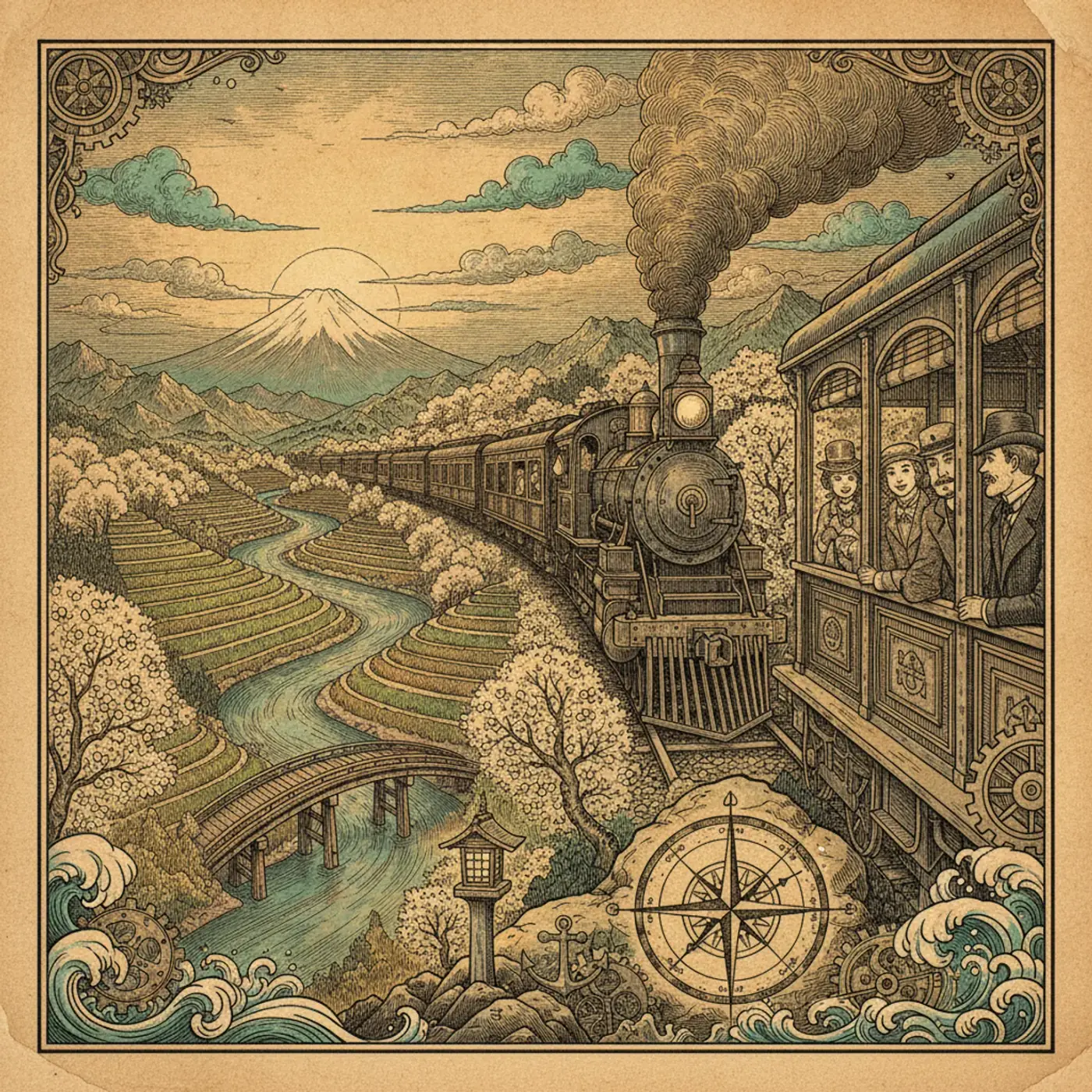
[ ITINERARY · THE DISPATCH ]
The Slow Train Lover's 6 Days Through Japan's Countryside: Kanazawa to Hakone
Six days, one legendary rail route, and zero bullet trains. This Japan slow train itinerary from Kanazawa to Hakone is the trip I'd take again tomorrow.
Short on time? The plan your Kanazawa trip day by day turns all of this into a route you can actually walk.
I have a rule about Japan: if your trip can be described entirely in terms of Shinkansen stops, you are missing the best parts. The bullet train is genuinely miraculous, yes. But it is also a sealed tube that fires you between major cities at 320 km/h, bypassing every mountain valley, every feudal post town, every steaming roadside onsen that makes Japan feel like Japan.
This six-day route — Kanazawa down to Hakone via regional rail, back roads, and a couple of well-placed local trains — is the antidote. I did it in mid-October and still think about it more than any other trip I’ve taken in Asia.
If you’re also thinking about the bigger picture for your Asia-Pacific travels, this slot into a longer regional loop beautifully.

Why Kanazawa Is the Right Starting Point
Kanazawa gets called “the Kyoto that tourists haven’t ruined” so often that it’s become a cliché — but it’s a cliché because it’s true. The city has a preserved geisha district, a legitimately excellent castle, and Kenroku-en, which routinely makes “top three gardens in Japan” lists. More importantly for our purposes, it sits on the Sea of Japan coast at the end of the Hokuriku Shinkansen line from Tokyo, which means getting here is easy even before you slow down.
My full Kanazawa Japan itinerary covers the city in detail, but for this route you want to arrive the evening before Day 1 and spend your first morning at the Omicho Market. Get there before 9am. The sashimi sets at the market stalls cost around 800–1,200 yen and are unreasonably good. Eat standing up. This is not a time for tables.
Spend Day 1 afternoon in the Higashi Chaya geisha district — narrow lanes, gold-leaf craft shops, wooden lattice facades. It photographs beautifully but also just feels different from anything else in Japan. Have dinner near Katamachi and sleep well.

Day 2: Kanazawa to Toyama, Then Into the Mountains
This is where the train magic starts. Take the Thunderbird limited express east from Kanazawa toward Toyama — it’s about 35 minutes and costs roughly 2,200 yen. In Toyama, switch to the Ainokaze Toyama Railway, a charming single-track regional line that hugs the coastline before climbing inland.
The views from Toyama toward the Tateyama range are the kind that make you grab your phone and then put it down because no photo will do it. Snow-capped peaks above rice paddies in October. Ridiculous.
From Toyama, catch the Takayama Line south. This is the leg most travelers skip — because it’s not on the JR Pass if you’re using a regional variant — but it’s the one I’d least want to miss. The train winds through the Hida mountains along a river gorge for about 2.5 hours. Get a window seat on the right side heading south.
Arrive in Takayama by late afternoon. This small city in Gifu Prefecture is stupidly charming: a preserved old-town district (Sanmachi Suji) with sake breweries, miso shops, and lacquerware that dates back centuries. Stay in a mid-range ryokan here — I paid around 12,000 yen per person with dinner and breakfast included, which is genuinely good value for the region.
Day 3: Takayama Rest Day (You’ll Thank Me Later)
Do not blow through Takayama in half a day. This is the pace trap that kills slow-train trips — people spend 90 minutes somewhere that deserves six hours because they’re chasing the next stop.
Morning: walk Sanmachi Suji before the tourist buses arrive (before 9am, ideally). Afternoon: take a local bus to Shirakawa-go, the UNESCO-listed village of thatched-roof gassho-zukuri farmhouses in the mountains about 50 minutes away. Buses run regularly and cost around 2,400 yen round trip.
Shirakawa-go in autumn is one of those places that makes you question whether you live your life correctly. Fog in the valley. Red maples against 300-year-old rooftops. Also, a lot of day-trippers by 11am — so arrive first thing, then retreat back to Takayama for lunch.
Dinner in Takayama: Hida beef is the local wagyu equivalent, and it’s cheaper here than anywhere else you’ll find it. A proper set at a decent restaurant runs 4,000–6,000 yen and is absolutely worth it.

Day 4: South to Nagoya, Then the Pivot East
This is the logistical day, and it’s shorter in terms of scenery but important strategically. Take the Hida express south from Takayama to Nagoya (about 2.5 hours, 5,870 yen). Nagoya is a functional city rather than a beautiful one — you’re here to change trains, not to linger.
That said: Nagoya Castle is genuinely impressive if you have a couple of hours, and the local dish miso katsu (pork cutlet with a thick, slightly sweet hatcho miso sauce) is one of those regional specialties that you definately don’t expect to like as much as you do. Get it at Yabaton near the station.
From Nagoya, take the Shinkansen to Mishima — this is the one bullet train in the whole itinerary, about 50 minutes, and it’s worth it because what you’re doing is positioning yourself at the eastern foot of Mt. Fuji with Hakone a short train ride away. Check in at Mishima or push straight through to Hakone-Yumoto on the Hakone Tozan Railway.
Day 5: Hakone — Slow by Design
The Hakone Tozan Railway is a rack railway that climbs through forested switchbacks to Gora. It goes slow on purpose. Embrace it. The line is genuinely one of the most scenic short rail journeys in Japan, and in October the hydrangeas are replaced by turning maples along the tracks.
From Gora, take the funicular up to Sounzan, then the ropeway over the volcanic Owakudani valley. On a clear day you can see Mt. Fuji from the ropeway gondola. On a less clear day you get sulfur steam and dramatic clouds and that’s honestly also excellent.
The Hakone Open Air Museum, a 10-minute walk from Chokoku-no-Mori station, is legitimately one of the best outdoor sculpture museums I’ve ever visited — and I say this as someone who is usually mildly skeptical of outdoor sculpture museums. The Picasso pavilion alone is worth the 1,600 yen admission.
Stay at a ryokan in Hakone-Yumoto or Miyanoshita. This is your onsen night. The hot springs here are real volcanic mineral water. Soak for as long as you can stand it.
Day 6: Lake Ashi and the Return
Morning on Lake Ashi is, in the right conditions, a fever dream. The lake reflects Fuji on clear days and the traditional pirate ship ferries (genuinely named “pirate ships”) cross it between Togendai and Moto-Hakone. Take the ferry. It costs about 1,200 yen and you feel slightly ridiculous on it, which is part of the charm.
Hakone’s proximity to Tokyo (about 90 minutes by Romancecar express train from Hakone-Yumoto to Shinjuku) makes it the perfect slow-trip endcap. You’ve come from Kanazawa through mountain cities and volcanic valleys and you arrive in Tokyo feeling like you’ve actually traveled, not just transported.
If this kind of immersive, unhurried trip appeals to you, the same philosophy works across Asia — I have a whole piece on setting up for two weeks of slow travel in Chiang Mai that uses the same framework. And if you’re building out a longer Japan-Korea-Europe loop, Seoul for solo women over 40 is worth your time for the next leg. For something completely different when you need a beach reset after too many trains, hidden Greek beaches that aren’t Santorini scratches that itch perfectly.
Practical Notes for Planning This Route
Rail pass math: The JR Pass does NOT cover the Ainokaze Toyama Railway or the Hakone Tozan line. For this route, individual tickets or regional passes (Hokuriku Arch Pass, Hakone Free Pass) will likely beat a national JR Pass unless you add Tokyo days on either end.
Best time to go: October for autumn leaves, May for green mountains. Avoid Golden Week (late April–early May) when every train and ryokan fills up weeks in advance.
Budget: 15,000–22,000 yen per day is realistic for mid-range ryokans with meals, regional rail, and a few entry fees. You can squeeze it lower with guesthouses; you can spend much more in Hakone’s luxury ryokan tier.
Booking ryokans: Reserve at least three to four weeks in advance, especially for Takayama and Hakone. Many smaller properties don’t take same-day bookings and the good ones fill fast.
This itinerary is six days and does not require a single word of Japanese — the Takayama and Hakone tourist infrastructure is solid — but having Google Translate’s camera mode ready for train schedules and menu items will save you repeatedly.
The best thing about this route: you never once have to fight for a seat, rush through a famous temple, or queue for forty minutes to see something you’ve already seen a hundred photos of. Slow trains, small cities, real Japan.
This article contains affiliate links marked rel="sponsored". We may earn a commission at no extra cost to you.