
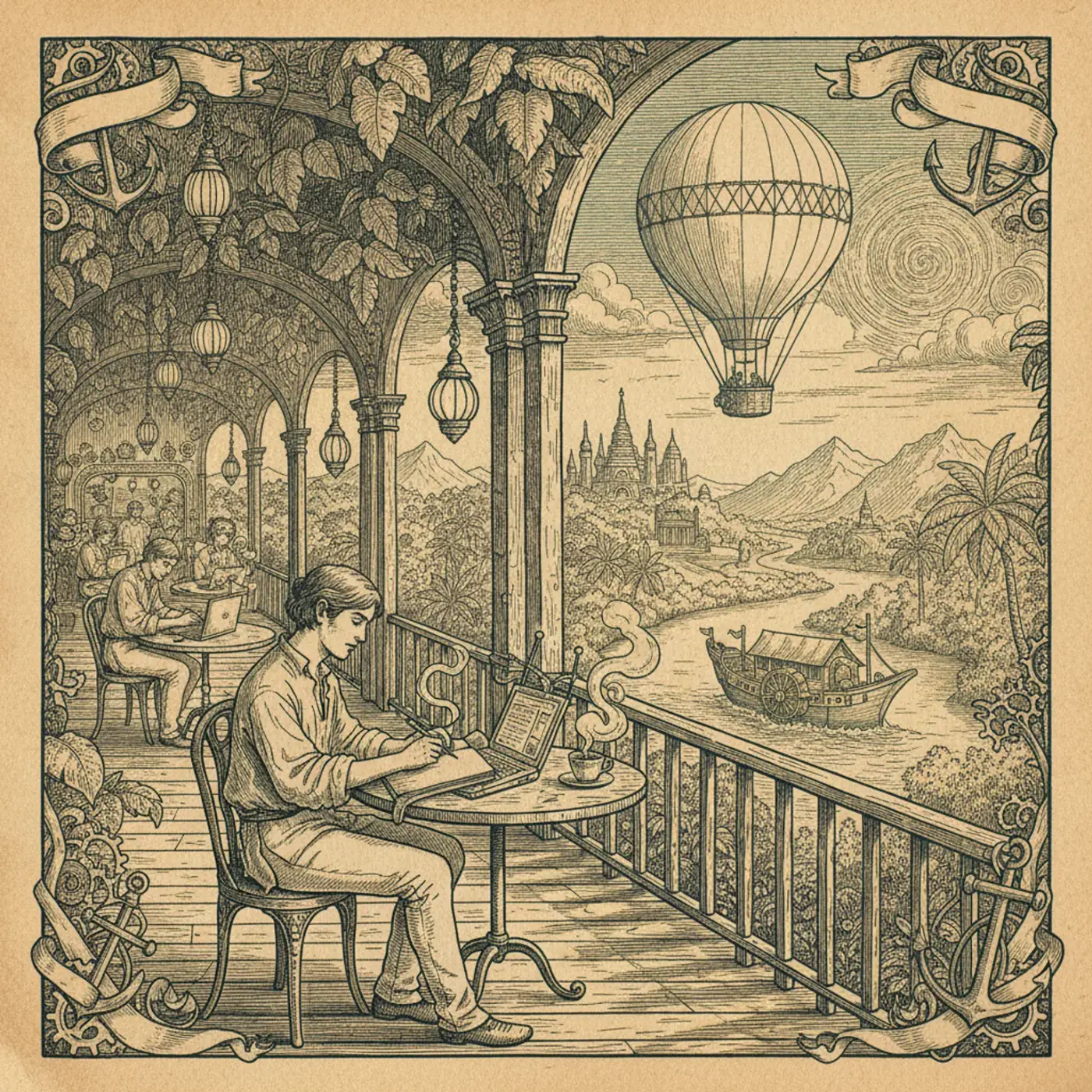
[ ITINERARY · THE DISPATCH ]
The Remote Worker's 2-Week Chiang Mai Setup: Cafes, Coworking, and Day Trips
Chiang Mai still earns its canonical status — if you know where to actually set up. Here's the two-week plan I wish I'd had on day one.
Planning the trip? Start with the how to spend 3 perfect days in Chiang Mai — it lays out exactly where to go, and when.
There’s a version of this article that opens with “Chiang Mai is a hidden gem for digital nomads.” I’m not writing that version. Chiang Mai has been the canonical remote-work city for over a decade, every nomad forum has a thread about it, and the secret is very much out. What hasn’t been written as clearly is the practical two-week setup guide — not the vibe-check listicle, but the actual logistics of landing, getting oriented, and building a productive rhythm before you have to leave.
That’s what this is. I spent two weeks here in early 2026 with a full client load and zero wiggle room for dead WiFi or cafe-hopping disasters. Here’s what worked.

Where to Actually Stay (and Where to Skip)
The Old City (within the moat) looks charming on a map and is genuinely beautiful — but for working, it’s a fifteen-minute songthaew ride from the best cafe clusters and gets weirdly quiet by 9pm. I’d stay there for a leisure trip, not a work sprint.
Nimman (short for Nimmanhaeminda Road and the soi streets off it) is the consensus pick for a reason. The Maya Mall area has a CAMP, a Starbucks, a dozen independent cafes, and grocery options within a five-minute walk. Accommodation ranges from 700–1,400 THB/night for decent private rooms with AC at guesthouses like Zensala or the cheaper end of guesthouses on Soi 7.
The Old City-adjacent east side (near Tha Phae Gate) splits the difference if you want temple access and a slightly slower pace. I’d put a first-timer there for nights 1–3 while orienting, then move to Nimman.
Check out our full Chiang Mai Thailand itinerary if you want the deeper cultural layer alongside the work setup — it covers temple logistics, night markets, and neighbourhood breakdowns in more detail.

The Cafe Hierarchy (Honest Edition)
CAMP by Maya — the OG free-WiFi cafe, run by True Coffee inside Maya Mall. It’s still operating in 2026, still has reliable internet (I clocked 30–45 Mbps consistently), still has unlimited free refills on drip coffee for around 80 THB to get in. The noise level peaks around 11am–2pm but it’s workable with headphones. The lighting is bad for video calls — head to a side booth.
Yellow (on Nimman Soi 7) — my personal daily driver. The WiFi hit 80 Mbps on a quiet Tuesday, the cold brew is actually good, outlets at every seat, and the staff don’t hover. Expect to spend 150–200 THB for a drink, no pressure to order more. Gets busy after 10am, arrive early.
Ristr8to — espresso-focused, quieter vibe, the beans are genuinely excellent. I’d send a friend here for a two-hour deep-work block. It’s not the place to spend a full nine-hour day; the seating isn’t set up for that.
MANA Coworking — when you need a proper desk and a guaranteed fast connection. Day passes run around 200–250 THB, includes fast WiFi, printing, and lockers. The AC is aggressive (bring a layer). A week pass drops the per-day cost meaningfully.

The Two-Week Work Rhythm
Weeks one and two have different energies if you do this right.
Week 1 — Settle and scout. Use the first three days to test multiple cafes and find your two go-tos. Get a SIM card at the airport (AIS or DTAC, 299 THB for 30-day unlimited data — don’t overthink it). Open a local bank account if you’re staying longer; for two weeks, just use an ATM with a no-fee card like Wise or Revolut. Work morning hours (7am–noon) before heat and crowds peak.
Week 2 — Optimize and explore. Once your setup is locked, you can start treating afternoons as flex time. Do the day trips (more on those below). Schedule client calls for early morning so you have post-lunch flexibility. The 5pm–8pm slot is often golden for a second work sprint if you’re on European or US time zones.
If you’re exploring the broader Asia-Pacific nomad circuit, Chiang Mai pairs naturally with a Taipei leg — though I’ll say the night market scene in Taipei is a different beast entirely from Chiang Mai’s Saturday Walking Street. Both worth doing; different moods.

Day Trips That Are Actually Worth Losing a Work Day
Two day trips I’d definately prioritize over staying at a desk:
Doi Inthanon National Park — Thailand’s highest peak, two stunning chedis, and a waterfall circuit. Hire a driver through your guesthouse (around 1,500–2,000 THB for a private car, worth splitting with another nomad) rather than joining a group tour that rushes the best spots. Leave by 7am to beat afternoon cloud cover. Plan to be offline from 8am–5pm — tell clients in advance.
Mae Kampong Village — a coffee-growing hill village about 60km east of the city. Less visited than Doi Inthanon, more atmospheric. You can rent a scooter (150–200 THB/day from shops near Tha Phae Gate) and self-navigate with Google Maps. The drive itself is half the point. Don’t attempt it after heavy rain — the road gets sketchy.
Chiang Rai day trip — doable but genuinely a long day (3 hours each way). I’d only do this if you have a free weekend day and real interest in the White Temple. Don’t try to work around it.

Logistics Corners People Forget
Visa: Most nationalities get 30 days visa-exempt, extendable once at the Chiang Mai Immigration Office for 1,900 THB. The extension takes about two hours on a weekday morning — go early, bring passport photos, dress non-slovenly. For a two-week trip this is irrelevant; for longer stays, plan ahead.
Getting around: Grab (Thailand’s Uber equivalent) works well in the city. Songthaews (shared red trucks) run fixed routes for 20–30 THB. Don’t bother renting a scooter for in-city use unless you’re confident — the traffic near the moat gets genuinely chaotic during evening rush.
Food budget: Street food lunch at Warorot Market or along the moat runs 50–80 THB. A proper sit-down meal at a mid-range Thai restaurant is 150–250 THB. Factor 300–500 THB/day for food if you’re eating well but not splashing at Western restaurants.
Power: Thailand uses Type A and B outlets. US plugs work fine. European plugs need an adapter — buy one at 7-Eleven for 50 THB rather than hauling a heavy universal adapter.
Nomads comparing city options sometimes ask how Chiang Mai stacks up against South American alternatives — if you’re curious, the Medellín coliving breakdown is worth a read for a different context. Chiang Mai wins on cost and cafe culture; Medellín wins on social infrastructure and language access for Spanish speakers.

The Honest Bottom Line
Chiang Mai’s reputation is earned. The cafe infrastructure is genuinely excellent, the cost-to-quality ratio for accommodation and food is hard to beat, and the day trip options mean you won’t burn out staring at a screen in a windowless WeWork equivalent. It rewards a little upfront orientation — get your SIM, pick your neighbourhood, lock in two or three work spots in the first 48 hours — and then it mostly just works.
Two weeks here won’t feel like a compromise — it’ll feel like proof that productive and interesting aren’t mutually exclusive.
This article contains affiliate links marked rel="sponsored". We may earn a commission at no extra cost to you.