
[ ITINERARY · THE DISPATCH ]
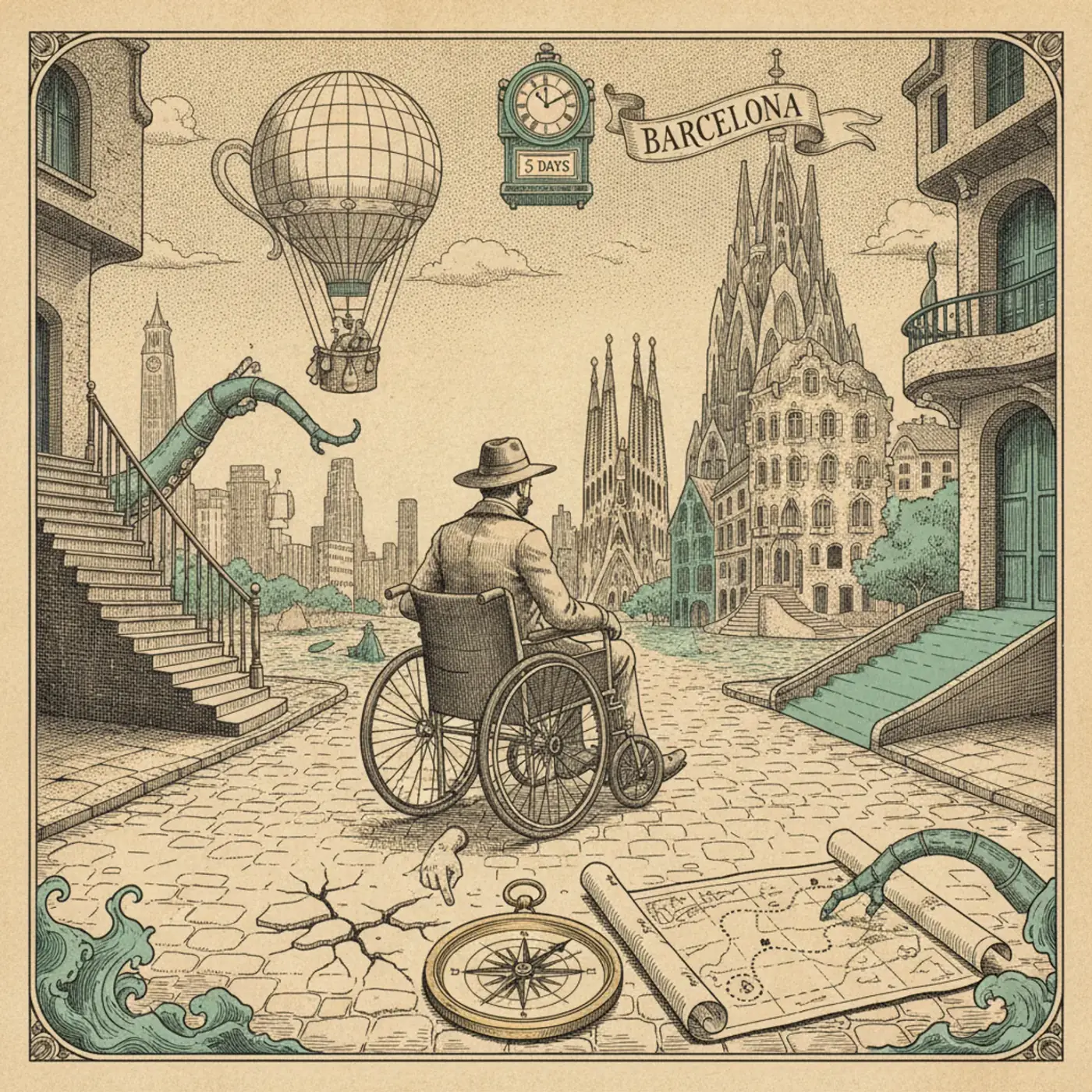
A Wheelchair-User's Honest 5 Days in Barcelona: What Actually Works
Barcelona sells itself as accessible. Some of it genuinely is. Here's what a wheelchair user actually found after 5 days — the good, the cobblestone nightmares, and the spots worth every effort.
For the full day-by-day version of everything below, read the our full Barcelona itinerary, with maps.
I’ll be upfront: I have a spinal cord injury and use a manual chair. I’ve been traveling for six years and I’m done with accessibility guides that describe a city as “mostly accessible” and leave it there. That phrase means nothing. So here’s what five days in Barcelona actually looked like for me in late spring — the wins, the fails, and the one afternoon I genuinely almost cried (in the good way).
If you want the full overview of the city before diving in, my complete Barcelona travel guide covers neighborhoods, timing, and logistics from scratch.
The Honest Overview: Barcelona Is a Tale of Two Cities
The medieval core — the Gothic Quarter, El Born’s tightest lanes — is paved with irregular stone and virtually no curb cuts. It’s picturesque and it is also basically inaccessible in a chair. If you spend three days fighting it, you’ll be exhausted and bitter.
The other Barcelona — Eixample, the waterfront, Barceloneta, Gracia’s wider streets — is genuinely good. Wide sidewalks, dropped curbs, flat terrain. That’s where your days should live.
My baseline rule: use the Gothic Quarter for coffee from a terrace, not for wandering.

Day 1: Arrive, Eixample, Get the Lay of the Land
Land at El Prat, grab the Aerobus (accessible, ramp deploys from the front — tell the driver). It drops you on Passeig de Gràcia, which is basically Eixample’s main artery and one of the most wheelchair-friendly streets I’ve walked in Europe. Wide, smooth, beautiful.
Check in somewhere in Eixample. The hotel options here are mostly modern builds or renovated mansions with lifts. I stayed near Carrer d’Enric Granados, a pedestrianized street with café terraces and zero cars. Dinner there, nothing fancy, around 20 euros a head.
First evening: just roll Passeig de Gràcia north to south. Casa Batlló and Casa Milà are lit dramatically at dusk and you can appreciate the facades without going inside. Save tickets for a proper visit on Day 2.

Day 2: Gaudí Without the Grief
Sagrada Familia is the centerpiece and it is, genuinely, accessible — if you plan ahead. Book online, select the elevator add-on (around 4 euros extra), and arrive at the time slot on your ticket. The main interior is fully ramped. The elevator takes you partway up one tower. Security staff were helpful and proactive when I arrived.
What nobody tells you: the surrounding streets on the east side have some rough patches. Come from Avinguda de Gaudí on the west — smoother approach, accessible entrance is clearly marked.
Casa Milà (La Pedrera) has a lift and is fully accessible indoors. The rooftop — the famous Gaudí chimneys — involves some uneven surfaces but nothing that stopped me. Worth it.
Afternoon: head to the Eixample grid and just exist in a café. You’ve earned it. The neighborhood’s “superblocks” — carless urban blocks with widened sidewalks — are a mobility dream.

Day 3: The Waterfront and Barceloneta
The waterfront from Port Olímpic down to Barceloneta is long, flat, and paved well. Rent a hand-cycle or a beach wheelchair (there’s a free loan service at Barceloneta beach — look for the red lifeguard hut near the main beach access point, they open at 10am). The sea air alone is worth the trip.
Lunch at the Barceloneta market or one of the chiringuitos — ask for a table outside, they’re on the flat boardwalk. Paella here runs 15-22 euros per person for the real deal.
Then: Museu d’Història de Catalunya, inside the Palau de Mar. Fully accessible, free on first Sundays, and almost never crowded. They have the Catalan independence story laid out clearly and engagingly. I was there two hours and didn’t mean to be.
Heading into this Europe trip, I’d been nervous about whether my accessible travel style would translate beyond Spain — this slow travel breakdown for Chiang Mai’s neighborhoods actually gave me a useful framework for thinking about any unfamiliar city grid.
Day 4: Montjuïc and the Views You Can Actually Reach
Montjuïc looks daunting from sea level. It’s a hill. But here’s the thing: the cable car from Paral·lel metro station (L2 and L3, both fully accessible) gets you up. The Fundació Joan Miró at the top is one of the best accessible museums I’ve visited anywhere — large, airy, no barriers, staff who actually know which routes avoid steps.
The castle at the summit has mixed terrain but the outer walls offer the best views of the city and port without entering the more uneven inner sections. Free, breezy, spectacular.
Do not attempt Montjuïc on foot from the Barceloneta side. The paths are steep and unmaintained in spots. Cable car or bust.
Day 5: Gracia, Mercado, and a Slow Goodbye
Gracia is Barcelona’s boho neighborhood and its main plaza — Plaça del Sol and Plaça de la Vila de Gràcia — are flat, café-ringed, and easy to navigate. The streets between them get narrow but not cobbled. A good half-day of wandering.
Mercado de l’Abaceria (the Mercat de Galvany is closer to Eixample and slightly easier) is worth a spin for a final market run. Most of Barcelona’s covered markets have been renovated and have flat floors with wide aisles.
Lunch in Gracia, then back through Eixample for any last shopping. The Diagonal metro station (L3, L5) is fully equipped. You’re done.
Metro and Transport: What You Actually Need to Know
Lines L1, L2, L3, and L5 are fully elevator-equipped at most central stations. L4 is the problem child — avoid routing through it. Before every journey, check the TMB accessibility map (search “TMB accessibilitat” — the PDF is downloadable). Some stations have elevators listed but out of service; the app flags this in real time.
Taxis: the yellow-and-black cabs have an accessible category you can book via the AppTaxi app. They’re more expensive than Uber but the drivers know how to secure a manual chair properly. I used them three times without a hitch.
If you’re building a broader European trip, my Europe itinerary hub has accessibility notes for other cities too. And if you’re curious about what accessible eating looks like in southern Europe, this plant-based Naples guide has a surprising amount of overlap in how to research accessible restaurants before you arrive.

The Stuff That Doesn’t Work (Be Honest With Yourself)
- Park Guell main terrace: ticketed area has uneven mosaic surfaces and steps to key viewpoints. Not worth the fight. The free lower park is beautiful and accessible.
- The Gothic Quarter at any depth: lovely for a quick coffee stop. Not for exploring.
- Rambla de Catalunya vs La Rambla: the former (one block west) has smoother paving, fewer crowds, and better surfaces. Skip La Rambla entirely — it’s definitley not worth the potholes and tourist scrum.

Practical Numbers
- Sagrada Familia: 26-36 euros depending on add-ons. Elevator: 4 euros extra.
- Casa Milà: 25-28 euros, book online.
- Metro single: 2.55 euros. T-Casual 10-trip: 12.15 euros.
- Accessible taxi (AppTaxi): roughly 15-20 euros within central Barcelona.
- Beach wheelchair loan (Barceloneta): free.
Barcelona is worth it — go knowing where to fight and where to coast, and you’ll have one of the best trips of your life.
This article contains affiliate links marked rel="sponsored". We may earn a commission at no extra cost to you.