
[ GUIDE · THE DISPATCH ]
How to Actually Use Public Transport in Marrakech: Grands Taxis, Petits Taxis, and Bus No. 19
Most guides just say 'take a taxi' and leave you stranded. Here's the actual breakdown of Marrakech's transport system — how to negotiate fares, spot the scams, and ride Bus No. 19 like a local.
If you want the whole thing mapped out, see the plan your Marrakech trip day by day.
I landed at Marrakech Menara Airport at 11pm, watched three fellow backpackers get quoted 200 MAD for the ride to the medina — a trip that should cost 80 — and quietly negotiated mine down to 70 before the driver had finished his opening pitch. That moment crystallized something I’d spent two trips learning: Marrakech has a perfectly functional, genuinely affordable transport network, and almost nobody explains how it actually works.
Every guide says “use taxis.” Almost none of them explain the difference between a grand taxi and a petit taxi, why the meter is a fiction, or that a city bus can take you from Djemaa el-Fna to the Menara Gardens for less than a cup of mint tea. Let’s fix that.
Before you go deep, bookmark the full Marrakech itinerary — it’ll put all these routes in geographic context.

The Two Taxi Types (and Why the Distinction Matters)
Marrakech has two completely separate taxi systems that confuse visitors into overpaying constantly.
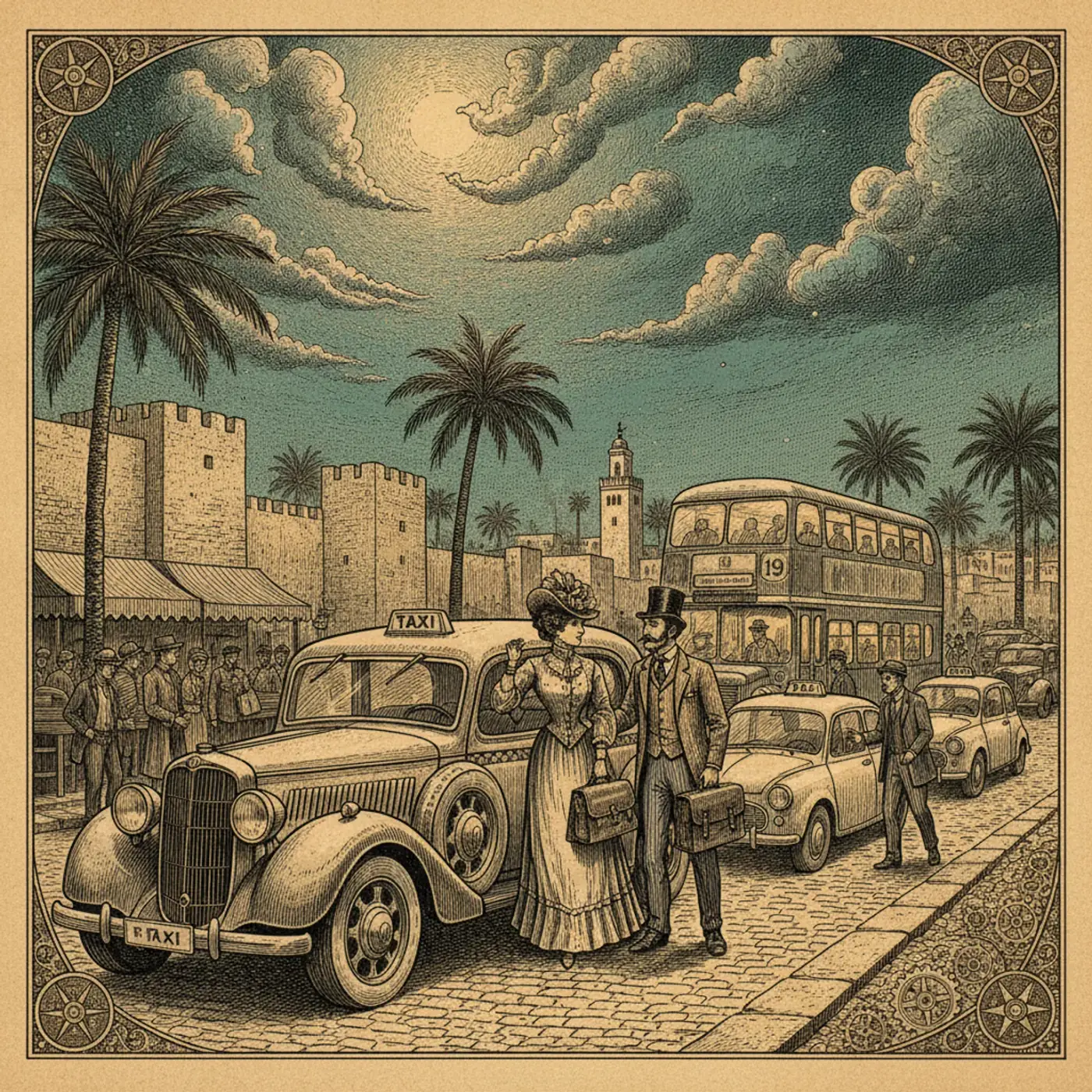
Petits taxis are the beige or cream-colored compact cars you’ll see everywhere in the medina and Gueliz. They’re metered, licensed for city-center use, and hold up to three passengers. In theory, the driver clicks on the meter and you pay what it says. In practice, you’ll encounter the meter about 15% of the time, usually late at night when drivers are desperate for fares.
Grands taxis are the battered white Mercedes sedans parked in specific stands around the city — near Djemaa el-Fna, outside Bab Doukkala, at the bus station. They technically hold six passengers (four in the back, two in the front passenger seat, yes really), and they run fixed shared routes: Marrakech city to Asni, to Ourika, to the airport road. They’re the long-distance shared ride network nobody talks about.
If you want to get from the Mellah to Gueliz, you want a petit taxi. If you want to get to the Atlas foothills for a day trip without paying tour-company prices, you want a grand taxi shared run.

Petit Taxi Fare Logic: What’s Actually Fair
Here’s the negotiation breakdown I’ve found consistent across two visits and probably 40 rides:
- Medina to Gueliz (city center): 20–30 MAD
- Anywhere within the medina: 15–20 MAD
- Airport to medina: 70–80 MAD at night, 60–70 MAD daytime (the official rate is around 80 MAD but you can negotiate)
- Medina to Hivernage (hotel district): 25–35 MAD
The meter, when running, typically starts at around 2.40 MAD and clicks up fast. For a 15-minute ride it’ll land somewhere between 15 and 25 MAD. If a driver quotes you 80 MAD for a medina-to-Gueliz ride, that’s not a misunderstanding — it’s a test.
My approach: agree on the fare before sitting down, say it once firmly, and if they won’t budge walk five steps and try the next driver. In my experience, second or third taxi in a rank almost always matches a reasonable offer. Never negotiate from inside the cab with your bags already loaded.

Grand Taxis: The Shared System Explained
The grands taxis parked at Bab er-Robb (near the southern medina walls) are your gateway to genuinely cheap inter-city movement. The logic: taxis wait until all seats are filled, then depart. You pay a per-seat price.
A shared grand taxi to Asni (gateway to the Atlas) costs around 25–30 MAD per person. A private hire of the same cab — which many drivers will immediately offer — runs 150–200 MAD. If you’re traveling solo and don’t want to wait, splitting with other travelers you meet at the riad is worth organizing in advance.
For budget travelers doing day trips covered in the Africa and Middle East regional hub, grands taxis to Ourika Valley or Setti Fatma are substantially cheaper than any organized tour and leave whenever the car fills.
The wait for a shared run varies wildly. Early morning (before 8am) is fastest because locals are commuting. Mid-afternoon you might sit for 45 minutes. Build in buffer time.
Bus No. 19: The Secret Budget Route
I’m going to be honest — I didn’t find this until my second trip and I’m a little annoyed nobody mentioned it in any guide I read.
Line 19 (operated by ALSA Marrakech) runs roughly from Place Youssef Ben Tachfine in Gueliz, through the edge of Djemaa el-Fna, out along Avenue de Menara past the Menara Gardens, and continues toward the airport road. The fare is 4 MAD. You pay the conductor on board with cash — exact change is appreciated but not required.
This is definitaly not a tourist bus. It’s crowded during school-run hours, moves at the speed of city traffic, and the stops aren’t always well-marked. But for reaching the Menara Gardens without paying 25 MAD for a petit taxi, or for getting budget travelers from a Gueliz hostel toward the medina for essentially free, it’s legitimately useful.
The ALSA app (available on Android) shows live routes. Alternatively, ask your accommodation to mark the nearest stop on a paper map — the bus stop signs exist but are easy to miss.

The Airport Run: Options Ranked by Cost
Arriving at Menara Airport and heading to the medina — here are your real options in order of price:
- Bus No. 19 (indirect): Around 4 MAD, but involves walking 10+ minutes from the terminal to the correct stop and a slow ride. Only viable with light luggage and in daylight.
- Petit taxi, negotiated: 70–80 MAD. Fixed-rate zone applies after midnight (slightly higher). Agree before getting in.
- Grand taxi private hire: 100–130 MAD from the official stand. More comfortable for groups.
- Airport transfer through riad: Many riads arrange this for 100–150 MAD. Slightly pricier but driver has your name on a sign, which after a long flight feels worth it.
If you care about transport costs the way I do when planning a week — similar to how I approach eating cheap and well, like the approach in my week eating only under 4-star Tokyo spots — the taxi negotiation pays off faster than almost any other single decision you’ll make.

What to Know Before You Ride
A few things nobody puts in the headline:
- No ride-hailing apps that work well. Careem exists in Morocco but penetration in Marrakech is thin and surge pricing in tourist areas can be odd. Bolt has some presence. Neither replaces local knowledge.
- Night surcharge is real. Petits taxis officially add 50% after 8pm. Factor this in when negotiating.
- Medina access for vehicles is restricted. Your taxi will get close to your riad but may not get to the door. Know your riad’s nearest landmark (a gate name like Bab Doukkala, or a mosque) and give that to the driver instead of a street address. The old city wasn’t built for cars and navigation apps go wrong fast.
- Connectivity matters. Having a local SIM or using the eSIM setup that costs me under $8 a month across 40 countries means you can verify routes in real time instead of relying on pre-downloaded maps that go stale.
For context on what transport costs mean relative to your overall budget, the full Marrakech itinerary hub has day-by-day cost estimates. And if you’re planning a broader trip that includes budget-conscious US stops before or after, 7 US cities with a better food scene than New York for half the price is worth a read for calibrating what “cheap travel” can look like when the infrastructure cooperates.
The Short Version
Marrakech’s transport system rewards exactly one thing: knowing the rules before the driver assumes you don’t. Agree on fares upfront, distinguish a grand from a petit taxi, and try Bus No. 19 at least once — not because it’s glamorous, but because arriving somewhere new for 4 MAD and a bit of chaos is the kind of story that sticks.
The single most important thing you can do before your first Marrakech taxi ride: know the rough fare in advance, say it first, and be willing to walk away — because nine times out of ten, the next driver takes it.
This article contains affiliate links marked rel="sponsored". We may earn a commission at no extra cost to you.