
[ DISCOVERY · THE DISPATCH ]
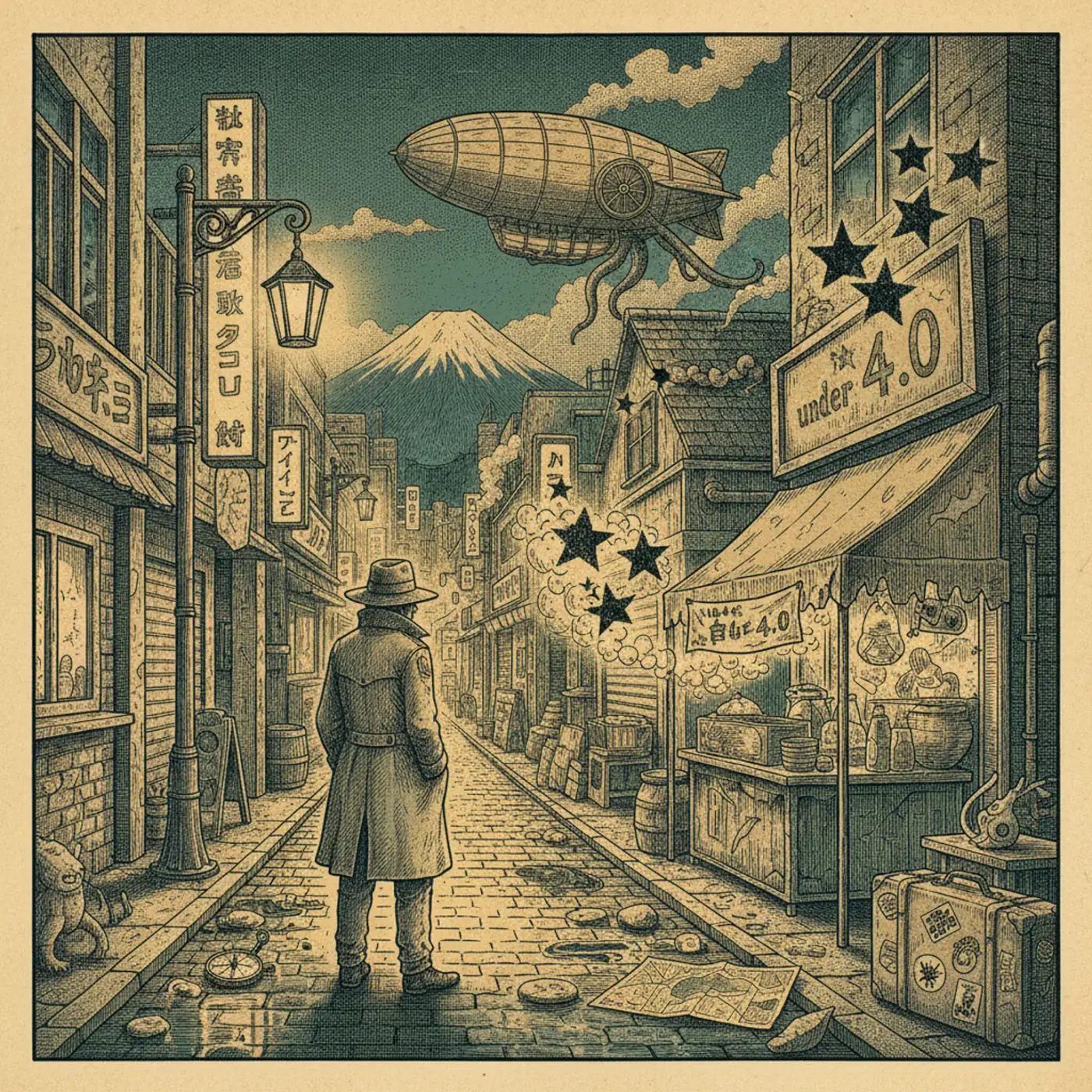
I Ate Only at Spots Under 4.0 Stars for a Week in Tokyo — Here's What Happened
I spent a week eating only at Tokyo restaurants with under 4.0 stars on Google. What I found inverts everything we think we know about review culture.
If you want the whole thing mapped out, see the Tokyo itinerary with an interactive map.
The idea started, as most bad-sounding ideas do, with a theory I couldn’t shake.
I’d been planning a trip to Tokyo — the full week-long Tokyo itinerary kind of trip — and I kept scrolling the same shortlist of restaurants. All 4.5 stars and above. All with professional photos. All with English menus prominently mentioned in reviews. And I kept thinking: who are these places actually for?
So I made a rule. For seven days in Tokyo, I would eat only at restaurants rated below 4.0 stars on Google Maps. No exceptions. If it had a 4.1 and I was hungry, I kept walking.
Here’s what I found.

Why Tourist-Facing Spots Dominate the High Ratings
Before I get into the food (and yes, it was mostly fantastic), the theory turned out to be correct, and it’s worth understanding why.
When a tourist visits Tokyo for five days and eats at a ramen shop, they are a perfect reviewer. They’re delighted by the novelty, it’s their first and only visit, expectations are calibrated to “this is foreign and interesting,” and they leave a glowing five stars with a photo of themselves slurping noodles. They will never come back. They will never discover that the place gets lazy on Tuesdays, or that the broth quality dipped after the original chef left.
Regular customers — the salaryman who comes every Thursday, the couple who live upstairs — tend not to leave reviews at all. If they do, they’re harder to please. They know when the gyoza skin is thicker than usual. They notice when the portion shrinks.
This creates a systematic rating inflation for tourist-facing spots. A restaurant that trains staff to smile at foreigners, keeps an English menu laminated by the door, and sits near a major station will accumulate five-star reviews from people who are easiest to impress. Meanwhile a neighborhood teishoku joint with a hand-written menu and a proprietor who’s been making the same mackerel set since 1987 sits at 3.7, unreviewed by anyone who visited from outside a five-block radius.
Knowing this, I spent a week deliberately hunting in that 3.7 zone.

The Setup: How I Actually Found These Places
I’m not going to pretend there’s a slick app for this. Google Maps lets you filter above a star rating, not below. My method was manual: I’d search a neighborhood, zoom in on the map, tap on restaurants until I found ones in the 3.2–3.9 range with at least 40 reviews (fewer than that and you’re just looking at bad restaurants with small samples).
I focused on neighborhoods away from the main tourist corridors — Shimokitazawa, Koenji, Nishi-Ogikubo, parts of Nakameguro away from the canal. These are places where locals actually live and eat.

What I Actually Ate (The Good, the Strange, the One Miss)
Shimokitazawa: The 3.6-star teishoku that wrecked me
On day two I found a lunch spot down a side street in Shimokitazawa — no English on the door, a small handwritten sign, maybe eight seats. Rated 3.6 with 67 reviews, several of which complained about “unfriendly service.” The service was not unfriendly. The owner was simply busy and did not perform enthusiasm at me. She brought me a mackerel set — grilled fish, miso soup, rice, three small pickles — for around 850 yen (about six dollars). It was impeccably seasoned. The fish had a slight char that I kept thinking about for three days afterward.
The “unfriendly” reviews were from people who expected to be welcomed like hotel guests. The regulars, evidently, knew to sit down and wait.
Koenji: A standing ramen bar at 3.4
Koenji is the right kind of weird, and the ramen bar I found there — no tables, just a counter facing the wall, six stools — was rated 3.4. The negative reviews mentioned that the broth was “too salty” and the wait was “rude.” The broth was aggressively seasoned in the way that serious ramen tends to be when it’s not calibrated for tourist palates. I waited about three minutes while the guy finished something. Then he handed me the best bowl of shio ramen I’ve had since I accidentally stumbled into a tiny spot in Sapporo years ago.
Price: 980 yen. Time: twelve minutes including eating. Worth every bit of the 3.4.
Nishi-Ogikubo: The miss
I’ll be honest — one spot was genuinely mediocre. A 3.7-rated curry place near Nishi-Ogikubo station had watery sauce and rice that tasted like it had been sitting. The low rating, in that case, was accurate. The experiment doesn’t guarantee gems; it just changes where you look. You’ll still get the occasional dud.
The Category Rule: Where Sub-4.0 Works (and Where It Doesn’t)
After a week, I’d developed a rough heuristic.
Works well below 4.0: Ramen, teishoku (set lunch), yakitori, standing bars (tachinomi), soba. These are foods locals eat constantly and review honestly. A 3.6 ramen shop has probably just been around too long to impress newcomers.
Use caution below 4.0: Sushi. The margin for error is higher, food safety concerns are real, and a low rating at a sushi counter sometimes means something substantive. I stayed above 3.8 for raw fish and felt fine about it.
Avoid below 4.0: Western food in Tokyo, generally. The low-rated Western spots tended to genuinely not be good. This is not a universal rule, but the risk-reward was worse.

What This Taught Me About Rating Culture More Broadly
This experiment is really about who gets to define “good.” And right now, Google Maps ratings are largely defined by people who visit once, expect a certain performance of hospitality, and bring benchmarks from home. That skews results heavily toward restaurants that cater to exactly those people.
The places I ate at for a week in Tokyo catered to nobody but their own neighborhood. They had no incentive to optimize for a tourist’s photo or a foreigner’s five-star review. They just had to keep making good food for the person who’d be back next Thursday.
It reminded me of something I’ve noticed in other travel contexts — the way certain travel “upgrades” can actually distance you from the real experience. Airport lounges, for instance, are optimized to feel premium rather than to connect you to anywhere. The rating system has a similar problem: it’s become optimized for one kind of traveler.
The Practical Reality of Eating This Way
You will not always speak the language. You will sometimes point at things. You will occasionally eat something you weren’t expecting. None of this is a problem — it’s the point.
Most of the spots I found had at least one staff member who could gesture effectively, or had plastic food displays outside. I used Google Translate’s camera function maybe twice. Budget-wise, eating sub-4.0 in Tokyo is also cheaper: my daily food spend averaged around 2,800 yen (roughly 18 dollars) across breakfast, lunch, and dinner, which for Tokyo is genuinely lean.
If you’re building out the rest of your days, the Asia-Pacific itinerary hub has solid frameworks for pacing a Japan trip that leaves room for this kind of wandering. And if you’re already in budget optimization mode, the same approach that works for Tokyo restaurants works for accommodation in other cities — I was surprised how well it translated when I tried booking a Bali villa for less than a standard hotel room.
One last note: this experiment took some physical energy. Walking into unfamiliar spots, deciphering menus, navigating without English support — it adds up. If you have any limitations around pacing or energy management, it’s worth planning your meals more intentionally. This piece on chronic illness travel in Vienna has genuinely good frameworks that apply anywhere, not just Europe.
Would I Do It Again?
Definitately. Without hesitation. Seven days of eating below 4.0 stars in Tokyo produced better food memories than most of my higher-rated, more carefully planned trips. The mackerel at that Shimokitazawa spot, the shio ramen in Koenji, a late-night standing bar in Nakameguro where nobody spoke to me and the highball cost 400 yen — these are the meals I’ll describe to people for years.
The rating system isn’t broken. It’s just measuring something slightly different from what you actually want.
The real hidden gem restaurants in Tokyo aren’t hidden because they’re secret — they’re hidden because the algorithm was never built to find them.
This article contains affiliate links marked rel="sponsored". We may earn a commission at no extra cost to you.