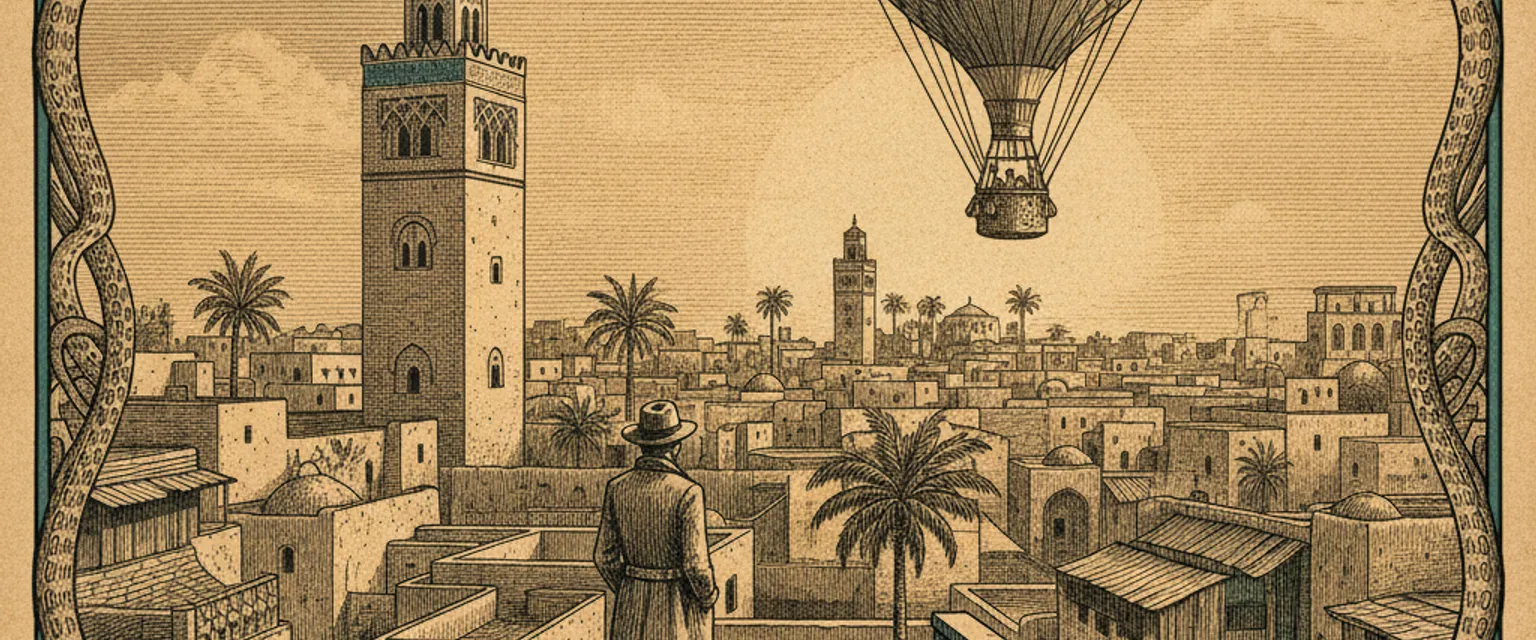
I got lost in the souk within eleven minutes of arriving, which everyone warns you about and nobody can prevent. A boy of maybe ten led me back to Jemaa el-Fnaa for the price of a fist-bump, and as the call to prayer rolled over the square the food stalls fired up at once, smoke and lamb and orange juice and a man with a cobra. I drank mint tea on a rooftop while the Atlas Mountains went pink, and decided the disorientation was the entire point.
The Perfect Marrakech Itinerary (2, 3, 4 & 7 Days)
Two days is the old city distilled. You lose yourself in the souks, stand in the chaos of Jemaa el-Fnaa at dusk, tour the Bahia Palace, and sleep in a riad with a courtyard fountain. It is sensory overload in the best way, and exactly enough to fall for the red city.
Stay inside a riad in the medina, not a resort outside. The courtyard quiet after the souk noise is the whole experience.
72 Hours: Gardens and Palaces
Three days adds the calm counterweight to the medina: the cobalt-blue Jardin Majorelle, the YSL museum next door, and the Saadian Tombs. You balance the sensory assault of the souk with green courtyards and tiled silence, and you eat far better for having slowed down.
4 Days: Into the Atlas
Four days buys a day trip into the High Atlas, to a Berber village in the Ourika Valley or the waterfalls beyond, where the air cools and the city falls away. You return to a hammam scrub and a rooftop dinner, and Marrakech stops feeling like a place you survive and starts feeling like one you understand.
7 Days: Mountains, Desert, and Coast
A week opens all of southern Morocco: an overnight in the Agafay stone desert or beyond to the dunes, a drive over the Tizi n'Tichka pass to Ait Benhaddou, and a day on the Atlantic at breezy Essaouira. You come back to the medina knowing it as home base rather than a maze.
Estimated budget:$220-$440
Estimated budget:$330-$660
Estimated budget:$480-$960
Estimated budget:$900-$1800
Day 1
The Medina and Jemaa el-Fnaa
Souks by day, the great square at dusk
Jemaa el-Fnaa
The beating heart of the medina, a UNESCO-listed square that transforms completely after dark.
Jemaa el-Fnaa is the great open square at the centre of the medina, a chaos of orange-juice carts, henna artists, snake charmers, and storytellers that UNESCO recognises as living oral heritage. By day it is hot and a touch hustly; by dusk it explodes into open-air food stalls. Arrive at sunset, watch from a rooftop cafe first, then dive in and eat where the locals queue.
The Souks (Souk Semmarine)
A labyrinth of covered lanes selling lanterns, leather, spices, and carpets.
North of the square, the souks fan out into a covered maze divided loosely by trade: leather in one lane, dyed wool in another, then metalwork, spices, and slippers. Souk Semmarine is the main artery. Haggling is expected and friendly, so start at a third of the asking price. Embrace getting lost; the medina is small enough that you always surface somewhere familiar.
Koutoubia Mosque
The 12th-century minaret that towers over the medina and orients the whole city.
The Koutoubia is Marrakech's largest mosque and its tallest landmark, a sandstone minaret built in the 1100s that set the template for towers across Morocco and Spain. Non-Muslims cannot enter, but the exterior and the rose gardens around it are lovely at golden hour. It is the easiest way to find your bearings, visible from half the rooftops in town.
Day 2
Palaces and Rooftops
Tiled courtyards, a hammam, and tea above the city
Bahia Palace
A 19th-century palace of painted ceilings, citrus courtyards, and zellij tilework.
The Bahia is a late-1800s palace built for a grand vizier, all carved cedar ceilings, stucco arches, and courtyards planted with orange and banana trees. It is the best single place to see the craft of Moroccan interiors without leaving the medina. Go early before the tour groups and the heat arrive, and allow about an hour to wander the empty rooms.
A traditional hammam
The steam-and-scrub ritual that is half spa, half rite of passage.
A hammam is the Moroccan bathhouse ritual: steam, a black-soap soak, and a vigorous scrub with a kessa glove that removes a startling amount of you. Local hammams are cheap and communal; riads and spas offer private versions with a massage. Either way it is the perfect reset after a day in the dust of the souk. Bring flip-flops and drink water afterwards.
Dinner at Nomad rooftop
Modern Moroccan plates on a terrace overlooking the spice square.
Nomad, on the edge of the old spice market, serves a lighter, contemporary take on Moroccan cooking, think cumin-roast carrots and grilled fish, across several rooftop levels with medina views. Book ahead and aim for sunset on the top terrace. It is a calm, stylish counterpoint to the street-food frenzy, and the call to prayer over dinner is unforgettable.
Day 3
Gardens and the New City
Cobalt blue, art, and a slower Marrakech
Jardin Majorelle
The electric-blue garden Yves Saint Laurent saved, dense with cactus and bamboo.
The Jardin Majorelle is a small botanical garden painted in an intense cobalt blue, created by the painter Jacques Majorelle and later rescued by Yves Saint Laurent. It is cool, shaded, and gorgeous, full of cacti, lily ponds, and that famous blue villa. Book a timed ticket online to skip the queue and arrive at opening, before the crowds and the midday glare.
Yves Saint Laurent Museum
A sleek museum next to the garden honouring the designer's love affair with the city.
Steps from the Majorelle garden, the YSL Museum is a striking terracotta-brick building housing a rotating selection of the designer's couture and his Moroccan-inspired work. Even if fashion is not your thing, the architecture, the cafe, and the contrast with the medina make it worthwhile. A combined garden-and-museum ticket saves a little money and time.
Saadian Tombs
Sealed for centuries, a royal necropolis of jaw-dropping carved marble.
The Saadian Tombs, hidden and rediscovered only in 1917, hold the 16th-century graves of the Saadian dynasty in chambers of carved cedar, stucco, and imported Italian marble. The Hall of Twelve Columns is the highlight. It is small, so go early or late to avoid the bottleneck at the narrow entrance passage, and pair it with the nearby El Badi Palace ruins.
Day 4
The High Atlas
Berber villages, waterfalls, and mountain air
Ourika Valley
A green river valley an hour from the heat, dotted with Berber villages.
The Ourika Valley, about an hour south into the foothills of the High Atlas, is the easiest mountain escape from Marrakech: a cool river valley of terraced fields, riverside cafes, and Berber villages. Most day trips combine a village walk, a tea in a local home, and a hike to the Setti Fatma waterfalls. Wear proper shoes and hire a local guide for the slippery falls trail.
A women's argan cooperative
See argan oil pressed by hand and buy it where the money actually stays.
On the road back, most Atlas day trips stop at a women's argan cooperative, where the oil is cracked and pressed by hand and the profits support the local women's collective. You can watch the process, taste amlou the almond-argan spread, and buy oil and cosmetics at fair prices. It is touristy but genuinely useful, and a far better souvenir than another lantern.
Day 5
Ait Benhaddou and the Pass
Over the Atlas to a mud-brick film set
Tizi n'Tichka Pass
The spectacular 2,260-metre mountain road that crosses the High Atlas.
The Tizi n'Tichka is the high, winding pass that carries the road from Marrakech over the spine of the High Atlas toward the desert, topping out above 2,200 metres. The switchbacks and viewpoints are the journey's whole reward, so take a driver and stop often. It is a long day; leave at dawn and bring layers, since the summit is cold even when the city bakes.
Ait Benhaddou
A fortified mud-brick ksar that has starred in half the desert films you have seen.
Ait Benhaddou is a UNESCO-listed ksar, a cluster of earthen kasbahs on a hillside above a river, used as a backdrop in everything from Gladiator to Game of Thrones. Cross the riverbed, climb through the ochre lanes to the granary at the top, and take in the desert horizon. Have lunch in the modern village opposite, then stay over or push on to Ouarzazate.
Day 6
Essaouira on the Coast
Atlantic wind, ramparts, and grilled fish
Essaouira ramparts and medina
A breezy, blue-and-white Atlantic port with a walkable walled old town.
Essaouira, two and a half hours west, is the antidote to inland heat: a windswept Atlantic port with 18th-century sea ramparts, a relaxed whitewashed medina, and gulls everywhere. Walk the Skala fortress walls where Orson Welles filmed Othello, browse the laid-back souk, and watch the famous wind kick up the surf. It is calmer and cooler than Marrakech in every sense.
The fishing port grills
Pick your fish off the boats and eat it grilled on the harbour.
At Essaouira's busy blue fishing harbour you can buy the morning's catch straight from the stalls and have it grilled on the spot at a row of simple harbourside eateries. Point at sardines, prawns, or a whole sea bream, agree a price by weight first, and eat at a plastic table with the boats clanking beside you. It is the freshest, most honest meal in Morocco.
Day 7
Desert Edge and Farewell
The Agafay stones and a last rooftop tea
Agafay Desert
A rocky, lunar desert just 40 minutes from town for sunset and a camp dinner.
If the Sahara dunes are too far, the Agafay is a stony desert of rolling grey hills only 40 minutes from Marrakech, with the Atlas as a backdrop. Luxury and simple camps alike offer sunset camel rides, quad bikes, and dinner under the stars. Go for golden hour, when the light turns the hills amber and the city's noise finally, completely disappears.
Cafe des Epices rooftop
A relaxed terrace over the spice square for a final mint tea.
End where you started, on a medina rooftop. Cafe des Epices, above the Rahba Kedima spice and apothecary square, is an unpretentious spot for a last glass of sweet mint tea and a plate of olives as the square winds down below. Watch the swifts wheel over the rooftops at dusk, settle your bearings, and toast a city you have only begun to know.
Marrakech is a city that comes at you all at once and then, slowly, lets you in. The medina, the walled old town, is a beautiful sensory ambush: the souk’s leather and saffron, the moped horns, the snake charmers, the call to prayer rolling over it all five times a day. Your instinct on day one is to flee to a quiet rooftop. By day three you have learned to move with the chaos instead of against it.
This itinerary is built on a simple rhythm that the city itself teaches you. Spend the cool mornings in the medina, palaces, and gardens; retreat for a hammam or a courtyard nap in the brutal afternoon heat; come back out for rooftop dinners and the nightly theatre of Jemaa el-Fnaa. The longer plans pull you up into the High Atlas and out to the Atlantic, which is where Moroccans themselves go to escape the inland furnace.
The 2/3/4/7-day versions are real forks in the road. Two days is the medina and the great square. Three adds the blue calm of the gardens and palaces. Four sends you into the mountains, and seven gives you film-set kasbahs, a windblown port, and a night at the edge of the desert.
How to use this plan
Use the day filter to match your trip length. Each day clusters by area and time of day so you spend the heat indoors and the golden hours outside. The medina is walkable but bewildering, so do not over-schedule; getting lost is part of it, and a petit taxi back to a landmark costs almost nothing. For the Atlas, Ait Benhaddou, and Essaouira you will want a hired driver or a small group tour rather than a self-drive, and you should book the Majorelle garden and any hammam ahead. Come in spring or autumn; high summer is genuinely punishing.
This article contains affiliate links marked with rel="sponsored". We may earn a commission at no extra cost to you.