I ate my first true Neapolitan pizza standing on the street outside Di Matteo, folded into quarters because that is the only sane way to hold it, the crust blistered and the middle soupy with San Marzano tomato, and a scooter nearly took my elbow off. The pizzaiolo grinned at me through the window. I had travelled a long way to understand that the best food on earth costs four euros and is served by people who do not care at all whether you are impressed.
48 Hours: Pizza, the Centro Storico, and the Underground
Two days is the historic centre — Spaccanapoli, the churches, Napoli Sotterranea, and the city's two greatest pizzerias on Day 1, the archaeological museum and the seafront on Day 2. Pompeii needs a third day. Naples in two days is loud, chaotic, and unforgettable.
Watch your bag and phone in the centro storico. Naples rewards the alert traveller; flaunt nothing and you will be fine.
72 Hours: Add Pompeii and Vesuvius
Three days adds the essential day trip to Pompeii — the entire Roman city frozen by the eruption — with the option to climb Vesuvius itself. Day 3 is the one that turns a city break into one of the great trips of southern Italy.
4 Days: The Amalfi Coast or Capri
Four days lets you reach the coast — a day on the Amalfi Coast (Positano, Amalfi, Ravello) or the boat to Capri and the Blue Grotto. Naples is the perfect, gritty base camp for some of the most beautiful coastline in the world.
7 Days: Naples and the Whole Bay
A week is the full bay — Pompeii and Herculaneum, Vesuvius, the Amalfi Coast, Capri, and the time to actually live in Naples between trips: the morning espresso standing at the bar, the long pizza lunches, the chaos of the markets. By Day 5 the chaos feels like home and you start defending the city to anyone who calls it dangerous.
Estimated budget:$170-$340
Estimated budget:$250-$520
Estimated budget:$360-$720
Estimated budget:$640-$1,300
Day 1
Centro Storico + Pizza + Underground
The ancient heart, the churches, and the city beneath the city
Spaccanapoli + the centro storico
The dead-straight Greek-Roman street that splits the old city in two, alive with chaos.
Spaccanapoli is the arrow-straight street that slices through the old city along its ancient Greco-Roman grid — washing strung overhead, shrines on every corner, scooters, nativity-figure workshops on Via San Gregorio Armeno, and noise everywhere. This is Naples at full volume. Walk its length slowly, duck into the churches, and buy a sfogliatella (the shell-shaped ricotta pastry) from a hole-in-the-wall bakery.
Cappella Sansevero (Veiled Christ)
A marble Christ under a marble veil so fine people once thought it was witchcraft.
The Cappella Sansevero holds the Veiled Christ (Cristo Velato), a sculpture by Giuseppe Sanmartino of Christ beneath a marble shroud so impossibly thin and translucent that contemporaries believed alchemy was involved. It is one of the most astonishing things made by human hands. The chapel is small and tickets are timed; book online in advance or you will not get in. No photos allowed, which forces you to actually look.
Pizza at Di Matteo or Gino Sorbillo
The birthplace of pizza, eaten where it was invented, for the price of a coffee elsewhere.
Naples invented pizza and the centro storico is where you eat it. Di Matteo on Via dei Tribunali (where Bill Clinton once ate the fried pizza) and Gino Sorbillo nearby are the two legends — expect a queue, a number, and a wait that is entirely worth it. Order the marinara (no cheese, just tomato, garlic, oregano) or the margherita and eat it folded a libretto, like a wallet. Four euros, perfect, no fuss.
Napoli Sotterranea (underground city)
Forty metres beneath the chaos lies a silent Greek-Roman city of tunnels and cisterns.
Napoli Sotterranea takes you 40 metres below the streets into the hollow heart of the city — Greek quarries, Roman aqueduct cisterns, and the tunnels that sheltered Neapolitans during WWII bombing. Part of the tour squeezes through passages barely shoulder-width by candlelight, which is not for the claustrophobic. It is the perfect cool, quiet contrast to the furnace of the streets above, and a genuine wonder.
Day 2
Archaeological Museum + the Royal City + Seafront
Pompeii's treasures, the Bourbon palaces, and the bay at sunset
Museo Archeologico Nazionale (MANN)
The treasures stripped from Pompeii and Herculaneum, including the famous Secret Cabinet.
The MANN is one of the most important archaeological museums in the world — it holds the finest mosaics, frescoes, and bronzes excavated from Pompeii and Herculaneum, the colossal Farnese sculptures, and the Gabinetto Segreto of erotic Roman art that was locked away for centuries. See this before Pompeii and the ruins suddenly come alive, because the best of what was found there is here. Allow at least two hours.
Royal Naples + Galleria Umberto
The Bourbon palace, the world's oldest active opera house, and a glittering arcade.
The grand quarter around Piazza del Plebiscito is monumental Naples — the Palazzo Reale, the San Carlo opera house (the oldest continuously active in the world, 1737), and the soaring iron-and-glass Galleria Umberto I arcade. Have a coffee at the historic Gran Caffè Gambrinus, then walk down to the waterfront. This is the elegant counterpoint to the centro storico chaos, all within a few blocks.
Lungomare + Castel dell'Ovo at sunset
The seafront promenade to the egg castle, with Vesuvius glowing across the bay.
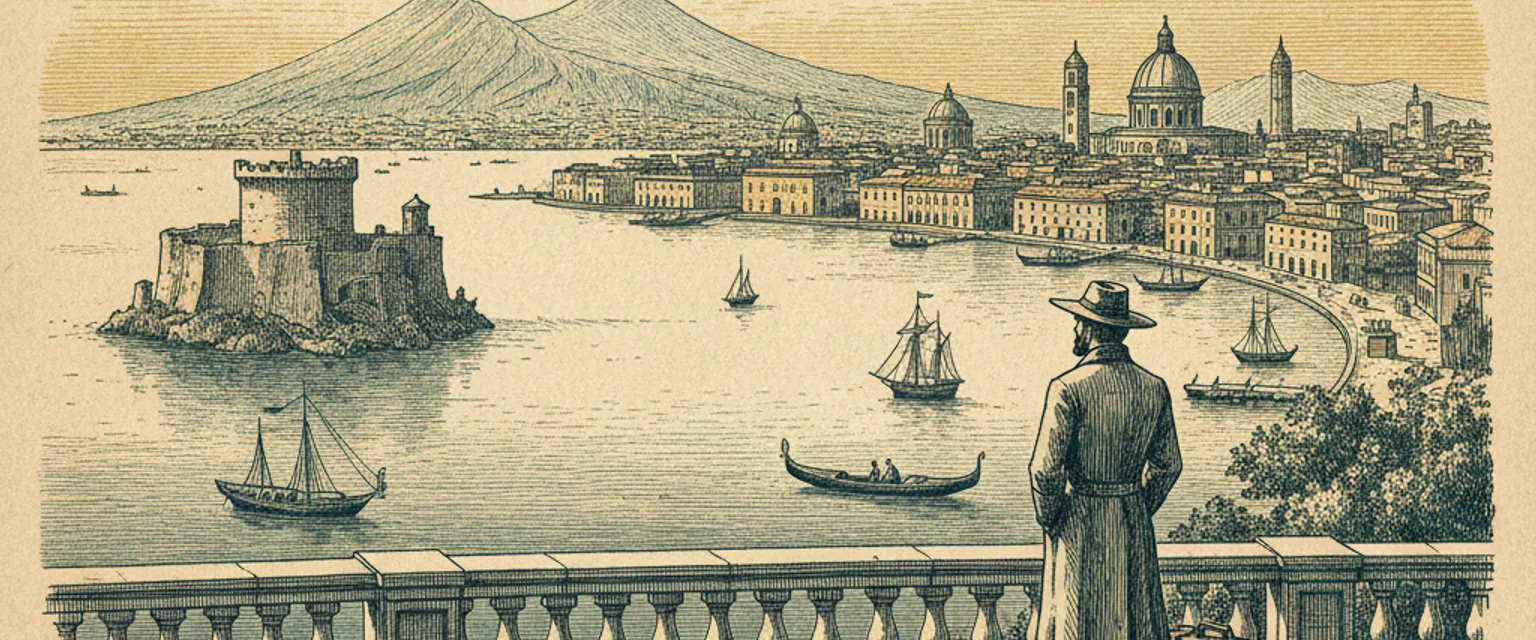
The Lungomare is the car-free seafront promenade running past the Borgo Marinari fishing village to the Castel dell'Ovo, the ancient castle on its little island. Walk it at golden hour with Vesuvius smouldering across the bay and Capri on the horizon. It is one of the great urban sunset walks in Europe. Stop at a seafront bar for an Aperol and watch the light go pink over the volcano that destroyed Pompeii.
Day 3
Pompeii + Vesuvius
The Roman city frozen in time and the volcano that froze it
Pompeii archaeological site
An entire Roman city buried in 79 AD and dug back out — streets, houses, bodies, and all.
Pompeii is 35 minutes from Naples on the Circumvesuviana train and is unmissable — a complete Roman city of paved streets, villas with frescoes, a forum, an amphitheatre, brothels, and the plaster casts of victims frozen in their final moments. It is vast; download a map or hire a guide and prioritise the Villa of the Mysteries, the Forum, and the Stabian Baths. Go early, bring water and a hat — there is no shade and the heat is relentless.
Mount Vesuvius crater
Climb the volcano that buried Pompeii and stare down into its smoking throat.
From Pompeii a shuttle runs up Vesuvius to the car park, from where a steep 30-minute gravel path leads to the crater rim. You walk the edge of an active volcano, peer into the smoking caldera, and take in a staggering panorama of the entire bay. Wear proper shoes and a layer; it is cooler and windier up top. The combination of buried city in the morning and the culprit in the afternoon is one of Italy's most powerful days.
Fried pizza + street food back in Naples
Back to the city for pizza fritta and a cuoppo of fried seafood from a street counter.
After a dusty day on the ruins, reward yourself with Naples street food. Pizza fritta — pizza dough stuffed, folded, and deep-fried — is the cheaper, older sibling of the baked version and gloriously messy. A cuoppo, a paper cone of fried fish, vegetables, or arancini, is the perfect walking dinner. Pair it with a cold Falanghina wine or a Peroni and eat on the street like everyone around you.
Day 4
Amalfi Coast Day Trip
Cliffside villages above an impossibly blue sea
Positano
Pastel houses cascading down a cliff to a beach, the postcard image of the Amalfi Coast.
The fastest way to the Amalfi Coast in summer is the ferry from Naples or Sorrento, which skips the white-knuckle coast road traffic. Positano is the showpiece — pastel houses tumbling down the cliffside to a pebble beach, fashion boutiques, and lemon everything. It is gorgeous and crowded; arrive early, swim, eat a lemon granita, and climb the stepped lanes before the midday crush. The view from the water as you approach is the famous one.
Amalfi town + Ravello
A medieval maritime republic and the cliff-top garden town high above it.
Amalfi town has a striking striped cathedral and a history as a powerful medieval maritime republic; it is the transport hub of the coast. From there a bus climbs to Ravello, perched high above the sea, with the gardens of Villa Rufolo and Villa Cimbrone offering the most sublime views on the entire coast — Gore Vidal lived here for a reason. Have a long lunch with a sea view and a glass of local white before the ferry back.
Seafood dinner in Naples
Spaghetti alle vongole and a chilled white, back in the city after a day on the water.
Back in Naples, eat seafood properly — spaghetti alle vongole (clams), frittura di paranza (mixed fried small fish), or a simple grilled catch from the bay. The trattorias around Borgo Marinari by the Castel dell'Ovo serve it with the water lapping nearby. A bottle of cold Greco di Tufo or Falanghina, salt still on your skin from the coast, is the right way to close an Amalfi day.
Day 5
Capri
The glamorous island in the bay and its glowing blue cave
Capri + the Blue Grotto
A fast ferry to the celebrity island, and a rowboat into a cave lit electric blue.
The fast ferry reaches Capri in under an hour. The Blue Grotto (Grotta Azzurra) is the famous draw — a sea cave where light entering underwater turns the whole interior an unearthly glowing blue; you lie flat in a tiny rowboat to get through the low entrance. It only works in calm seas and good light, so go in the morning. It is touristy and brief but genuinely unlike anything else.
Capri town + the Gardens of Augustus
The Piazzetta, the designer shops, and a terrace view of the Faraglioni sea stacks.
Take the funicular up to Capri town and the famous Piazzetta, then walk to the Gardens of Augustus for the classic view of the Faraglioni — the three towering sea stacks rising from the water. Anacapri, higher up, has the chairlift to Monte Solaro and the lovely Villa San Michele. Skip the designer shopping unless that is your thing; the views are the real luxury and they are free.
Late return + a quiet Naples dinner
Back to the mainland for a relaxed neighbourhood trattoria away from the crowds.
Catch a late-afternoon ferry back before the island day-trippers all leave at once. For dinner, retreat to a neighbourhood trattoria in the Chiaia or Vomero districts — quieter, more local, and excellent. Order whatever the waiter recommends from the day's catch, a side of friarielli (the bitter Neapolitan greens), and a carafe of house wine. After a day of island glamour, simple Naples is the better meal.
Day 6
Vomero + the Hilltop Castles
The view from above and the museums in the heights
Castel Sant'Elmo + Vomero funicular
Ride the funicular up to the star-shaped fortress with the best view of the whole bay.
Take one of the historic funiculars up to the Vomero district and the Castel Sant'Elmo, the great star-shaped fortress crowning the city. The ramparts give the single best panorama in Naples — the entire centro storico spread below, the bay, Vesuvius, and Capri all in one sweep. It is the photo that explains the city's geography in an instant, and the climb (by lift inside) is easy.
Certosa di San Martino
A Carthusian monastery turned museum, with baroque cloisters and famous nativity scenes.
Right beside the castle, the Certosa di San Martino is a former Carthusian monastery and now a rich museum — dazzling baroque cloisters, a church dripping with marble, the celebrated collection of presepi (Neapolitan nativity scenes), and another terrace view. It is calm, cool, and gorgeous, one of the most underrated stops in the city. Pair it with the castle for a complete morning in the heights.
Lunch in Vomero
An elegant, breezy district where Neapolitans actually live, with great no-frills restaurants.
Vomero is the comfortable residential district where many Neapolitans live — leafier, cooler, and calmer than the centre, with excellent unpretentious restaurants and good shopping along Via Scarlatti. Have a long lunch here away from the tourist trail, then take the funicular back down. It shows you a side of Naples that the centro storico crowds never see: ordinary, middle-class, and quietly proud.
Day 7
Herculaneum + a Slow Farewell
The better-preserved sister of Pompeii, and one last pizza
Herculaneum (Ercolano)
Smaller than Pompeii, far better preserved — wooden beams, upper floors, and mosaics intact.
Herculaneum, also on the Circumvesuviana line, is Pompeii's smaller and in many ways better-preserved sister. Buried by a different kind of volcanic surge, it kept its upper storeys, wooden beams, doors, and even some food carbonised in place. It is more compact, less crowded, and easier to grasp as a real town where people lived. The mosaics in the House of Neptune and Amphitrite are extraordinary. A perfect quieter ruins morning.
A proper Neapolitan caffè ritual
Espresso standing at the bar, paid for in advance, the way the city demands.
Naples takes coffee as seriously as pizza. Have your espresso the local way — standing at the bar, downed in two sips, often sweetened by default, and consider paying the caffè sospeso (a coffee paid forward for a stranger, a Neapolitan tradition). Gambrinus or any neighbourhood bar will do. Add a sfogliatella riccia, the crisp layered ricotta pastry, for the definitive Naples morning.
Farewell pizza where it all began
One last margherita in the centro storico, folded and eaten the only correct way.
End where you started, in the centro storico, with one final pizza. By now you know to order the marinara or the margherita, to eat it folded, and not to ask for pineapple unless you want to be quietly judged forever. The crust blistered, the centre soft, four euros on the table, a scooter screaming past the door. Naples does not try to charm you and that is exactly why it does. You will come back.
Naples is the city that does not care whether you like it, and that is exactly why I fell for it. It is loud, chaotic, and gloriously alive — scooters on the pavement, washing strung between balconies, shrines on every corner, and the best food on earth sold by people who are entirely unimpressed by you. After the polished theatre of Florence or Rome, Naples is a slap of real life, and once it gets under your skin nowhere else feels quite honest enough.
This itinerary is built around two truths. First: this is the birthplace of pizza, and a four-euro margherita eaten folded in your hand at Di Matteo or Sorbillo will ruin every pizza you eat for the rest of your life. Second: Naples is the perfect base for the whole bay — Pompeii, Vesuvius, the Amalfi Coast, Capri — all within easy reach by train or ferry.
The 2/3/4/7-day versions move from the city outward. Two days is the centro storico, the underground, and the great museum. Seven days is the full bay, with time to actually live in Naples between trips: the espresso standing at the bar, the long pizza lunches, the sunset on the Lungomare with Vesuvius glowing.
A practical note: keep your wits and your valuables close in the old centre, flaunt nothing, and you will be completely fine — the city’s reputation is far worse than the reality. Use the duration filter above to see your version of Naples.
This article contains affiliate links marked with rel="sponsored". We may earn a commission at no extra cost to you.