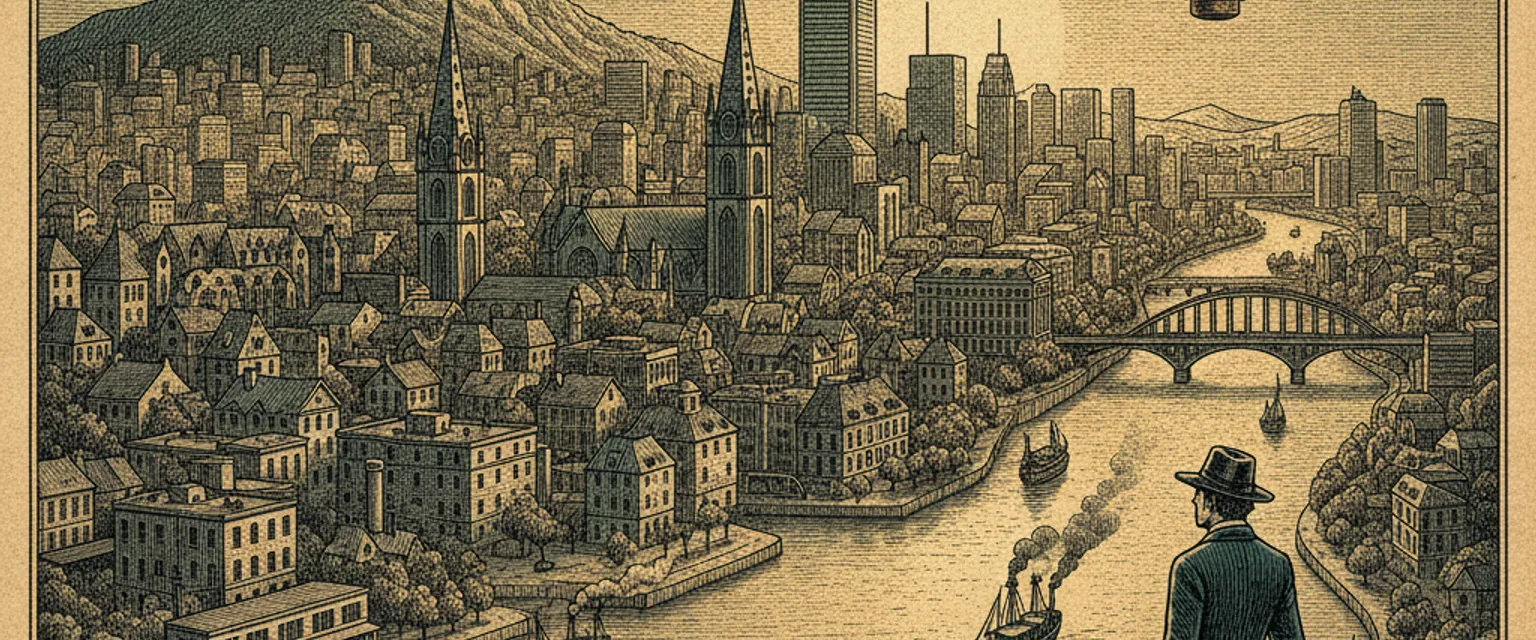
I ordered a smoked meat sandwich at Schwartz's at 11 PM, stood at the counter because there were no seats, and a stranger beside me explained, unprompted and at length, why the bagels at St-Viateur are superior to Fairmount. I had not asked. I have never forgotten. Montreal is a city that holds firm opinions about carbohydrates and will share them whether or not you solicited the lecture. I went to both bakeries the next morning to settle it personally. The argument, I can report, is unwinnable.
Two days covers the essentials on foot. Old Montreal's cobblestones and the Notre-Dame Basilica, a climb up Mount Royal for the city panorama, smoked meat at Schwartz's, and a Mile End bagel. You leave having eaten well and walked off most of it.
Go up Mount Royal at sunset, not noon. The light over the river is the whole point.
72 Hours: Add the Plateau
Three days adds the Plateau Mont-Royal, the neighbourhood of spiral staircases, murals, and cafes that defines residential Montreal. You get a proper bagel comparison, the Jean-Talon Market, and a night out on Boulevard Saint-Laurent.
4 Days: Museums and Markets
Four days lets you slow down. The Montreal Museum of Fine Arts, the Underground City when the weather turns, the Atwater Market on the Lachine Canal, and a long lunch in Little Italy. This is the trip where Montreal stops being a checklist.
7 Days: Montreal as a Resident
A week means you find your cafe, you bike the Lachine Canal, you do a day trip to Quebec City or the Eastern Townships, and you stop translating the menus in your head. You learn that the Metro is excellent and that nobody actually minds if your French is bad.
Estimated budget:$280-$480
Estimated budget:$420-$720
Estimated budget:$560-$960
Estimated budget:$980-$1700
Day 1
Old Montreal and the Old Port
Cobblestones, the basilica, and the river
Notre-Dame Basilica
A neo-Gothic interior so blue it looks lit from inside the walls.
The 1829 Notre-Dame Basilica is the showpiece of Old Montreal, a neo-Gothic interior painted deep ultramarine and studded with gold stars, with a wood ceiling and stained glass that depicts the city's religious history rather than biblical scenes. Go at opening to beat the tour buses. The 30-minute organ recitals are worth timing your visit around.
Old Port and Place Jacques-Cartier
The riverside promenade where Montreal started, ferris wheel and all.
The Old Port runs along the St Lawrence with a promenade, the Grande Roue observation wheel, and Place Jacques-Cartier sloping up toward City Hall. It is touristy and worth it anyway. Walk the cobbled Rue Saint-Paul, the oldest street in the city, and duck into the stone-walled cafes when it rains, which it will.
Schwartz's Deli
Montreal smoked meat since 1928, served at a shared counter with zero ceremony.
Schwartz's on Boulevard Saint-Laurent has been smoking brisket the same way since 1928. Order the medium-fat smoked meat on rye with mustard, a side of pickle, and a black cherry soda. There is a line. Stand in it. The takeout counter next door is faster if you would rather eat in a nearby park.
Day 2
Mount Royal and Downtown
The mountain that gave the city its name
Mount Royal Park
Olmsted designed it, and from the Kondiaronk Belvedere you see the whole island.
Mount Royal is the forested hill at the city's centre, landscaped by Frederick Law Olmsted of Central Park fame. Hike or take the bus up to the Kondiaronk Belvedere for the classic skyline-and-river view. On Sunday afternoons in summer the eastern slope hosts the Tam-Tams, an informal drum circle that has run for decades.
Montreal Museum of Fine Arts
Five pavilions, free permanent collection, and a genuinely great cafe.
The Montreal Museum of Fine Arts spreads across both sides of Sherbrooke Street with a strong Canadian and Inuit collection, a decorative arts wing, and ambitious touring shows. The permanent collection is free. Allow two hours, more if a major exhibition is on. The Decelles cafe is a good lunch fallback.
Boulevard Saint-Laurent nightlife
The Main, where the city drinks, dances, and argues until 3 AM.
Boulevard Saint-Laurent, known as the Main, is the historic dividing line between French and English Montreal and the spine of the city's nightlife. Bars range from natural-wine spots to thumping clubs. Start with a drink at a Plateau-end terrasse and follow the noise south. Last call is 3 AM, late by North American standards.
Day 3
The Plateau and Mile End
Spiral staircases, murals, and the bagel war
Plateau Mont-Royal walk
Exterior spiral staircases, three-storey murals, and the city's prettiest residential streets.
The Plateau is Montreal at its most photogenic, a grid of colourful triplexes with the wrought-iron spiral staircases that exist because a long-ago bylaw pushed stairs outdoors to save interior space. Walk Rue Saint-Denis and the side streets, catch the murals along the MURAL festival route, and stop at a terrasse for a cafe au lait.
St-Viateur and Fairmount Bagels
Two wood-fired bakeries, two blocks apart, one eternal feud. Try both, pick a side.
Montreal bagels are smaller, denser, and sweeter than New York's, boiled in honey water and baked in wood-fired ovens. St-Viateur and Fairmount sit a few blocks apart in Mile End and locals will defend their preference like a religion. Buy a sesame from each, eat them warm on the sidewalk, and form an honest opinion.
Jean-Talon Market
Quebec's produce, cheese, and maple everything under one busy open-air roof.
Jean-Talon Market in Little Italy is one of North America's great public markets, packed with Quebec strawberries in season, cheese stalls, charcuterie, and an entire economy of maple products. Graze your way through it for a late lunch. The surrounding Little Italy cafes serve the best espresso in the city.
Day 4
Markets, Canal, and the Underground
Lachine Canal by bike and a museum for the weather
Atwater Market and the Lachine Canal
A 1933 art-deco market hall on a canal built for bikes and picnics.
Atwater Market sits beside the Lachine Canal in an art-deco hall with a clock tower, surrounded by butchers, cheesemongers, and flower stalls. Rent a Bixi bike from the market and ride the flat canal path toward Old Montreal or out to Lachine. Pack a picnic from the market stalls and eat it on the grass by the locks.
The Underground City (RESO)
32 kilometres of tunnels connecting malls, metro, and museums for the winter.
The RESO, Montreal's Underground City, links downtown malls, metro stations, hotels, and offices through 32 kilometres of climate-controlled tunnels. It is a survival tool in January and a curiosity in July. Use it to reach the Place des Arts and the contemporary art museum when the weather refuses to cooperate.
Long lunch in Little Italy
Espresso, pasta, and the unhurried Montreal afternoon.
Little Italy around the Jean-Talon Market is where Montreal's Italian community has held court since the early 1900s. Settle into a trattoria for a slow lunch, then order an espresso at Cafe Italia, a no-frills counter that has been pulling shots and showing football for decades. This is a meal to linger over, not rush.
Day 5
Quebec City Day Trip
The walled French city three hours east
Old Quebec and the Chateau Frontenac
The only walled city north of Mexico, looking exactly like a postcard of itself.
Quebec City is roughly three hours by train or car and worth the early start. Old Quebec is the only fortified city north of Mexico, a UNESCO site of stone ramparts, narrow lanes, and the Chateau Frontenac hotel dominating the bluff above the St Lawrence. Walk the Dufferin Terrace, descend to the Petit-Champlain quarter, and eat poutine somewhere with no English on the menu.
Quartier Petit-Champlain
The oldest commercial district in North America, all cobbles and crooked roofs.
Petit-Champlain at the foot of the cliff claims to be the oldest commercial street in North America, a tight run of seventeenth-century stone houses now full of boutiques and cafes. Take the funicular down from the terrace, wander the Place Royale, and catch the late train back to Montreal. It is touristy and entirely charming about it.
Day 6
Parks, Islands, and the Botanical Garden
Green space and the legacy of Expo 67
Montreal Botanical Garden
One of the world's great botanical gardens, with a serene Japanese garden at its heart.
The Montreal Botanical Garden is among the largest in the world, with themed gardens spread across 75 hectares, including a celebrated Chinese garden and a quiet Japanese garden with a tea pavilion. In autumn the Gardens of Light lantern festival is genuinely magical. The adjacent Insectarium and the Biodome share the Olympic Park site.
Parc Jean-Drapeau and the Biosphere
Expo 67 islands with Buckminster Fuller's geodesic dome and river beaches.
Parc Jean-Drapeau occupies two islands in the St Lawrence built for Expo 67. The Biosphere, Buckminster Fuller's geodesic dome, now houses an environment museum. There is a beach, the Circuit Gilles Villeneuve for cyclists, and the best low-angle view of the downtown skyline across the water. The Metro drops you right on the island.
Day 7
Eastern Townships Day Trip
Vineyards, lakes, and small-town Quebec
Eastern Townships wine route
Rolling vineyards and cider houses about ninety minutes southeast of the city.
The Eastern Townships, southeast of Montreal, are Quebec's quiet wine and cider country, a landscape of lakes, covered bridges, and rolling farmland that turns spectacular in autumn. The wine route around Dunham and Brome Lake links a dozen small producers, several making surprisingly good cool-climate whites and the region's famous ice cider. A car makes this trip; a tour will drive you so you can taste.
Knowlton and Brome Lake
A lakeside village of antique shops, ducks, and an unhurried afternoon.
Knowlton on the shore of Brome Lake is the kind of village the Townships do best, a main street of antique shops, a good bistro or two, and a famous local duck on every menu. Walk the lakefront, browse the bookshops, and have an early dinner before the drive back. It is a deliberate decompression after a week in the city.
Montreal is the closest thing to Europe you can reach on a North American flight, and it knows it. The city runs in French, eats like Paris with a Quebec accent, and stays out far later than its size suggests. It is also genuinely walkable, ferociously seasonal, and cheaper than its charm implies once the exchange rate works in your favour.
This itinerary is built around one fact: Montreal is a city of neighbourhoods, and the visitors who never leave Old Montreal miss the actual place. Old Montreal is worth a day. The Plateau, Mile End, and Little Italy are where the city lives, eats, and argues about bagels.
The 2/3/4/7-day versions are real choices, not padding. Two days is the icons and the smoked meat. Three adds the neighbourhoods that make people move here. Seven gives you Quebec City, the Townships, and enough time to stop checking the map.
How to use this plan
Use the day filter to match your trip length. Each day clusters by area so you walk more and commute less, and the Metro covers the rest. Come in summer for terrasses and festivals, or in autumn for the colour and the apple harvest, and pack a layer no matter what the forecast claims.
This article contains affiliate links marked with rel="sponsored". We may earn a commission at no extra cost to you.