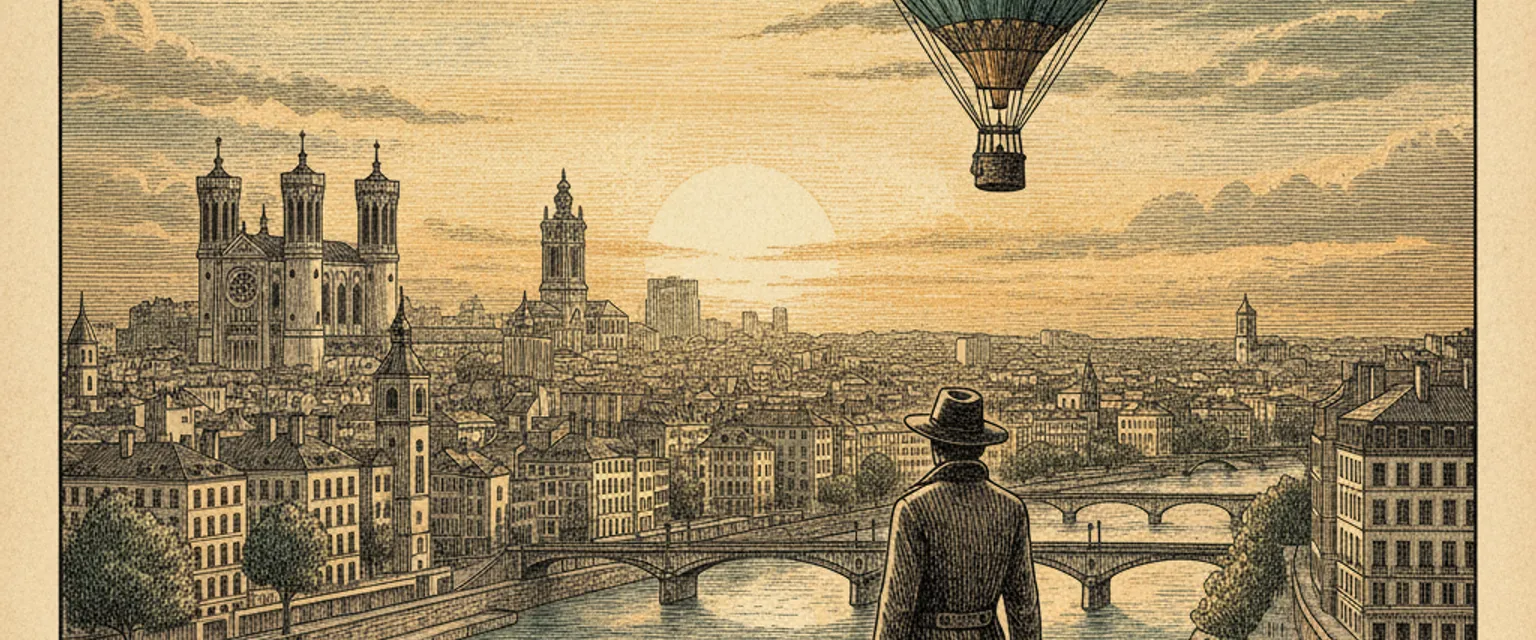
I asked a Lyonnais where to eat and he stared at me like I'd asked where to find oxygen. Then he walked me four blocks, pushed open an unmarked door into a stone corridor I'd have sworn was someone's hallway, led me through a courtyard, out another door, down an alley, and deposited me in front of a bouchon with no sign. "Here," he said. "Order the quenelle. Do not ask for ketchup." I have never obeyed an instruction so completely.
Two days is Vieux Lyon's Renaissance streets, the funicular up to Fourvière basilica for the view, the Roman theatres, and one proper bouchon dinner. Walk the traboules. Eat more than you think you can. Lyon rewards appetite.
Book a genuine bouchon (Daniel et Denise, Le Garet) ahead — the good ones fill up and the tourist ones near Bellecour are forgettable.
72 Hours: Add the Croix-Rousse Silk Hill
Three days adds the Croix-Rousse — the old silk-weavers' district up the hill, with its own traboules built tall for hauling looms, a daily market, and the best neighbourhood feel in the city. Plus the Presqu'île for shopping.
4 Days: Confluence, Museums & Markets
Four days means the futuristic Confluence district where the two rivers meet, the extraordinary Musée des Confluences, the Paul Bocuse covered market for a foodie pilgrimage, and time to actually linger in cafés instead of rushing between sights.
7 Days: Beaujolais, Pérouges & Living Like a Lyonnais
A week lets you day-trip into the Beaujolais vineyards an hour north, visit the medieval hilltop village of Pérouges, settle into a favourite café on the Place des Terreaux, and eat your way through every category of Lyonnais cooking from quenelle to praline tart to the terrifying tablier de sapeur.
Estimated budget:€280-€460 est. (1 hotel night, funicular pass, one bouchon dinner)
Estimated budget:€440-€720 est. (2 nights, Croix-Rousse market, museum entries)
Estimated budget:€600-€960 est. (3 nights, Confluences museum, Bocuse market lunch)
Estimated budget:€1,050-€1,700 est. (full week, Beaujolais day trip, mid-range hotels)
Day 1
Vieux Lyon + Traboules + Fourvière
Renaissance streets below, Roman ruins above
Vieux Lyon Renaissance quarter
One of Europe's largest Renaissance districts, and the prettiest part of the city.
Start on Rue Saint-Jean and wander. The pastel townhouses date from the 15th and 16th centuries when Lyon was the banking and silk capital of Europe. Look up for the gargoyles and look down the alleys for the traboules. The Cathédrale Saint-Jean has a 14th-century astronomical clock that still works.
Traboules of Vieux Lyon
Secret covered passageways that cut through buildings. The Resistance used them too.
Traboules are hidden corridors that thread through courtyards from one street to the next — built so silk workers could move bolts of fabric without rain. The Long Traboule at 54 Rue Saint-Jean runs through four buildings. Push the door (most are unlocked daytime), be quiet, people live here. The Resistance famously used them to vanish from the Gestapo.
Fourvière Basilica via funicular
The hilltop church locals nickname the upside-down elephant. The view is the point.
Take the funicular ('la ficelle') from Vieux Lyon up to the Basilique Notre-Dame de Fourvière, a wildly ornate 19th-century pile glittering with mosaics inside. The terrace gives you the whole city: two rivers, red rooftops, the Alps on a clear day, Mont Blanc if you're lucky.
Bouchon dinner — Daniel et Denise or Le Garet
The Lyonnais tavern format. Hearty, porky, unapologetic, and unmissable.
A bouchon is a small Lyonnais restaurant serving the city's robust classics: quenelle de brochet (pike dumpling in crayfish sauce), salade lyonnaise, andouillette, praline tart. Daniel et Denise has a Bocuse d'Or-winning chef and a Michelin Bib. Le Garet is the old-school institution. Book ahead, arrive hungry, do not ask for substitutions.
Day 2
Roman Lyon + Presqu'île + Bellecour
Two thousand years of city in one walk
Roman Theatres of Fourvière (Lugdunum)
Lyon was the capital of Roman Gaul. The ancient theatres still host concerts.
On Fourvière hill sit two Roman theatres from the 1st century BC, when this was Lugdunum, capital of the Three Gauls and birthplace of two emperors. The larger theatre still stages the summer Nuits de Fourvière festival. The adjacent Lugdunum museum is excellent and built into the hillside so you barely notice it from outside.
Presqu'île + Rue de la République
The grand peninsula between the rivers — shopping, squares, and 19th-century swagger.
The Presqu'île is the elegant tongue of land between the Saône and the Rhône. Walk Rue de la République from Place des Terreaux (with its Bartholdi fountain, by the Statue of Liberty sculptor) down to Place Bellecour, one of the largest pedestrian squares in Europe. Department stores, brasseries, and the city's commercial heart.
Pink praline tart at a Pignol or Sève pâtisserie
The lurid pink tart that is Lyon's sweet signature. Try it once, buy it twice.
The tarte aux pralines is a shocking-pink tart of sugar-crusted almonds set in a sweet pastry shell — a Lyonnais obsession. Pignol and Sève are the classic pâtisseries. Pair with a coffee on a Presqu'île terrace. It is far too sweet and you will finish it anyway.
Day 3
Croix-Rousse Silk Hill
The working hill that wove the world's silk
Croix-Rousse daily market (Boulevard de la Croix-Rousse)
A proper neighbourhood market on the old silk-weavers' hill.
The Croix-Rousse was the canut (silk-weaver) district, and its daily market along the boulevard is the real, unglamorous, excellent Lyon: cheese, charcuterie, produce, rotisserie chicken, flowers. Buy a saucisson and a hunk of Saint-Marcellin and have an impromptu picnic.
Croix-Rousse traboules + Mur des Canuts
Taller traboules built for hauling looms, plus Europe's biggest trompe-l'oeil mural.
The Croix-Rousse traboules are taller and steeper than Vieux Lyon's, built so 19th-century weavers could move their massive Jacquard looms. The Passage Thiaffait and the Cour des Voraces (with its dramatic staircase) are the highlights. End at the Mur des Canuts, a huge painted mural that looks like a real street section of the hill.
Aperitif on Place des Terreaux
The grand square at the foot of the hill, perfect for a kir and people-watching.
Descend the hill to Place des Terreaux, flanked by the Hôtel de Ville and the Musée des Beaux-Arts. Order a kir (white wine and crème de cassis) at a terrace and watch the Bartholdi fountain's stone horses rear at the dusk. This is the civilised end to a hill day.
Day 4
Confluence + Musée des Confluences + Bocuse Market
Where the rivers meet and the future arrived
Les Halles de Lyon Paul Bocuse
The covered market named for Lyon's god of cooking. A pilgrimage with samples.
The indoor food hall is named after Paul Bocuse, the chef who defined modern French cooking from his restaurant just outside the city. Sixty stalls of the best charcuterie, cheese, oysters, and the famous Mère Richard Saint-Marcellin. Eat oysters and a glass of white at the bar for an early lunch. This is foodie holy ground.
Musée des Confluences
A deconstructivist crystal-and-steel cloud at the tip of the peninsula.
At the southern point where the Saône meets the Rhône, this science and anthropology museum lives inside one of the most striking buildings in France — a swirling glass-and-steel structure that looks like a crashed spaceship. The collections sweep from dinosaurs to global cultures. The building alone justifies the trip down.
Confluence district riverside
Lyon's bold new quarter of coloured architecture and waterside bars.
The reclaimed industrial Confluence district is a playground of experimental buildings — the green-and-orange Cube, the silvery shopping centre, converted docks. Walk the riverside, grab a drink at a quayside bar, and see how a French city does 21st-century ambition without losing its soul.
Golden-stone villages and gamay reds far better than the November hype suggests.
Beaujolais is more than the rushed November 'nouveau' — the cru villages (Morgon, Fleurie, Brouilly) make serious, juicy gamay reds. Drive or take a tour into the Pierres Dorées (golden-stone) hills. Oingt is a honey-coloured hilltop village; cellar tastings dot the countryside. A designated driver or a tour is essential.
Long vineyard lunch
Coq au vin made with the local gamay, eaten where the grapes grow.
Lunch in a village auberge is the whole point — coq au vin or andouillette with a bottle of the cru from the slope outside the window. Lyonnais take their wine country seriously and slowly. Do not plan anything for the afternoon. Let the meal run long.
Day 6
Day Trip — Pérouges + Parc de la Tête d'Or
A medieval village and Lyon's great green lung
Pérouges medieval village
A perfectly preserved cobbled hilltop village, 40 minutes east of Lyon.
Pérouges is a fortified medieval village of cobbled lanes and stone houses so intact that films are shot here. It is tiny — an hour of wandering covers it — and famous for its galette de Pérouges, a sugary flat brioche tart served warm. Come on a weekday morning before the coach groups arrive.
Parc de la Tête d'Or
A vast free park with a lake, a free zoo, and rose gardens — Lyon's Hyde Park.
Back in the city, the Parc de la Tête d'Or is one of France's largest urban parks: a boating lake, a genuinely good free zoo, an exceptional botanical garden, and a rose garden that peaks in June. Rent a rowboat or just walk. This is where Lyon families spend their Sundays.
Day 7
Slow Lyon — Beaux-Arts, Markets, Goodbye
The last day, done at the pace the city prefers
Musée des Beaux-Arts de Lyon
France's biggest fine-art museum outside the Louvre, in a former convent.
Housed in a 17th-century Benedictine convent on Place des Terreaux, the Musée des Beaux-Arts holds an enormous collection from Egyptian antiquities to Impressionists, with a serene cloister garden in the middle. Two hours, then coffee in the garden. The most underrated big museum in France.
Farewell lunch at a favourite bouchon
Return to the bouchon you liked best. Order the quenelle one last time.
By day seven you have a preferred bouchon. Go back. The patron will half-recognise you. Order the quenelle, the saucisson brioché, a pot of Côtes du Rhône. This repetition — choosing the same good thing twice — is the entire compliment a city like Lyon wants to receive.
Lyon Part-Dieu — departure
The TGV station that puts you in Paris in two hours flat.
Lyon Part-Dieu is the high-speed hub — Paris in under two hours, Marseille in ninety minutes, Geneva just over the border. Buy a last saucisson and a jar of Lyonnais mustard for the journey. The station itself is unlovely, but the trains are superb.
Lyon is the city French people send you to when they’re tired of you raving about Paris. It sits where the Saône and the Rhône meet, with a Renaissance old town on one bank, a working silk hill above it, and a grand 19th-century peninsula between the two rivers. For two thousand years it has been a crossroads — Roman capital, banking centre, silk powerhouse, and, above all, the place the French quietly agree is the country’s true food capital.
The geography sorts itself out fast. Vieux Lyon and Fourvière hill are on the west bank of the Saône. The Presqu’île — the elegant peninsula of squares and shopping — sits between the rivers. The Croix-Rousse silk hill rises to the north. The futuristic Confluence district points south where the waters join. Get those four zones straight and you can navigate without a map.
What makes Lyon special isn’t any single monument — it’s the texture. The traboules, hidden passages that thread through courtyards from street to street. The bouchons, where lunch is porky and serious. The pink praline tarts in every pâtisserie window. The view from Fourvière with the Alps on the horizon. This itinerary is built to get you both the sights and that texture, scaled to however long you’ve got.
Where to Stay in Lyon
Neighbourhood
Vibe
Best For
Walk to Vieux Lyon
Vieux Lyon
Renaissance streets, cobbles, atmosphere
First-timers who want the postcard
On it
Presqu’île
Central, shopping, brasseries
Convenience and nightlife
10 min
Croix-Rousse
Local, arty, neighbourhood feel
Those wanting the real Lyon
25 min
Confluence
Modern, riverside, design-led
Architecture lovers
30 min (tram)
This article contains affiliate links marked with rel="sponsored". We may earn a commission at no extra cost to you.