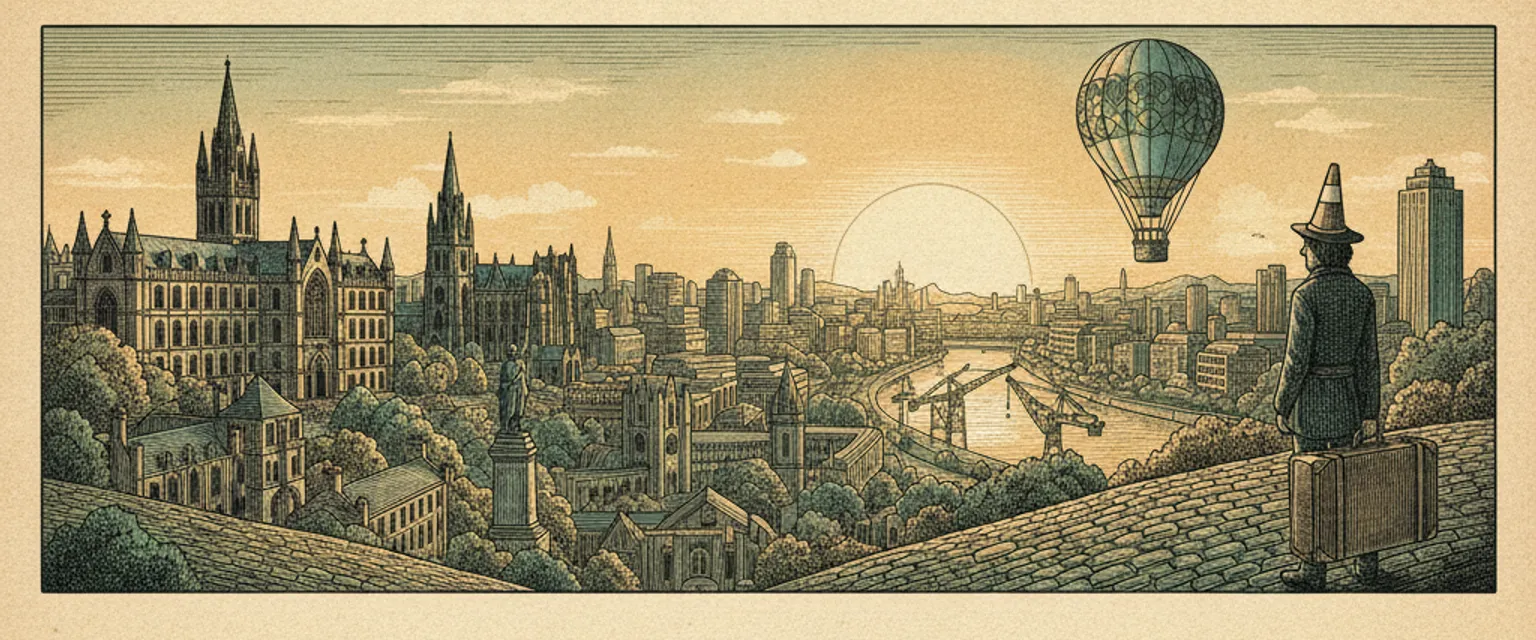
I got lost looking for a bar in the Merchant City and asked a man at a bus stop. He didn't just give directions. He walked me there — eleven minutes out of his way, in the rain, telling me the entire history of his football club, his granddaughter's wedding, and why Edinburgh people are, and I quote, "all fur coat and nae knickers." At the door he shook my hand, refused a drink, and vanished into the night. That is Glasgow in one encounter. Edinburgh has the looks. Glasgow has the heart.
48 Hours: Kelvingrove, the West End & a Big Night Out
Two days covers the free and brilliant Kelvingrove gallery, a wander through the leafy West End, the city's Victorian centre, and one proper Glasgow night out — because the nightlife here is genuinely the best in Britain. Friendly city, easy to walk, hard to dislike.
Glasgow's night out is a real attraction, not an afterthought. Leave a free evening for the pubs and live-music venues around the West End and city centre.
72 Hours: Add Mackintosh & the Burrell
Three days adds the design genius of Charles Rennie Mackintosh — the Mackintosh at the Willow tearooms and the House for an Art Lover — plus the recently reopened Burrell Collection in its woodland park. Glasgow's art and design pedigree runs deep.
4 Days: Music, Markets & the Clyde
Four days lets you dig into Glasgow's UNESCO City of Music status — record shops, legendary venues, the Barras market — and the regenerated Clyde waterfront with the Riverside Museum and the Science Centre. Plus the food scene, which has quietly become excellent.
7 Days: Loch Lomond, Stirling & Glasgow's Soul
A week opens up the Highlands' doorstep — Loch Lomond is 40 minutes away, Stirling Castle an hour, and the Trossachs glens just beyond. Combine the day trips with slow Glasgow mornings, neighbourhood pubs, and enough live music to understand why this city produces so many great bands.
Estimated budget:£180-£320 est. (1 hotel night, free museums, one big night out)
Estimated budget:£300-£520 est. (2 nights, Mackintosh sites, Burrell)
Estimated budget:£420-£700 est. (3 nights, music venues, Clyde museums)
Estimated budget:£750-£1,250 est. (full week, Loch Lomond and Stirling day trips)
Day 1
West End — Kelvingrove + University + Byres Road
Glasgow's leafy, bohemian, gallery-rich heart
Kelvingrove Art Gallery and Museum
A red-sandstone cathedral of a museum — free, vast, and genuinely beloved.
Kelvingrove is the most visited free museum in the UK outside London, and for good reason. The Spanish baroque building holds everything from Dalí's Christ of Saint John of the Cross to Spitfires, taxidermy, and a daily organ recital at 1pm. It is gloriously unsnobbish — half art gallery, half curiosity cabinet. Allow two hours minimum.
University of Glasgow & the Cloisters
Gothic spires and a vaulted cloister that stood in for Hogwarts.
The University of Glasgow's main building is a soaring Victorian Gothic pile crowning Gilmorehill, with a famously atmospheric undercroft cloister that has appeared in countless films. The free Hunterian Museum inside is Scotland's oldest public museum. The grounds give grand views back over Kelvingrove and the West End.
Byres Road & Ashton Lane
The West End's bustling spine — bookshops, bars, and a cobbled lane of restaurants.
Byres Road is the beating heart of bohemian Glasgow: independent shops, cafés, and pubs full of students and locals. Duck down Ashton Lane, a cobbled back lane strung with fairy lights and lined with bars and restaurants. It is touristy but irresistible. Grab a drink at the Ubiquitous Chip's whisky bar upstairs.
Live music & pubs around the West End
Glasgow's nightlife is the best in Britain. This is not a controversial claim here.
Start the evening properly. Òran Mór (a converted church with a famous ceiling mural by Alasdair Gray) does food, drinks, and live sessions. The bars of Ashton Lane and Great Western Road keep going late. Glasgow's welcome is legendary — strangers become friends by the second pint. Pace yourself; the night is long here.
Day 2
City Centre + Merchant City + Cathedral
Victorian grandeur and the medieval old town
George Square & the City Chambers
The civic heart, with a town hall whose interior outshines many palaces.
George Square is the grand civic centre, ringed by statues and dominated by the City Chambers — a Victorian municipal building whose marble staircases and mosaic interiors are so opulent they doubled for the Vatican on screen. Free guided tours run most weekdays. The square itself is the city's gathering and celebrating spot.
Merchant City wander
Glasgow's restored tobacco-merchant district — grand warehouses turned bars and galleries.
The Merchant City is the elegant grid of streets built on 18th-century tobacco and sugar wealth, now full of stylish bars, boutiques, and the Gallery of Modern Art (the one with the traffic cone permanently on the Duke of Wellington's head — a beloved act of civic cheek). Good for coffee, browsing, and an early-evening drink.
Glasgow Cathedral & the Necropolis
The only medieval cathedral on the mainland to survive the Reformation intact, plus a hill of tombs.
Glasgow Cathedral is a soaring medieval Gothic survivor — its dark crypt holds the tomb of St Mungo, the city's founder. Behind it rises the Necropolis, a Victorian hilltop cemetery of dramatic monuments with superb city views. Together they are atmospheric, free, and a complete contrast to the West End's leafy charm.
Dinner in the city centre — Ox and Finch or Crabshakk
Glasgow's food scene has quietly become very good. Small plates lead the way.
Glasgow's restaurants have raised their game enormously. Ox and Finch (Finnieston) does excellent shared small plates in a buzzy room. Crabshakk on Argyle Street is the city's beloved seafood bar. Both sit in the Finnieston strip, the hippest eating-and-drinking street in the city. Book ahead at weekends.
Day 3
Mackintosh Trail + Burrell Collection
The design genius who defined Glasgow style
Mackintosh at the Willow tearooms
Charles Rennie Mackintosh's faithfully restored 1903 tearooms — design and afternoon tea in one.
Charles Rennie Mackintosh is Glasgow's design hero, and the Willow Tea Rooms on Sauchiehall Street are his masterpiece — a total artwork from the high-backed chairs to the leaded glass, painstakingly restored. Take afternoon tea in the Salon de Luxe to experience it as intended, then visit the exhibition upstairs. Book the tearoom ahead.
House for an Art Lover
A Mackintosh design built decades after his death, in a serene Bellahouston park.
The House for an Art Lover, set in Bellahouston Park, was designed by Mackintosh and his wife Margaret Macdonald for a 1901 competition but only built in the 1990s. The result is a luminous, geometric vision of their style — the Music Room especially. The walled gardens and café make it a peaceful half-day.
The Burrell Collection
One man's astonishing hoard of art, reopened in a glass pavilion in the woods.
Sir William Burrell, a shipping magnate, gave the city a staggering collection — Degas, medieval tapestries, Chinese ceramics, stained glass. Housed in an award-winning glass building in Pollok Country Park, it reopened in 2022 after a major refurbishment and is now one of Britain's best museums. Free entry. Combine with a woodland walk.
Day 4
The Clyde + Music City + the Barras
Riverside regeneration and Glasgow's musical soul
Riverside Museum & the Tall Ship
Zaha Hadid's wave-roofed transport museum on the Clyde, with a Victorian sailing ship outside.
The Riverside Museum, in a dramatic Zaha Hadid building on the river, is Glasgow's free transport and technology museum — trams, locomotives, vintage cars, and a recreated old Glasgow street. Moored outside is the Glenlee, a restored 1896 tall ship you can board. A great rainy-day option and genuinely fun.
The Barras Market & Barrowland Ballroom
Glasgow's raucous East End weekend market, beside its most legendary music venue.
The Barras is the city's gloriously chaotic weekend flea market in the East End — bric-a-brac, vinyl, street food, and patter. Towering over it is the Barrowland Ballroom, the storied gig venue with the neon sign, where countless great bands have played. The area has reinvented itself with craft beer and street food alongside the old stalls.
Record shops & live music
A UNESCO City of Music — dig through vinyl, then catch a gig.
Glasgow is a UNESCO City of Music and it shows. Browse the record shops (Monorail at Mono, LoveMusic), then line up a gig — King Tut's Wah Wah Hut (where Oasis were signed), the SWG3 warehouse, or a session at a back-room pub. There is live music in this city every single night of the week.
Day 5
Day Trip — Loch Lomond & the Trossachs
The Highlands begin forty minutes from the city
Loch Lomond — Luss & Balloch
Britain's largest loch, with pretty villages and a cruise, on Glasgow's doorstep.
Loch Lomond is barely forty minutes from the city and feels a world away. The conservation village of Luss has flower-fronted cottages and a pebble beach; Balloch at the southern tip runs loch cruises among the wooded islands. This is the famous gateway where the Lowlands give way to the Highlands, immortalised in the song.
The Trossachs & Aberfoyle
Misty glens, forest trails, and the heart of Rob Roy country.
Just beyond Loch Lomond, the Trossachs National Park offers proper Highland scenery — Loch Katrine, forest walks, and the village of Aberfoyle. Rob Roy MacGregor roamed these glens. Take a forest trail or the steamship on Loch Katrine, then a warming dram in a village inn before the easy drive back to Glasgow.
Day 6
Day Trip — Stirling Castle
The fortress that decided Scotland's fate
Stirling Castle
A crag-top Renaissance fortress where Scottish kings were crowned and crowned again.
An hour from Glasgow, Stirling Castle sits dramatically on a volcanic crag and rivals Edinburgh's. Its restored Renaissance Royal Palace gleams with reproduction tapestries and a golden ceiling. From the ramparts you can see the Wallace Monument and the Ochil Hills. This was the strategic key to Scotland — control Stirling, control the country.
Bannockburn or the Wallace Monument
The battlefield where Bruce won, or the tower honouring Braveheart himself.
Round out the day with history. The Battle of Bannockburn Experience uses 3D technology to relive Robert the Bruce's 1314 victory. Or climb the Victorian Gothic National Wallace Monument on Abbey Craig for huge views and William Wallace's own sword. Either makes a powerful pairing with the castle before heading back.
Day 7
Slow Glasgow — Parks, Markets, Goodbye
The last day at Glasgow's warm, unhurried pace
Glasgow Botanic Gardens & Kibble Palace
A grand Victorian glasshouse and riverside walks in the West End.
The Botanic Gardens at the top of Byres Road are free and lovely — the domed Victorian Kibble Palace glasshouse shelters tree ferns and white marble statues, while the grounds run down to the Kelvin river walkway. A gentle final morning among the locals walking their dogs and reading on the lawns.
Finnieston farewell brunch
A last meal on Glasgow's coolest strip before you go.
End on Argyle Street in Finnieston, the city's most fashionable eating strip beneath the iconic Finnieston Crane. Brunch at one of the cafés, a final flat white, and a wander past the SEC Armadillo and the OVO Hydro on the Clyde. A relaxed goodbye to a city that made you feel like you'd lived here for years.
Glasgow Central / Airport — departure
A magnificent Victorian station, or a quick hop to the airport.
Glasgow Central is a grand Victorian terminus worth a look in its own right — the glass roof, the meeting-place clock, the hidden Victorian village on the underground tour. Trains south to England, or the bus or taxi out to Glasgow Airport in 20 minutes. Buy some tablet (Scottish fudge) and shortbread for the road.
Glasgow is the city Scotland sends you to when you want to actually enjoy yourself. Edinburgh, an hour east, has the castle and the looks and knows it. Glasgow has the warmth — a famously friendly, funny, slightly chaotic place built on Victorian shipbuilding wealth and now riding high on art, design, and music. It is the kind of city where a stranger will walk you to your destination and tell you their life story on the way.
The layout is easy. The West End, around the University and Kelvingrove, is the leafy, bohemian quarter of galleries, cafés, and Byres Road. The city centre is a grid of grand Victorian commerce, with the Merchant City and George Square at its core. The medieval cathedral and the East End sit to the east, and the regenerated Clyde waterfront runs along the south. Most of it is walkable, and an excellent subway loops the rest.
Three threads run through any good Glasgow trip: the art (those free, brilliant museums), the design genius of Charles Rennie Mackintosh, and the nightlife — genuinely the best in Britain, anchored by a UNESCO City of Music title that the venues earn nightly. This itinerary weaves all three, and the longer versions send you out to Loch Lomond and Stirling, with the Highlands beginning just up the road.
Where to Stay in Glasgow
Neighbourhood
Vibe
Best For
Walk to Kelvingrove
West End
Leafy, bohemian, gallery-rich
First-timers wanting charm
5-15 min
Merchant City
Stylish, central, bars and boutiques
Nightlife and convenience
25 min (subway)
Finnieston
Hip eating-and-drinking strip
Foodies
15 min
City Centre
Shops, transport hubs, grand architecture
Easy access everywhere
25 min (subway)
This article contains affiliate links marked with rel="sponsored". We may earn a commission at no extra cost to you.