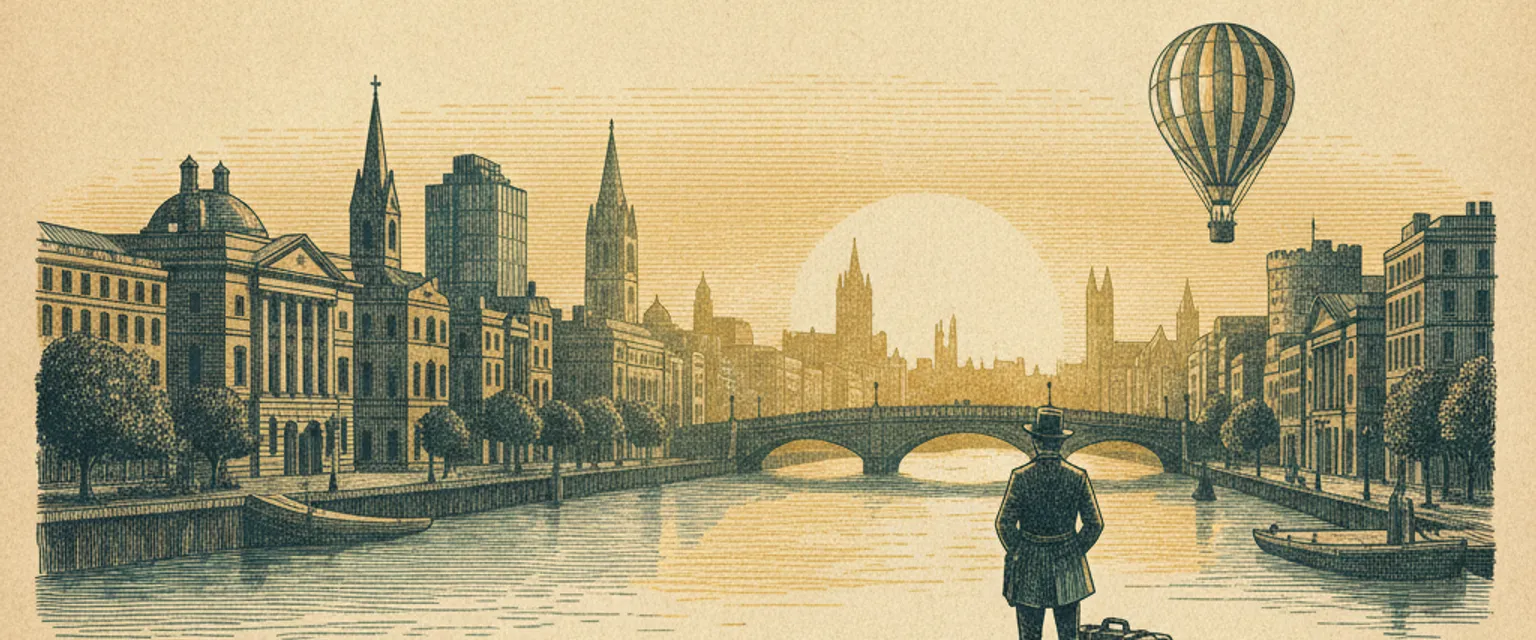
I asked a barman in a Stoneybatter pub for directions and forty minutes later I had a full pint I had not ordered, a history of the neighbourhood, a strong recommendation against the place I had been heading to, and three new opinions about Irish politics. I never did get the directions. Dublin is a city where a simple question is a doorway, and where the shortest distance between two points is a conversation that lasts an hour. The pint, for the record, was perfect. They almost always are.
Two days covers the core. Trinity College and the Book of Kells, a walk through Georgian Dublin, the Guinness Storehouse for the rooftop pint, and a proper night in a real pub away from the Temple Bar markup. It is a compact, satisfying first taste.
Skip the pint inside Temple Bar. Walk five minutes for one a third of the price and twice as good.
72 Hours: History and the Coast
Three days adds Kilmainham Gaol, where modern Ireland was forged, and a DART train down the coast to the fishing village of Howth for a cliff walk and seafood. You also get the Chester Beatty, the city's quiet cultural gem.
4 Days: Museums and Neighbourhoods
Four days lets Dublin breathe. The National Museum's bog bodies and gold, the Irish Museum of Modern Art at the Royal Hospital, and the foodie streets of Stoneybatter and the Liberties. This is where Dublin stops being a stag-party caricature.
7 Days: Dublin as a Base
A week means you treat Dublin as a home base and ride out. Glendalough's monastic valley in the Wicklow Mountains, the Boyne Valley's Neolithic tombs older than the pyramids, and enough time in the city to find your own local and be remembered in it.
Estimated budget:$320-$540
Estimated budget:$480-$820
Estimated budget:$640-$1100
Estimated budget:$1100-$1900
Day 1
Trinity College and Georgian Dublin
The Book of Kells and the old core on foot
Trinity College and the Book of Kells
A ninth-century illuminated gospel and the Long Room library that stops people mid-sentence.
Trinity College, founded in 1592, holds the Book of Kells, a gloriously decorated ninth-century gospel manuscript. The real showstopper is the Long Room, a 65-metre barrel-vaulted library lined with marble busts and ancient books. Book the earliest timed slot online; the queue by mid-morning is brutal and the room is best while quiet.
Georgian Dublin and Merrion Square
Famous coloured doors, leafy squares, and the reclining Oscar Wilde statue.
The streets south of Trinity hold Dublin's Georgian heart: the rainbow of painted doors on Merrion and Fitzwilliam Squares, the elegant terraces, and a louche statue of Oscar Wilde lounging on a rock in Merrion Square park. Stroll, photograph the doors everyone photographs, and cut through St Stephen's Green on your way to lunch.
A real pub in Stoneybatter or the Liberties
A proper pint of Guinness in a snug, far from the Temple Bar tourist tax.
Skip the inflated Temple Bar and head to a genuine local. Mulligan's near the quays, The Cobblestone in Smithfield for trad music, or any unhurried pub in Stoneybatter will pour a better pint for a fraction of the price. Order a Guinness, let it settle the full two-part pour, and fall into conversation with whoever is next to you.
Day 2
Guinness and the West of the City
The black stuff and the cathedrals
Guinness Storehouse
Seven floors of brewing theatre ending in a 360-degree rooftop pint.
The Guinness Storehouse at St James's Gate is Ireland's most-visited attraction, a self-guided museum shaped like a giant pint glass. The payoff is the Gravity Bar on the seventh floor, where your included pint comes with a 360-degree view of the city. Book a timed ticket online to skip the line and go earlier rather than later.
Christ Church Cathedral and Dublinia
An 11th-century cathedral with a vast crypt and a mummified cat-and-rat.
Christ Church Cathedral dates to the 11th century and sits on the medieval high ground of the old city. Its crypt is one of the largest in Britain or Ireland and houses, among the treasures, a mummified cat and rat found in an organ pipe. The attached Dublinia exhibition brings the Viking and medieval city to life and is good for restless travellers.
Kilmainham Gaol
The prison where the 1916 leaders were executed and modern Ireland was born.
Kilmainham Gaol is the most moving site in Dublin, a decommissioned prison where leaders of the 1916 Easter Rising were held and executed. The guided tour through the eerie Victorian east wing and the stonebreakers' yard is essential to understanding Ireland. Tickets sell out days ahead; book online before you travel, not on the day.
Day 3
Howth and the Coast
A DART ride to cliffs and seafood
Howth cliff walk
A breezy headland loop with gorse, sea, and a view to Ireland's Eye.
Howth is a fishing village 25 minutes north on the DART commuter train. The cliff path loops around the headland past heather, a lighthouse, and views across to the island of Ireland's Eye. The full loop takes around two hours; the shorter green route is gentler. Wear real shoes and expect weather that changes its mind hourly.
Howth harbour seafood lunch
Fish and chips or fresh crab claws on the pier, gulls permitting.
Back at the harbour, Howth rewards the walk with seafood straight off the boats. Get fish and chips from a pier counter and eat it watching the seals beg by the fishmongers, or sit down for chowder and brown bread at a harbour restaurant. The seals are professionals; guard your lunch accordingly.
Chester Beatty Library
A free, world-class collection of manuscripts hidden in Dublin Castle's gardens.
Back in town, the Chester Beatty is Dublin's quiet masterpiece, a free museum in the Dublin Castle grounds holding sacred texts, Islamic and East Asian manuscripts, and illuminated Qurans of staggering beauty. It has twice been named Europe's museum of the year and almost nobody queues. The rooftop garden is a calm place to finish the day.
Day 4
Museums and Local Neighbourhoods
Gold, bog bodies, and the Liberties
National Museum of Ireland — Archaeology
Iron Age bog bodies and a hoard of prehistoric Irish gold, all free.
The National Museum of Ireland on Kildare Street is free and holds the country's archaeological treasures: Iron Age bog bodies preserved in peat, the Ardagh Chalice, the Tara Brooch, and one of Europe's great collections of prehistoric gold. The bog bodies are genuinely arresting. Allow ninety minutes and read the panels; the context is the point.
Irish Museum of Modern Art
Contemporary art inside a grand 17th-century former soldiers' hospital.
The Irish Museum of Modern Art occupies the Royal Hospital Kilmainham, a serene 17th-century building modelled on Les Invalides, with formal gardens that are a destination in themselves. The collection and rotating shows lean contemporary and Irish. It is free, rarely crowded, and pairs naturally with a walk in the surrounding grounds.
The Liberties and Stoneybatter
Old working-class quarters turned distillery district and brunch belt.
The Liberties is Dublin's oldest neighbourhood, now home to revived whiskey distilleries like Roe and Co and Teeling alongside markets and old pubs. Across the river, Stoneybatter has become the city's most self-consciously cool village, full of cafes and craft beer. Wander, take a distillery tour if the timing fits, and eat where the locals do.
Day 5
Glendalough Day Trip
A monastic valley in the Wicklow Mountains
Glendalough monastic site
A sixth-century round tower beside two glacial lakes, deep in the mountains.
Glendalough is an early-medieval monastic settlement in a glacial valley about an hour and a half south in the Wicklow Mountains. The ruined round tower, cemetery, and churches sit beside two dark lakes ringed by forest. It is one of Ireland's most atmospheric places. Tours run from the city; a car gives you more time on the trails.
Wicklow lakeside trails
Boardwalks and forest paths around the Upper Lake, mining ruins included.
From the monastic site, trails fan out around the Upper Lake, including an easy lakeshore boardwalk and steeper routes past the old lead-mining ruins of the Miners' Village. Pack a sandwich and walk at least to the Upper Lake; the scenery earns its reputation. The visitor centre has maps for every fitness level.
Day 6
Boyne Valley Day Trip
Neolithic tombs and the seat of the High Kings
Bru na Boinne — Newgrange
A passage tomb older than Stonehenge, aligned to the winter solstice sunrise.
Newgrange in the Boyne Valley is a 5,200-year-old passage tomb older than the pyramids and Stonehenge, famous for a roof box that channels the solstice sunrise down its passage. Access is only by guided shuttle from the Bru na Boinne visitor centre, so arrive early and book ahead in summer. The reconstructed light demonstration inside is unforgettable.
Hill of Tara
Grassy mounds and standing stones where Ireland's High Kings were crowned.
The Hill of Tara, the ceremonial seat of Ireland's High Kings, is a gentle grassy ridge of ancient earthworks, a passage tomb, and the standing Lia Fail stone. There is little signage and few crowds, just long views across the midlands and a strong sense of deep time. Wear boots; it is exposed and frequently muddy. Drive back to Dublin by dusk.
Day 7
Slow Dublin and the Phoenix Park
A relaxed final day in the city
Phoenix Park
One of Europe's largest city parks, complete with a wild herd of fallow deer.
Phoenix Park is one of the largest enclosed city parks in Europe, home to a herd of fallow deer that has roamed since the 1660s, the Dublin Zoo, and the residence of the Irish President. Rent a bike at the gate, ride to the Papal Cross and the deer meadows, and bring something for a picnic. On a rare clear morning it is the best free thing in the city.
Grafton Street and George's Street Arcade
Buskers, browsing, and a Victorian covered market for last-day shopping.
Spend a final afternoon on pedestrianised Grafton Street, where buskers play to the shopping crowds, then duck into the Victorian George's Street Arcade for vintage shops, secondhand books, and a good coffee. Finish at a snug in a heritage pub for one last properly poured pint before you go. It is an unhurried, fitting farewell.
Dublin is a small city that punches absurdly above its weight, mostly with words and stout. It produced four Nobel laureates in literature, it will tell you about all of them, and it pours arguably the best pint of Guinness on the planet at the source. It is also damp, walkable, and warmer in spirit than the weather ever manages.
This itinerary is built around one honest truth: Temple Bar is a trap, and the real Dublin happens in the pubs of Stoneybatter and the Liberties, in the free national museums, and on the DART line out to the coast. Tick the icons fast, then go where the locals actually drink and eat.
The 2/3/4/7-day versions are genuinely different trips. Two days is books and pints. Three reaches the sea at Howth. Seven uses Dublin as a base for Glendalough’s mountains and the Boyne Valley’s tombs, which are older than the pyramids.
How to use this plan
Use the day filter to match your trip length. Days are grouped so you walk the compact centre and take the train or a tour for the coast and countryside. Book Kilmainham Gaol and the Book of Kells online before you arrive, bring a rain layer regardless of the forecast, and leave room in the schedule for the conversations that will inevitably ambush you.
This article contains affiliate links marked with rel="sponsored". We may earn a commission at no extra cost to you.