
[ DISCOVERY · THE DISPATCH ]
There's a Pink Lake in Australia So Bright It Looks Photoshopped From the Plane
Lake Hillier stays bubblegum pink even if you scoop it into a bucket, and scientists still don't fully agree why. The catch: you can really only grasp it from a plane. Here's the strangest lake in Australia.
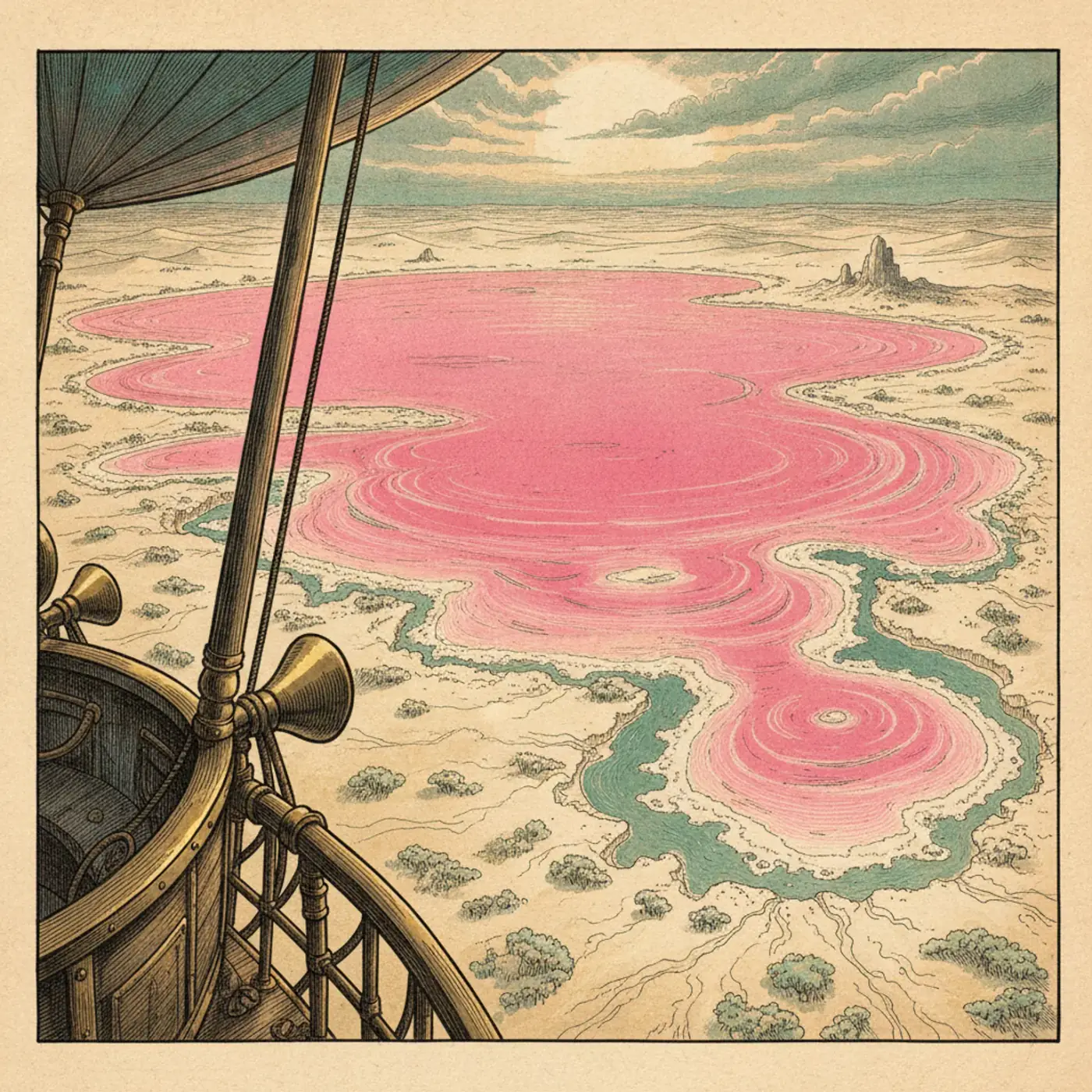
The first time I saw a photo of Lake Hillier, the pink lake in Australia, I assumed someone had got carried away with a saturation slider. It’s not subtle pink. It’s not blush, or salmon, or “pink if the light hits it right.” It’s bubblegum. Pepto-Bismol. The exact pink of a kid’s birthday cake, sitting in a ring of dark green forest, right next to the deep blue Southern Ocean. The contrast is so cartoonish it genuinely looks faked.
It isn’t. And here’s the kicker that flipped my brain around: scoop the water into a bottle, and it stays pink. Most “pink lakes” lose their color the moment you separate the water from whatever’s tinting it. Hillier holds. That little fact is what turns it from a pretty curiosity into a proper mystery.

Where it even is
Lake Hillier sits on Middle Island, the biggest of a scatter of islands called the Recherche Archipelago, off the south coast of Western Australia, near the town of Esperance. It was first noted by a European in 1802 — the explorer Matthew Flinders climbed the island’s peak, clocked the pink lake, and wrote it down like a man slightly unsure of his own eyes. It’s about 600 meters long, ringed by a thin band of sand and a dense eucalyptus and paperbark forest. From the ground, on the island, it just looks like a salty pink pond. From the air, it looks like something fell out of a Wes Anderson film.

So why is it pink? (Nobody fully agrees)
Here’s where it gets fun, because the honest answer is: we’re not 100% sure. The leading explanation is biological. The lake is extremely salty — saltier than the sea — and that kind of harsh, salty water is loved by a few specific tiny organisms. The prime suspect is an algae called Dunaliella salina, which in high-salt, high-sun conditions pumps out a red-orange pigment (a carotenoid, the same family that makes carrots orange) as a sort of sunscreen for itself.
Then there are salt-loving bacteria — halophiles known as halobacteria — living in the salt crusts, which are also reddish-pink. A 2022 research project that actually sequenced the lake’s microbes found a whole community of these pink-and-red pigment-producing organisms working together. So the color is probably a team effort: algae plus bacteria plus the way they all react to that brutal salt and sunlight.
But “probably” is doing real work in that sentence. The exact recipe, and why Hillier holds its color so stubbornly when other pink lakes fade, still isn’t nailed down. Which I find delightful. In an age where we’ve mapped basically everything, there’s a lake you can hold in your hand that science still can’t fully explain.

Wait — is it the same as Australia’s other pink lakes?
Good question, and an easy mix-up. Australia has several pink lakes, and a few of them are much easier to reach — there’s even one literally called “Pink Lake” near Esperance, which confusingly is often not pink anymore (changing salt levels). Lake MacDonnell on the Eyre Peninsula in South Australia turns a vivid pink you can drive right up to. Hutt Lagoon, also in WA, is another roadside pink one.
But Lake Hillier is the famous one for two reasons: that absurd, consistent bubblegum hue, and the fact that it sits like a pink coin right beside the navy ocean, with only a thread of trees between them. The other lakes are pink-ish and accessible. Hillier is pink-pink and almost untouchable. That scarcity is half its magic.

Why it stuck with me
I think what gets me about it isn’t even the color, weird as it is. It’s that it’s a small, quiet reminder that the planet is still doing strange, half-understood things in corners we mostly fly over without looking. A lake the color of a milkshake, made by invisible organisms surviving in water too salty for almost anything else, holding its color in a bottle for reasons we can only mostly explain. No filter. No trick. Just biology being gloriously, stubbornly weird.
You probably won’t tick this one off easily — it’s remote, protected, and best seen from a small plane. But honestly? I kind of love that. Not everything should be a five-minute Uber and a selfie. Some things should make you work, or at least book a scenic flight and crane your neck. Lake Hillier earns the effort just by existing.
Some of the best things on Earth aren’t there to be touched — just witnessed, briefly, from a small plane, while you mutter “that can’t be real” under your breath. It’s real. It’s pink. Go look.
This article contains affiliate links marked rel="sponsored". We may earn a commission at no extra cost to you.