
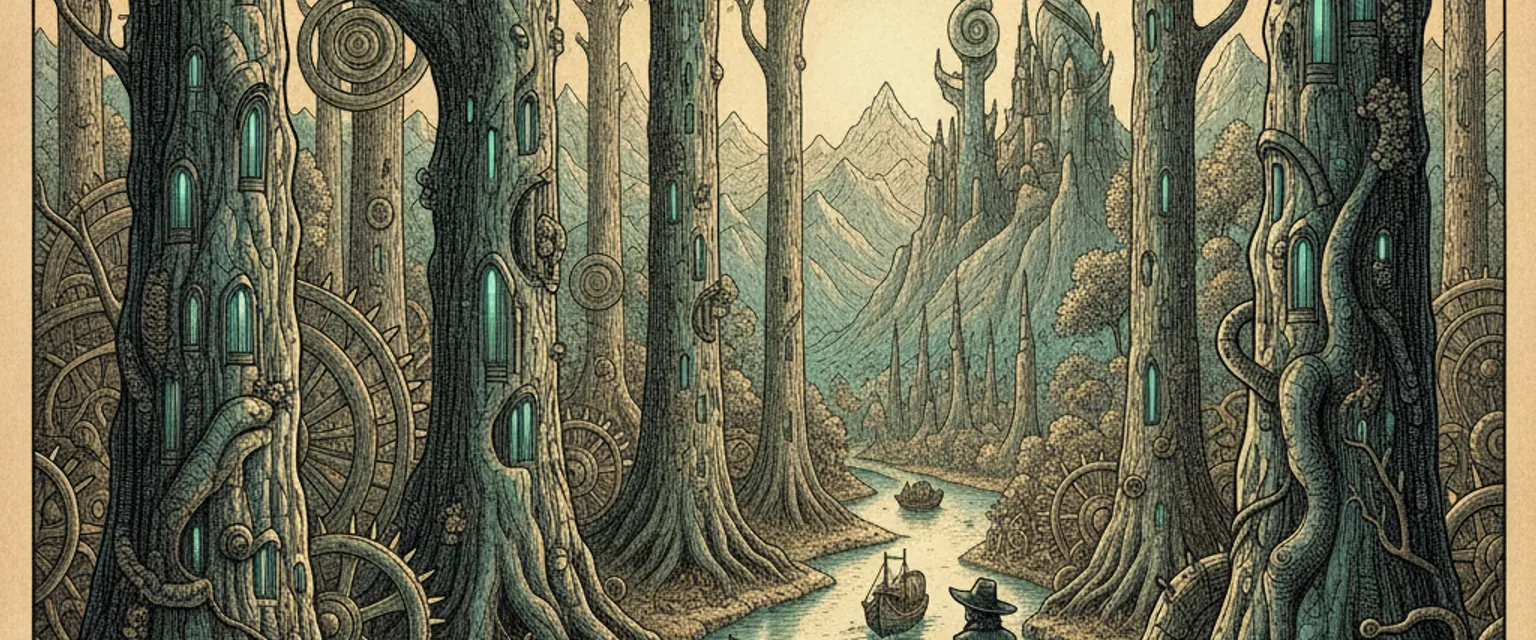
[ DISCOVERY · THE DISPATCH ]
The Forests You Visit for the Trees That Shouldn't Exist
Crooked, colour-shifting, ancient, or so old they predate the pyramids. Here are the strangest forests in the world, and the one in Poland where every single tree bends the same impossible way and nobody can fully explain it.
The strangest forests in the world, where the trees seem to break the rules
I stood in the Crooked Forest in Poland for about ten minutes before I said anything out loud, and what I eventually said was just “but why.” Around 400 pine trees, all planted in the 1930s, every one of them bent ninety degrees at the base — a sharp J-shaped kink, all curving the same direction, north — before straightening up and growing tall and normal. Like the whole grove flinched at the same moment. Nobody knows for certain why. There are theories (a tool to make curved timber, snow damage, a clever furniture-maker who never came back) but no proof. And that not-knowing is exactly why I go to the strangest forests in the world. They make your brain itch.
Most forests are, you know, forests. Trees, green, nice. But some of them are wrong in the best way, and those are worth crossing a continent for. Here’s my list.
The Crooked Forest, Poland — the one that flinched
Krzywy Las, near Gryfino in northwest Poland, is the one above. It’s small — you can see the whole strange grove in twenty minutes — and it’s free, and it’s a bit of a faff to reach (closest base is Szczecin). But standing among 400 trees that all decided, in unison, around 1934, to grow sideways and then change their minds is genuinely uncanny. The leading theory is that human hands bent the young saplings to grow curved planks, then the Second World War interrupted everyone’s plans. Maybe. I prefer it unexplained, honestly.
Go on a weekday. It’s tiny and it’s gotten popular, and the spell breaks fast with a coach party in it.
The rainbow eucalyptus — trees that look painted, but aren’t
Now for colour. The rainbow eucalyptus (Eucalyptus deglupta) sheds its bark in strips through the year, and the fresh bark underneath starts bright green and then ages through blue, purple, orange and maroon — so a single trunk looks like someone went at it with paint, streaks of every colour at once. They’re real. The colours are real. You’ll keep touching them to check.
The best easy place to see them is Hawaii — there’s a famous stand on the road to Hāna on Maui, and more in the Keahua Arboretum on Kauai (free, and far less mobbed). They also grow across the Philippines and Indonesia where they’re native. Best after rain, when the wet bark goes saturated and almost neon.

The ancient ones — trees older than recorded history
Some forests are strange simply because they’re impossibly old. The Bristlecone Pines in the White Mountains of California include individuals over 4,800 years old — older than the pyramids, alive when Stonehenge was new. They grow gnarled and twisted and half-dead at altitude, in poor soil that nothing else wants, and the slow gruesome beauty of them is hard to describe. There’s a marked grove (the Methuselah trail) but the location of the very oldest tree is deliberately kept secret to protect it, which I love. Go in summer — the access road is snowed shut much of the year, and it’s at 3,000m so take the altitude seriously.
And then the dragon’s blood trees of Socotra, Yemen — umbrella-shaped, alien-looking things that bleed red sap, growing on an island so isolated that a third of its plants exist nowhere else on Earth. Hard and complicated to reach right now, but no list of strange forests is honest without it. It looks like a film set for a planet that isn’t ours.
The drowned and the upside-down
Lake Kaindy in Kazakhstan has a “sunken forest” — an earthquake dammed a valley in 1911, drowned a stand of spruce, and now the bare bleached trunks rise straight up out of impossibly turquoise water like a forest of spears. You can scuba it. The trees are still standing underwater, preserved by the cold, branches and all. It’s eerie and gorgeous and about four hours from Almaty on rough road.
And for “upside-down,” there’s the baobabs — Madagascar’s Avenue of the Baobabs, those huge swollen-trunked trees that look like they were yanked out and shoved back in roots-up. Some are 800 years old. Go for sunset, when the trunks glow orange and the whole avenue does the thing it’s famous for. It’s touristy now, but some clichés earn it.
How to actually enjoy a weird forest
A few honest notes. These places are fragile, and a lot of the strangeness survives precisely because not many people have trampled it — so stay on paths, don’t carve the rainbow bark, don’t climb the ancient pines. The crowds are the real threat to most of them now, not loggers.
And give them time. A strange forest doesn’t reveal itself in a drive-by photo. The Crooked Forest needed me to stand still and stop trying to solve it. The bristlecones needed me to sit down and actually reckon with the fact that the thing in front of me was alive before writing existed. That’s the whole point of seeking out trees that shouldn’t exist — they put you in your place, gently, and you leave a bit smaller and a bit happier.
The “but why” is the souvenir. Some of these, you’ll never get an answer. Definately the best kind.
Go stand under a tree that breaks the rules. The ones that make no sense are the ones you’ll remember.
This article contains affiliate links marked rel="sponsored". We may earn a commission at no extra cost to you.