
[ DISCOVERY · THE DISPATCH ]
The Abandoned Railways That Are Now the Best Walks in the Country
Abandoned railways turned walking trails give you tunnels, viaducts, and dead-flat gradients through country you'd never otherwise see. Here's why old tracks make the best paths, and how to find the ones worth a day.
I have a soft spot for abandoned railways turned walking trails that borders on the unreasonable. My partner thinks it’s a bit morbid, walking down the spine of something dead. But that’s exactly it — these paths have a melancholy to them that a normal hiking trail just doesn’t. Somebody surveyed this route a hundred and fifty years ago. Somebody blasted that tunnel by hand. Trains ran here, full of people going somewhere, and then one day they stopped, and the rails came up, and the brambles moved in. And now? Now it’s the best flat walk in the county.
Let me tell you why these are better than half the “proper” trails out there.

The gradient is a gift
Trains are lazy. Wonderfully, gloriously lazy. A steam locomotive could not climb a steep hill hauling forty tons of coal, so the engineers who built these lines refused to let the ground rise more than a whisper. The result, a century later, is a path that barely tilts. You can walk ten miles on an old line and your knees won’t even notice.
This matters more than people think. I took my mother — who is 71 and has a hip she calls “the traitor” — along a converted line in the Peak District and she did six miles without a single complaint, which for her is basically a standing ovation. You don’t get that on a normal fell path. The railway does the hard work of being gentle for you.

Tunnels. The tunnels are the whole thing
A good rail trail will, at some point, swallow you. You walk toward a dark stone arch, the temperature drops about five degrees, the light behind you shrinks to a coin, and for thirty seconds you’re in genuine pitch black with water dripping somewhere and your own footsteps echoing back wrong. It’s a little bit terrifying and completely brilliant.
The Combe Down tunnel near Bath is over a mile long and lit, which sounds like it’d ruin the magic but somehow doesn’t — the lights are dim and bluish and it feels like walking through the inside of a whale. Bring a torch for the unlit ones regardless. Phones die at the worst moments, and being halfway through a black tunnel when your only light goes is a memory you don’t want.

The viaducts will stop you mid-sentence
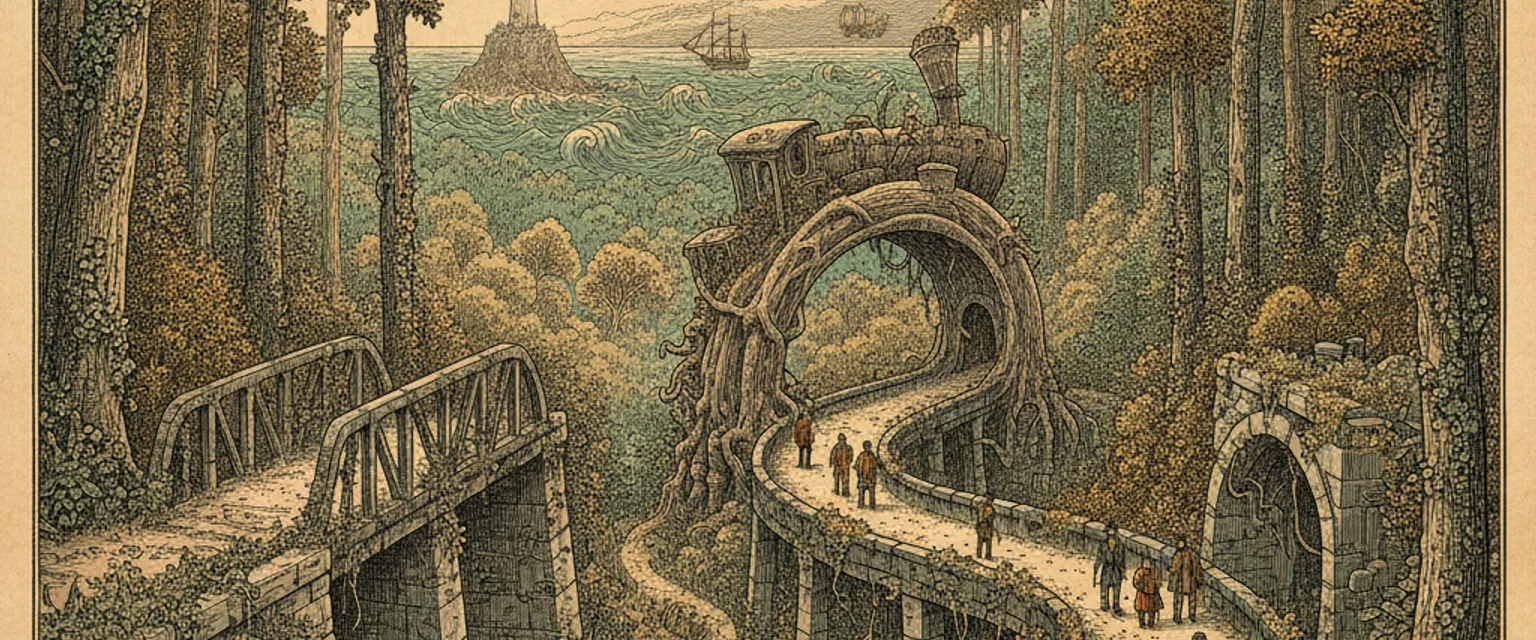
If the tunnels go through the landscape, the viaducts soar over it. These are the showpieces — long curving arcs of brick or stone striding across a valley on twenty arches, and you walk right along the top with the whole county laid out below. The first time I crossed one, somewhere in Wales, I actually stopped talking mid-sentence. Just stood there. A hundred feet of air under me, a river the width of a shoelace down below, and a kestrel hanging dead still in the wind at eye level.
There’s no fence in some places, or barely one. Mind the edge with kids and dogs. But honestly the slight unease is part of why it lands so hard.
How to find the good ones
This is where people go wrong — they search “walks near me” and get the same five overcrowded routes. To find rail trails specifically, try:
- Look for path names with “Way”, “Trail”, “Greenway”, or the old railway company’s name in them. “The Tarka Trail”, “the Camel Trail”, that sort of thing.
- Old Ordnance Survey or topographic maps show disused lines as dashed black lines, often labelled “dismantled railway”. If a footpath traces one of those for miles, dead straight or gently curving — that’s your route.
- The country’s rail-trail charity (most countries have one now) keeps proper lists. In the States it’s the Rails-to-Trails Conservancy, and their map is the single best resource I’ve found anywhere.
And here’s a tell from the map alone: if a path is suspiciously straight for miles, ignoring the contours, cutting through hills instead of going around them — that’s almost certainly an old line. Roads wiggle. Footpaths wander. Railways commit.
Why they get under your skin
I think it’s the ghosts, honestly. Not literal ones (probably). But you walk down a cutting and you pass a crumbling platform with grass growing through it, a faded enamel sign, the stub of a signal post, and you can feel the absence of everyone who used to be here. Commuters, mail bags, soldiers going off to wars, schoolkids. All gone. And what’s left is yours, just for an afternoon, quiet and flat and green.
Find your nearest dismantled line. Walk it slowly. Let it be a bit sad. It earns it.
Go find the dashed black line on the map. That’s where the good walk is hiding.
This article contains affiliate links marked rel="sponsored". We may earn a commission at no extra cost to you.