
[ DISCOVERY · THE DISPATCH ]
The Last Wild Train Lines Where the View Is the Whole Point
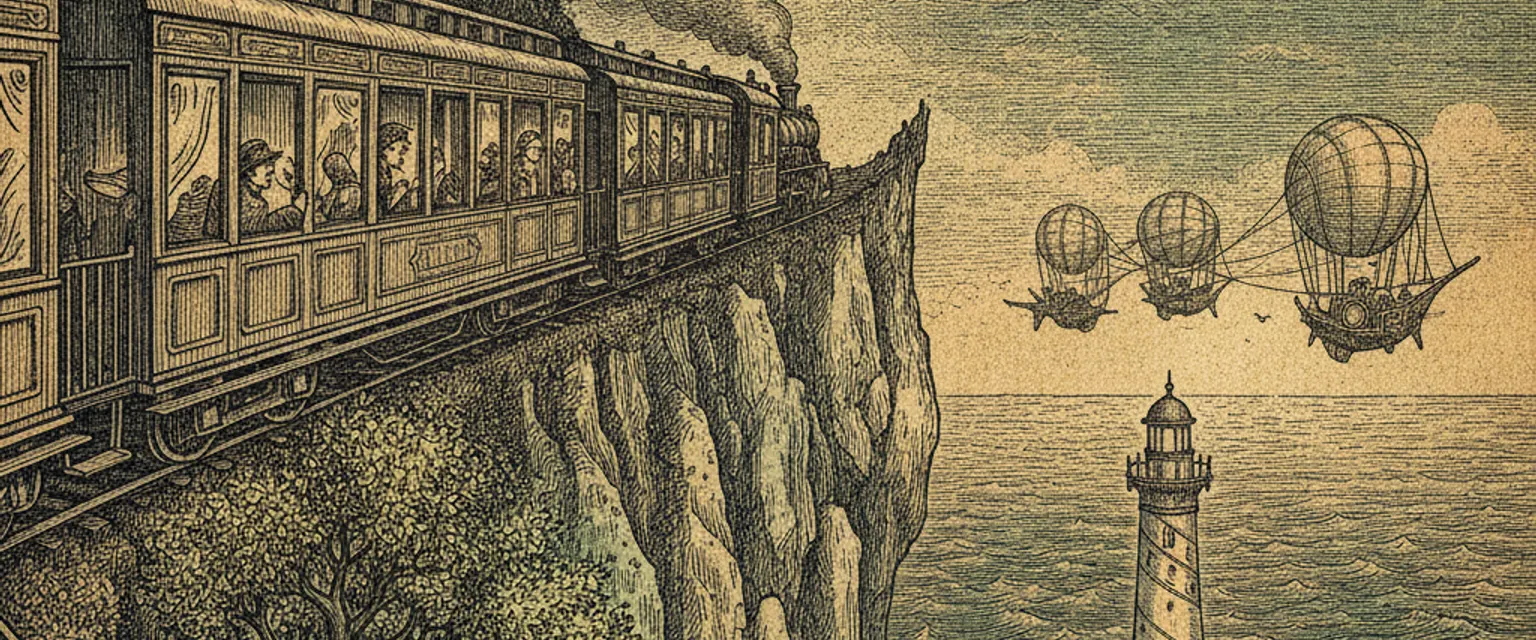
Not the famous luxury routes with the white tablecloths. The rickety, vertigo-inducing, gorgeous lines that locals actually use and Instagram somehow hasn't strip-mined yet. Pack a window seat and low expectations of comfort.
The conductor on the train out of Kandy was eating a curry off a banana leaf and offered me some without looking up. Outside the open door — there is no door, really, just an absence where a door philosophically should be — the hill country of Sri Lanka was unspooling in green terraces, tea pickers waist-deep in the bushes, the whole train leaning into a curve so I could see its own front end snaking ahead. People hung out of the carriage with their feet over the tracks. Nobody mentioned safety. It was perfect.
That ride taught me the difference between a scenic railway and a train as theme park. The famous luxury routes — the ones with the champagne and the marketing budget — are lovely, but they sell you the view back at a markup. The lines I love are the ones locals ride to get to work, where the spectacular scenery is just a side effect of the mountains being in the way. Here are the wild ones.
The blue train through Sri Lankan tea country
The line from Kandy to Ella in Sri Lanka’s central highlands is, for my money, the most beautiful budget train ride on earth, and a second-class ticket costs about the price of a coffee back home. The old British-built track climbs through Nuwara Eliya’s tea estates, past the Nine Arches Bridge — a colonial-era stone viaduct the train curves dramatically across, which has become a quiet pilgrimage spot — and into misty hills that look painted.
The trains are slow, often late, and gloriously open. You can stand in the doorway with the wind in your face (carefully — people do fall), buy fried snacks from vendors who board at every station, and watch the country tilt past at the speed of a brisk walk.

The “Devil’s Nose” switchbacks of Ecuador
In the Andes near Alausí, Ecuador, there’s a stretch of railway called the Nariz del Diablo — the Devil’s Nose — that solves an almost impossible problem of geography with sheer audacity. To descend a near-vertical 800-meter rock face, the line zigzags in a series of switchbacks, the train advancing forward then reversing down to the next level, clawing its way down the mountain in a series of stomach-dropping tacks.
It was built at brutal human cost in the early 1900s and is the kind of engineering that feels less like transport and more like a dare. The view straight down off the side of the carriage is not for everyone. It’s exactly for some of us.

A mountain line that survived a war
Bosnia’s railway from Sarajevo to Mostar threads through the Neretva river canyon, a route of tunnels and bridges hugging an absurdly turquoise river through limestone gorges. It’s a normal domestic train — locals commute on it, the carriages are nothing fancy — but the scenery through the Neretva valley rivals anything in the Alps, and for a fraction of the price and almost none of the crowds.
What gets me about this one is its quiet resilience: this is a country that was at war within living memory, and the line runs through some of the most scarred and beautiful terrain in Europe, carrying ordinary people about their ordinary days past extraordinary views. No tour group has discovered it yet. Go before they do.
The toy train into the Himalayan clouds
The Darjeeling Himalayan Railway in India — affectionately the “Toy Train” — is a narrow-gauge line that has been chuffing up to the hill station of Darjeeling since 1881, hauled in parts by actual steam locomotives. It climbs through tea estates and pine forest, looping back on itself at the Batasia Loop, often running so close to the road and shops that you could lean out and buy fruit.
It’s slow to the point of comedy — you could sometimes walk faster — and that’s the point. This is a UNESCO World Heritage line where the journey is the entire destination, and the moment the clouds part to reveal Kangchenjunga, the third-highest mountain on earth, hanging above the town, justifies every minute of the crawl.
The flåm detour most people get wrong
Norway’s Flåm Railway gets called one of the world’s most beautiful, and it is — a steep branch line plunging past the Kjosfossen waterfall into a fjord valley. But here’s the insider move: everyone rides the tourist-packed Flåm line and stops there. The genuinely wild stretch is the main Bergen Line it connects to, crossing the bleak, gorgeous Hardangervidda plateau — Europe’s largest high mountain plateau — a stark, snow-streaked moonscape that most tourists sleep through because it’s not the famous bit. Stay awake for the plateau. That’s the part nobody photographs.
Why bother with the rickety ones?
Because a train where the view is the whole point doesn’t need a tasting menu to justify itself. The lines on this list are cheaper, emptier, and more honest than the marquee luxury routes, precisely because they were built for locals and not for the gram. You sit by an open window, the country does the work, and you arrive somewhere having actually watched the distance pass instead of cruising over it at 38,000 feet. Book the window seat. Skip the white tablecloth.
Quick Q&A
Which is the best budget scenic train ride? Sri Lanka’s Kandy-to-Ella line. Second class costs almost nothing and the tea-country scenery rivals routes that charge hundreds.
Are these remote train lines safe for tourists? Generally yes — they’re regular passenger services locals use daily. The main risk is the local habit of riding in open doorways, which is on you, not the railway.
Do I need to book in advance? For popular reserved carriages like Kandy–Ella, book a few days ahead. Most of the others are walk-on local services where you simply buy a ticket at the station.
This article contains affiliate links marked rel="sponsored". We may earn a commission at no extra cost to you.