
[ GUIDE · THE DISPATCH ]
Getting Around Bangkok: BTS, MRT, Boats, and Why You Should Fear the Traffic
Getting around Bangkok is a choice between gliding above the gridlock or sitting in it for an hour. Here's how I use the Skytrain, the river boats, and the canal shortcut locals love, plus the tuk-tuk scam to dodge.
For the full day-by-day version of everything below, read the how to spend 3 perfect days in Bangkok.
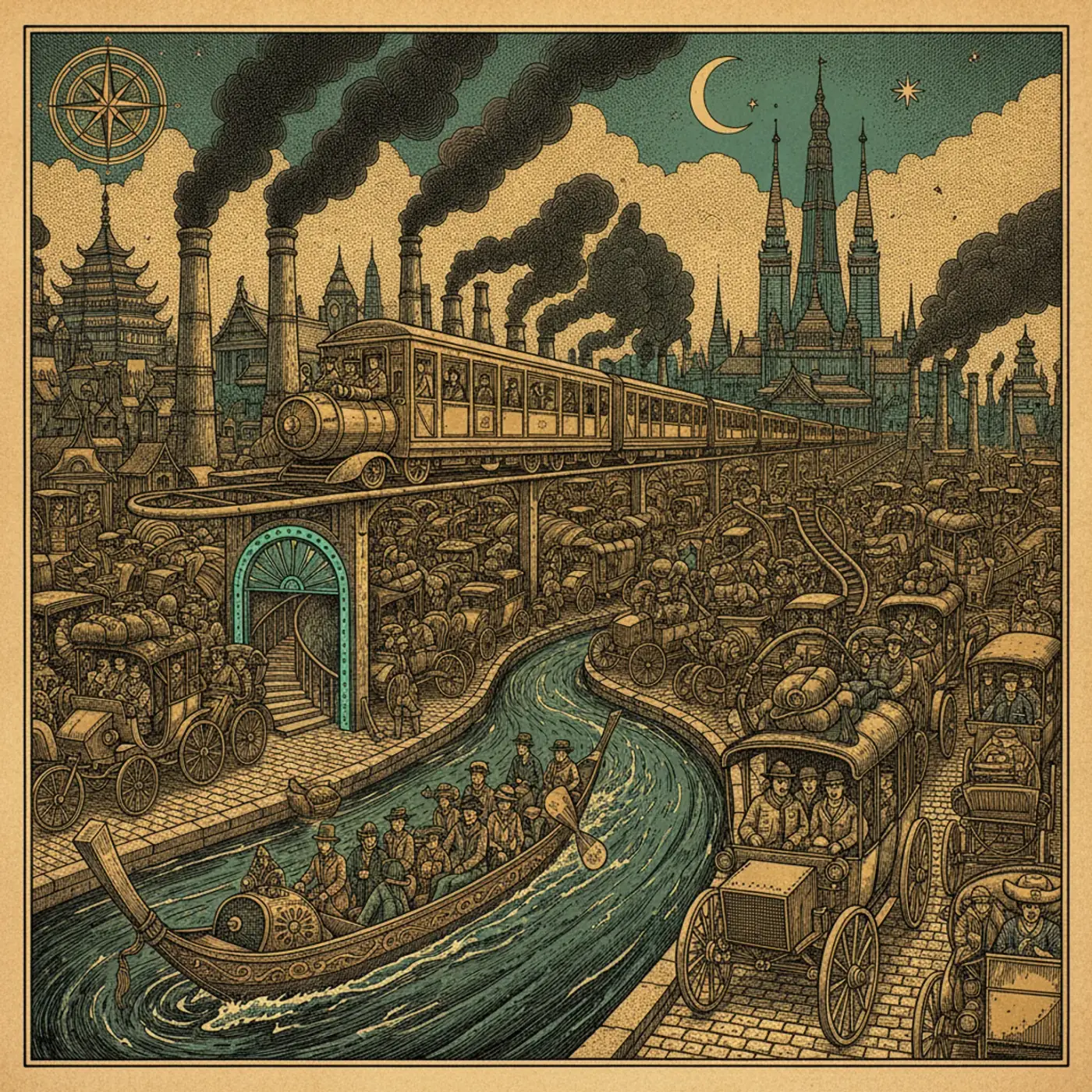
Getting around Bangkok is really one decision repeated all day: above the traffic, or in it? Above means the BTS Skytrain and the MRT, cool and fast and weirdly serene over a city that’s losing its mind at street level. In it means a taxi or tuk-tuk inching through a heat-shimmering wall of brake lights while your meter, or your patience, runs out. I lived there for a stretch. I learned to fear the road. You should too, gently.
Here’s how to move.

The Skytrain and metro are your best friends
The BTS Skytrain runs on raised tracks high above the road (the Sukhumvit and Silom lines) and it is air-conditioned, frequent, cheap, and it sails right over the gridlock you’d otherwise be trapped in. The MRT is the underground metro and connects to the BTS at a few key stations like Asok/Sukhumvit and Sala Daeng/Si Lom. Between the two of them you can reach most of the modern city, the malls, the nightlife, Chatuchak market, without touching a road.
Buy a Rabbit card for the BTS if you’re staying more than a day or two, it saves fumbling for change at every gate. The MRT uses its own little tokens or its own card, annoyingly, the two systems still aren’t fully unified, but for short visits just buy single rides and don’t overthink it.
The one gap: the old town, the Grand Palace and Wat Pho and Khao San Road, isn’t on the Skytrain. For that, you go to the river.

Boats: the cheat code most tourists miss
The Chao Phraya river is a working highway, and the boats on it are the fastest way to reach the old city. The key one is the orange-flag express boat. It’s the local commuter line, it costs a pittance (around 15–16 baht a hop), and it stops at all the sights that matter. Get off at Tha Tien (N8) for Wat Pho, or Tha Chang (N9) for the Grand Palace.
There’s also a blue-flag “tourist boat” with English commentary that costs several times more. It’s fine, but you don’t need it, the orange boat goes to the same piers. Save the money.
Tuk-tuks, taxis, and the scams to dodge
Tuk-tuks. Look, they’re fun, do it once. But they are not cheaper than a metered taxi and the driver will not use a meter, you negotiate, and you will lose. For a short hop, fine. For getting somewhere, no.
And here’s the scam, the famous one: a friendly tuk-tuk driver offers you a “tour” of three temples for 20 baht, basically free. It is not a tour. It is a slow drive to a “government gem shop” or a tailor where he gets a commission for delivering you, and you’ll waste an hour being hard-sold a fake sapphire. If anyone offers a too-cheap tour, or tells you the Grand Palace is “closed today, special Buddha day,” walk away. It’s open. It’s a hustle. The first time a guy told me the palace was shut I almost believed him, he was so cheerful about it.
For actual taxis, get in, then say “meter, please.” If they refuse the meter, get out. Grab (the rideshare app, like Uber) works great in Bangkok and removes the whole haggle, I use it for anything off the rail lines, especially in the heat or after a few beers.
A sane day, mapped
This is how it actually slots together. Skytrain or MRT to get across the modern city. Walk to the river when you want the old town. Orange boat up and down the Chao Phraya for the temples. Canal boat when you want to cut across fast. Grab for the awkward gaps and the late nights. Almost never a tuk-tuk for transport, only for the novelty.
A note on timing, because it changes everything here. Rush hour in Bangkok, roughly 7–9am and 4–7pm, turns the roads to concrete, and the Skytrain platforms get genuinely packed too, you may have to let a train or two go by before you can squeeze on. Plan your road-based trips, the airport run especially, outside those windows if you possibly can. And the heat. It is relentless from late morning, so I lean on the air-conditioned BTS and MRT in the worst of the day and save the boats and walking for early morning and evening when it’s bearable.
The airport, quickly, since first-timers stress about it. Suvarnabhumi (the main one) connects to the city by the Airport Rail Link, a cheap, fast train that dodges all the road traffic, take it, especially in rush hour when a taxi could crawl for ninety minutes. Don Mueang (the budget airport) is trickier, with bus and limited rail options, so a Grab or metered taxi is usually the call from there, just allow extra time. Either way, never let a tout in the arrivals hall arrange your ride.
Do that and Bangkok shrinks to a manageable, even pleasant size. Ignore it, default to taxis, and you’ll spend half your trip motionless on Sukhumvit Road watching a man sell garlands between the lanes, wondering where the day went.
The traffic here isn’t a nuisance, its a force of nature. Plan around it the way you’d plan around weather. Go over it, go on the water, and only go through it when you’ve got no other choice.
Tap onto the Skytrain, hop the orange boat, brace on the canal boat, and let the people stuck in the cabs envy you. That’s getting around Bangkok done right.
This article contains affiliate links marked rel="sponsored". We may earn a commission at no extra cost to you.