
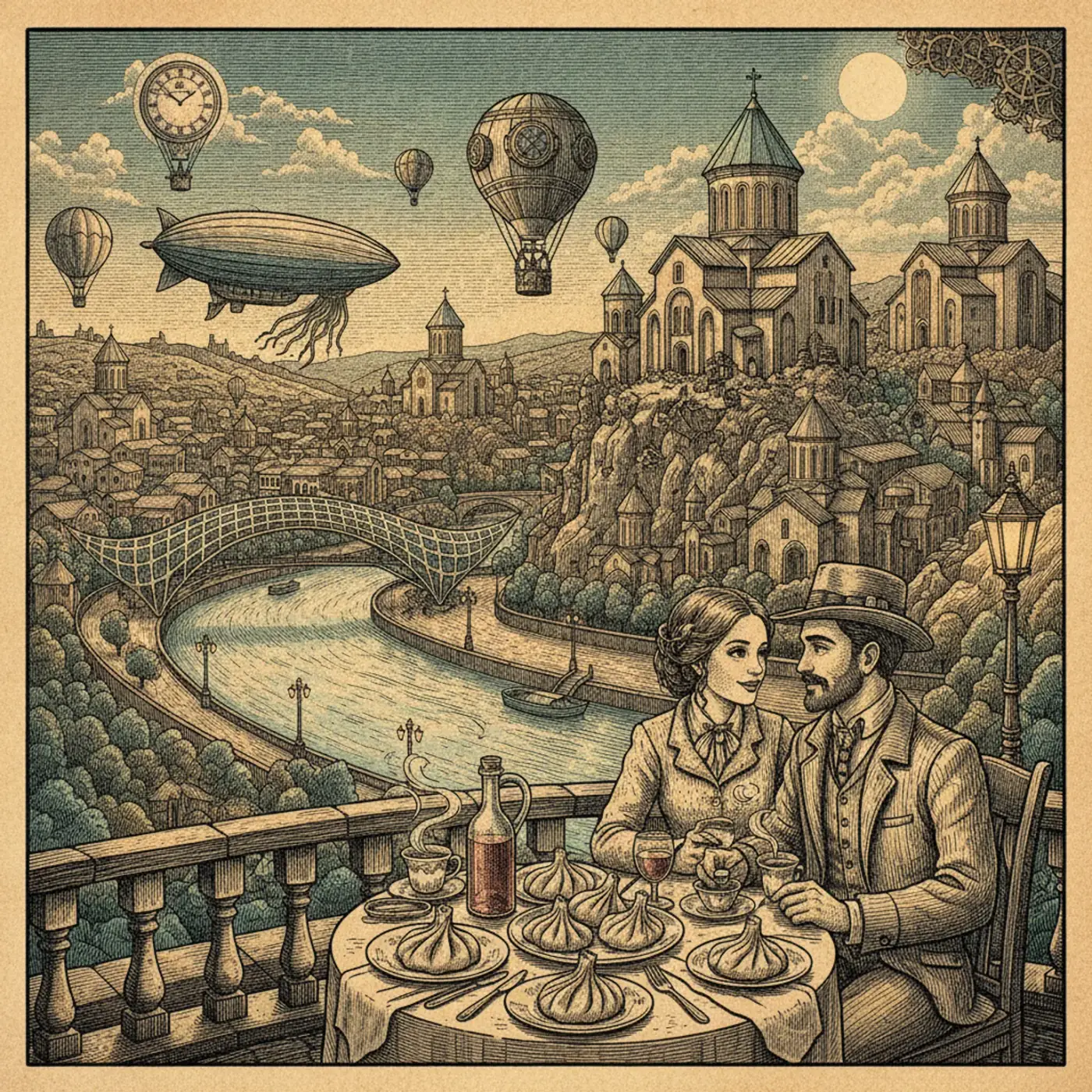
[ ITINERARY · THE DISPATCH ]
Four Days in Tbilisi: Wine, Khinkali, and a Surprising Number of Churches
Tbilisi is one of those cities that sneaks up on you — you arrived for a weekend, you've booked a return flight, and somewhere along the way you ate your weight in khinkali and learned the correct way to hold a wine horn.
I had my first khinkali in a basement restaurant in Tbilisi’s Old Town at 11pm on a Tuesday, after a Georgian man at the next table noticed I was eating mine wrong (with a fork, apparently a cardinal sin), leaned over without being asked, and demonstrated the correct technique: hold the dumpling by the top knot, bite a small hole, drink the broth first, then eat everything except the knot itself. He watched to make sure I did it right. I did. He nodded. We did not exchange another word. It was the most educational twenty seconds of my trip.
Tbilisi operates at its own frequency. Four days feels like the right amount of time to start understanding it — and just barely not enough to want to leave.

Day 1: Old Town, Narikala, and the Sulfur District
The Old Town (Kala) is best experienced on foot, slowly, without a plan. The signature wooden balconies — ornately carved, painted in faded blues and greens, hanging over narrow alleys — are everywhere, and so are cats. Many cats. Friendly cats who have made a permanent settlement in every sunlit corner.
Work your way uphill to Narikala Fortress, the ruined Persian-era citadel that overlooks the city. The views here over the Kura River and the church-dotted hillsides are the image of Tbilisi you’ve seen in every travel photograph, and they are absolutely worth the climb.
Descend via the gondola or on foot to the Abanotubani sulfur bath district. The domed bathhouses have been operating since at least the 17th century and the water, piped naturally from underground thermal springs, smells strongly of eggs. You will either love this or you will not. Book a private room at Orbeliani Baths — the blue tile facade is the most photographed building in the city, and the soak is genuinely excellent.

Day 2: Wine Country Detour or In-City Deep Dive
| Option A: Kakheti Day Trip | Option B: City Wine & Culture | |
|---|---|---|
| Morning | Minibus to Sighnaghi (2.5 hrs) | Georgian National Museum |
| Afternoon | Winery visit + amber wine tasting | Shardeni Street wine bar crawl |
| Evening | Return to Tbilisi for dinner | Khinkali dinner in Sololaki |
| Best for | Wine enthusiasts, nature lovers | City-focused, no early starts |
Georgia invented wine — or at least, is the oldest continuous wine-making culture on record, stretching back 8,000 years. The traditional method, qvevri, involves fermenting wine in large clay amphorae buried underground. The result is amber wine (skin-contact white), which is funky, complex, and nothing like the whites you know.
You can experience this in the city — Vino Underground on Galaktion Tabidze Street is a legendary natural wine bar — or take a day trip to Kakheti, the main wine region, two hours by shared minibus.
Dinner both options: Pasanauri restaurant for a definitive khinkali spread. Order the meat-filled ones, the cheese ones, and the mushroom ones. Order more than you think you need.

Day 3: Rustaveli Avenue and the Flea Market at Dry Bridge
Rustaveli Avenue is Tbilisi’s grand boulevard and cultural spine. The Georgian National Gallery and State Philharmonic both sit along it, along with Soviet-era architecture in various states of renovation.
The Dry Bridge Market is the real draw of the morning — a sprawling flea market where Soviet memorabilia, oil paintings, handmade jewellery, and random Soviet kitchenware all live side by side. Arrive early. Bargain without being aggressive. Leave with something you didn’t know you needed.
Afternoon: the Botanical Garden sits in a gorge directly behind Narikala and provides a green, quiet counterpoint to the city’s noise. Entry is cheap, the waterfall at the back is real, and almost no one is there.
Evening: Fabrika, a repurposed Soviet sewing factory turned creative hub with an outdoor courtyard of food trucks, bars, and a hostel. It shouldn’t work as well as it does. It absolutely works.

Day 4: Mtatsminda and the Long Farewell
Take the Mtatsminda funicular up to the hilltop park above the city. The park is pleasantly Soviet in character — a Ferris wheel, a small amusement area, and views that stretch over the entire Tbilisi basin. Drink a coffee at the top with no agenda.
Work back down through Sololaki, the elegant 19th-century quarter, stopping at the Anchiskhati Basilica (the oldest surviving church in Tbilisi, 6th century, impossibly small, completely beautiful) before a final lunch of mtsvadi (Georgian skewered meat, grilled over vine cuttings) at a garden restaurant.
Do I need to know Georgian or Russian? Georgian script is genuinely baffling and not related to any other alphabet. Menus often have pictures or English. Google Translate’s camera mode handles the rest.
Is Tbilisi safe? Very much so — it consistently ranks among the safest cities in the former Soviet sphere. Basic urban awareness applies; nothing unusual.
How expensive is Tbilisi? Budget travel heaven. A sit-down meal with wine: €8–15. Private bath soak: €10–15. A good hotel in Old Town: €40–80/night.
This article contains affiliate links marked rel="sponsored". We may earn a commission at no extra cost to you.