
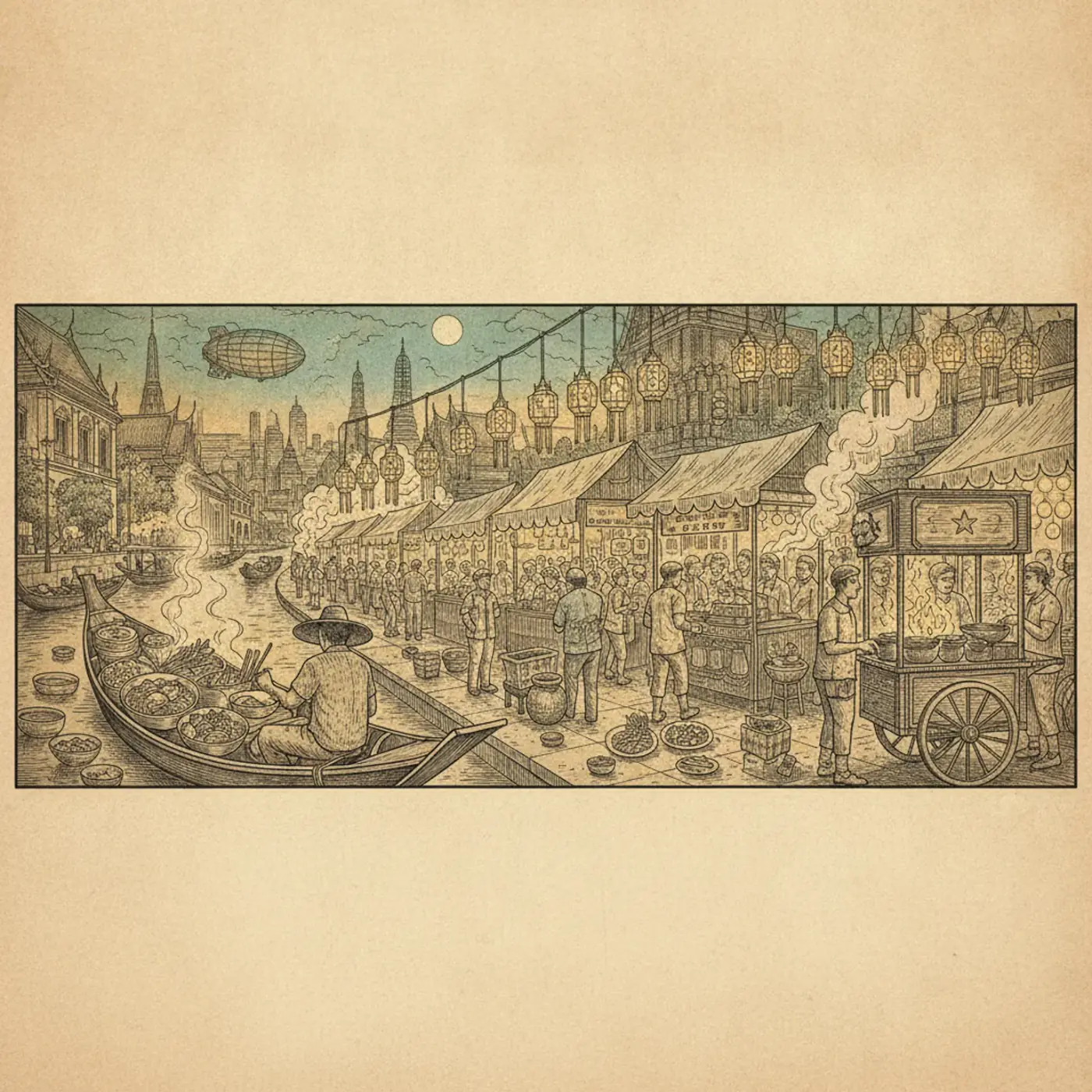
[ ITINERARY · THE DISPATCH ]
The Foodie 3-Day Bangkok Itinerary: Boat Noodles, Night Markets, and a Michelin Street Cart
Three days in Bangkok, mapped entirely by what you'll eat — boat noodles, a green-curry hole-in-the-wall, and that Michelin-starred street cart everyone queues two hours for. Come hungry.
For the full day-by-day version of everything below, read the perfect 3-day Bangkok itinerary.
I’ll level with you: my 3 days in Bangkok were not about temples. I saw exactly one. The rest of the time I ate, and ate, and then ate again, because Bangkok is the best street-food city on earth and treating it as anything else is a waste of stomach space. This is an eating itinerary. Wear stretchy trousers.
The golden rule first: eat little and often. Six tiny meals beat two big ones here, because every stall does one thing brilliantly and you want to hit as many as you can. A bowl of noodles, walk it off, a skewer, walk it off, repeat. Your wallet won’t even notice — most of this is one or two dollars a plate.

Day 1: Old town, the classics, and a Michelin cart
Start in Banglamphu / the old town. Morning, get jok (rice congee) from a street stall for breakfast — comfort food, maybe 40 baht, with an egg cracked in and ginger on top. Then yes, fine, see Wat Pho with the giant reclining Buddha, because it’s near and it’s extraordinary and you can’t only eat. (You can almost only eat.)
Lunch: pad thai, but do it properly at Thip Samai on Maha Chai Road — the legendary one, wrapped in egg. There’s usually a queue. It moves. Around 60-120 baht and worth the wait.
Then the big one. Evening, head to Jay Fai on Maha Chai. This is the street cart that got a Michelin star — an elderly woman in ski goggles cooking over charcoal at her wok. The drunken noodles and especially the crab omelette (a fat golden roll absolutely stuffed with crab) are the dishes. The catch: the wait can be hours and the crab omelette runs 1,000+ baht, which is wild for street food but it’s a one-off. You can call ahead to book a slot now — do it, it’ll save you a two-hour pavement vigil.
Day 2: Boat noodles, markets, and the great graze
Morning, go to the Victory Monument boat-noodle alley (Sukhothai Soi 7 area, the canalside spots). Boat noodles — kuay teow reua — are tiny intense bowls of dark, rich broth, historically served from boats, now from stalls. They’re about 15-25 baht a bowl. The whole tradition is to eat several. People stack their empty bowls into towers. Order four to start. Pork or beef, with the crispy bits. This was my single best meal in the city and it cost less than a coffee back home.
Afternoon, hit a market. If it’s a weekend, Chatuchak is the giant one — get a coconut ice cream there to survive the heat. Any day, Or Tor Kor market near Chatuchak is a foodie’s dream: gorgeous produce, curries, fruit you’ve never seen. Try mangosteen and rambutan and, if you’re brave, durian (it smells like a gym bag and tastes like custard heaven, don’t knock it).
Evening is night-market time. Skip the tourist-heavy ones and find a local night market — grilled skewers (moo ping, sticky pork on sticks, 10 baht each), som tam (green papaya salad, ask for “phet nit noi” = a little spicy unless you’ve got an asbestos mouth), and mango sticky rice for pudding. Graze for two hours. This is the soul of the city.

Day 3: Curry, river, and a proper sit-down
By day three you’ll have eaten enough standing up. Have a real lunch. Find a small curry shop — the kind with trays of pre-made curries you point at over rice (raad kao). A green curry or a southern-style massaman, maybe 60 baht, a plate piled high. These point-and-eat shops are everywhere and never wrong.
In the afternoon, take a river boat — the Chao Phraya express boat is cheap public transport and a brilliant way to see the city for about 15 baht. Get off near a riverside spot for a coffee or a Singha beer and watch the longtails roar past.
For your last dinner, treat yourself a little. A khao soi (northern curry noodle soup) if you can find a good one, or a plate of grilled river prawns. Then one final mango sticky rice, because you’re leaving and you’ll regret it if you don’t.
Two practical notes. Carry cash in small notes — most stalls don’t do cards. And if a place is packed with Thai people eating, that’s your sign; if it’s empty with a big English menu and photos of the food, keep walking.
Three days, maybe twenty meals, and I think I spent more on the one Michelin omelette than on everything else combined. That’s Bangkok. The cheapest food is the best food. Go hungry, stay hungry, leave heavier.
Eat where the locals queue, order one more bowl than you think you need, and don’t you dare skip the boat noodles. Bangkok’s whole genius is on a 25-baht plate.
This article contains affiliate links marked rel="sponsored". We may earn a commission at no extra cost to you.