
[ LISTICLE · THE DISPATCH ]
6 Things I Wish I'd Known Before Renting a Car in Iceland
I drove Iceland's Ring Road without knowing half of what I should have. Here's the list I wish someone had handed me at the rental counter in Reykjavik.
For the full day-by-day version of everything below, read the how to spend 3 perfect days in Reykjavik.
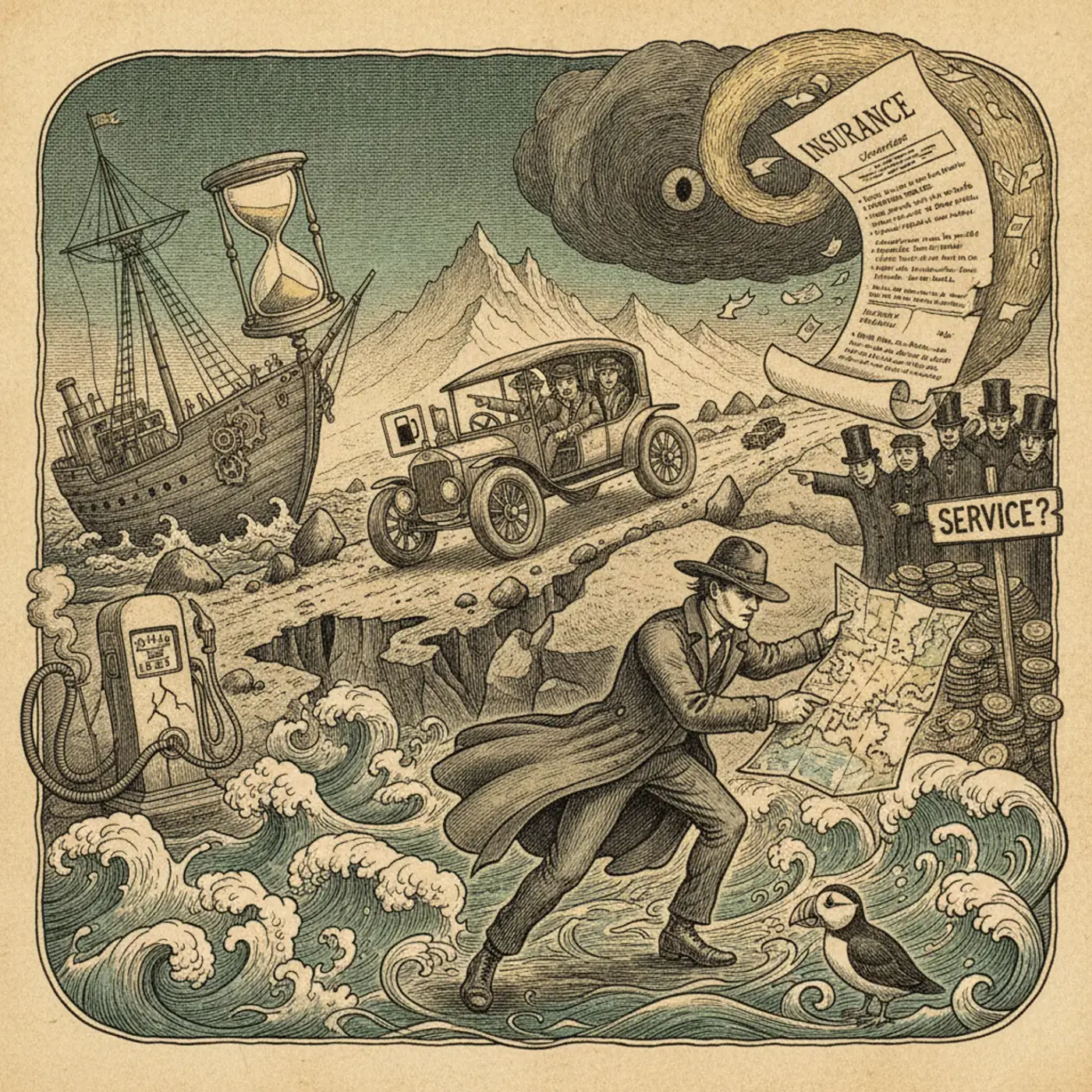
The woman at the Reykjavik rental counter asked me, with a perfectly pleasant expression, if I wanted to add gravel protection. I said no, confident that my credit card coverage would handle anything Iceland threw at me. Three days later I was standing on a highland track outside Vík photographing a stone chip in the windscreen the size of a thumbprint, doing the maths in my head. Reader, the maths was bad.
If you’re deep in the pre-trip research phase for an Iceland self-drive, this is the list I needed. Not the generic stuff — the actual gaps between what you think you know and what Iceland will cost you if you’re wrong.

1. Your Credit Card “Covers Everything” — Except It Probably Doesn’t
I’ll start here because it’s the one that stings most people. Yes, many premium credit cards offer collision damage waiver (CDW) for rental cars. What they almost never cover in Iceland: gravel damage, sand and ash damage, and wind damage. These are separate line items on every Icelandic rental agreement, and they exist because Iceland has specific hazards that don’t appear in the standard international car-rental risk model.
Gravel damage covers chips and cracks from the unpaved roads — and there are a lot of unpaved roads, including some you’ll accidentally turn onto on your way somewhere else. Sand and ash protection matters in the south and east where volcanic black-sand plains create airborne debris that can strip paint from a car. Wind damage is exactly what it sounds like: in winter especially, gusts can rip open a car door and bend it back on its hinges.
Before you leave home, call your credit card company and ask specifically about those three. Get the answer in writing. If the answer is “not covered,” budget roughly 2,000–3,500 ISK per day (roughly 14–25 USD at mid-2026 rates) to add them at the counter. Worth every króna.
2. F-Roads Are Not Just “Rougher Roads”
Iceland’s F-roads — the highland tracks prefixed with F on maps — are legally restricted to 4x4 vehicles with high clearance. This isn’t advisory. If you rent a small economy car and drive an F-road, your insurance is voided entirely. Your rental agreement will say this in plain language. You will owe the full cost of any damage.
The tricky part is that some F-roads are not obviously marked on Google Maps. I nearly drove the F208 to Landmannalaugar in a standard Duster because the map showed it as a road and I hadn’t zoomed in far enough to catch the “F” prefix. It was another driver who flagged me down and pointed at my tyres.
For the Ring Road and most popular day trips from Reykjavik, a standard AWD or even a 2WD suffices in summer. But if your itinerary includes Landmannalaugar, Askja, Kerlingarfjöll, or Þórsmörk, you need a proper 4x4 — and you need to book it early because they sell out.
3. Fuel Stations Are Further Apart Than Any Map Suggests
Iceland has roughly 350,000 people spread across a country the size of Kentucky. The road network outside the capital reflects this. On the eastern Ring Road between Höfn and Egilsstaðir, you are looking at about 170 km without a fuel station. That’s not a detour — that’s the main road.
The rule I adopted after the first near-miss: fill up every single time I saw a fuel station, regardless of how much was in the tank. Even if I’d just filled up 40 km back. Even if the gauge was at three-quarters. It felt obsessive and it was absolutely the right call.
N1 is the main fuel network and their app shows station locations. Many stations in smaller villages are unstaffed and require a credit card with a PIN — Icelandic pumps often don’t accept foreign cards without chip-and-PIN, so carry a backup card and test it before you need it.

4. The Weather Forecasts Are Right. Take Them Seriously.
I have traveled in a lot of places where locals say “oh the weather forecast is useless, just go anyway.” Iceland is not one of those places. The Veður app (the Icelandic Met Office) is genuinely accurate and it uses a color-coded road hazard system. Yellow is caution. Orange is consider not going. Red means the road is closed or impassable and the system is telling you in plain terms to stay put.
I met a couple in Vík who had driven into a yellow warning because they “only had one day left.” They arrived, couldn’t get out of the car safely in the wind, sat in the carpark for two hours, and drove back. The landscape was invisible in horizontal rain. They missed Reynisfjara entirely.
The Safetravel.is website also has real-time road condition alerts. Bookmark both before you leave Reykjavik. Check them every morning. This isn’t me being dramatic — it’s the literal advice of the Icelandic Road and Coastal Administration.
5. Headlights On. Always. It’s the Law.
This one is simple and easy to forget: Icelandic law requires headlights to be on at all times while driving, day and night, year round. Most modern rental cars have automatic lights and will handle this for you. But if you’re in an older vehicle or one where you’ve accidentally switched to position lights instead of full headlights, you can get fined.
Worth checking the moment you pull out of the rental lot, before you’re halfway to the Blue Lagoon trying to remember if your lights are on.
6. You Can’t “Wing It” in Peak Season
July and August in Iceland are not a secret. The Ring Road campsites fill by mid-afternoon. The popular waterfall carparks — Skógafoss, Seljalandsfoss, Dyrhólaey — can have queues. Accommodation in the east and north can genuinely sell out weeks in advance.
The joy of a self-drive is flexibility, but flexibility in Iceland means having your accommodation booked and having a rough daily plan while staying loose on the details within each day. I did the Ring Road in September which helped — fewer people, more space, cheaper rates — but even then I was scrambling for beds in Mývatn because I’d left it too late.
If you’re building your base itinerary before the road trip kicks in, the Reykjavik itinerary hub is the best place to start — it covers where to stay, what to skip, and how many days you actually need before you hit the road.
For more European self-drive inspo, the Europe itineraries section has destinations that require the same kind of methodical planning Iceland does.
And if you like the off-script approach to travel — showing up somewhere and deciding what you actually care about rather than what the algorithm says you should care about — you might enjoy this piece on two weeks in Japan refusing to visit any temple, which is a different country but the same energy. Or if you’re drawn to visually interesting cities done properly, the Marrakech design-obsessed itinerary and the Japan-beyond-the-obvious guide are both worth your time before you go somewhere that definately requires more research than you think.
The real answer to “what do I wish I’d known” is simpler than any individual item on this list: Iceland is a place where the stakes of being underprepared are higher than almost anywhere else in Europe, and the rewards of being well-prepared are proportionally spectacular.
Do the research, buy the gravel insurance, and fill up the tank — the rest takes care of itself.
This article contains affiliate links marked rel="sponsored". We may earn a commission at no extra cost to you.