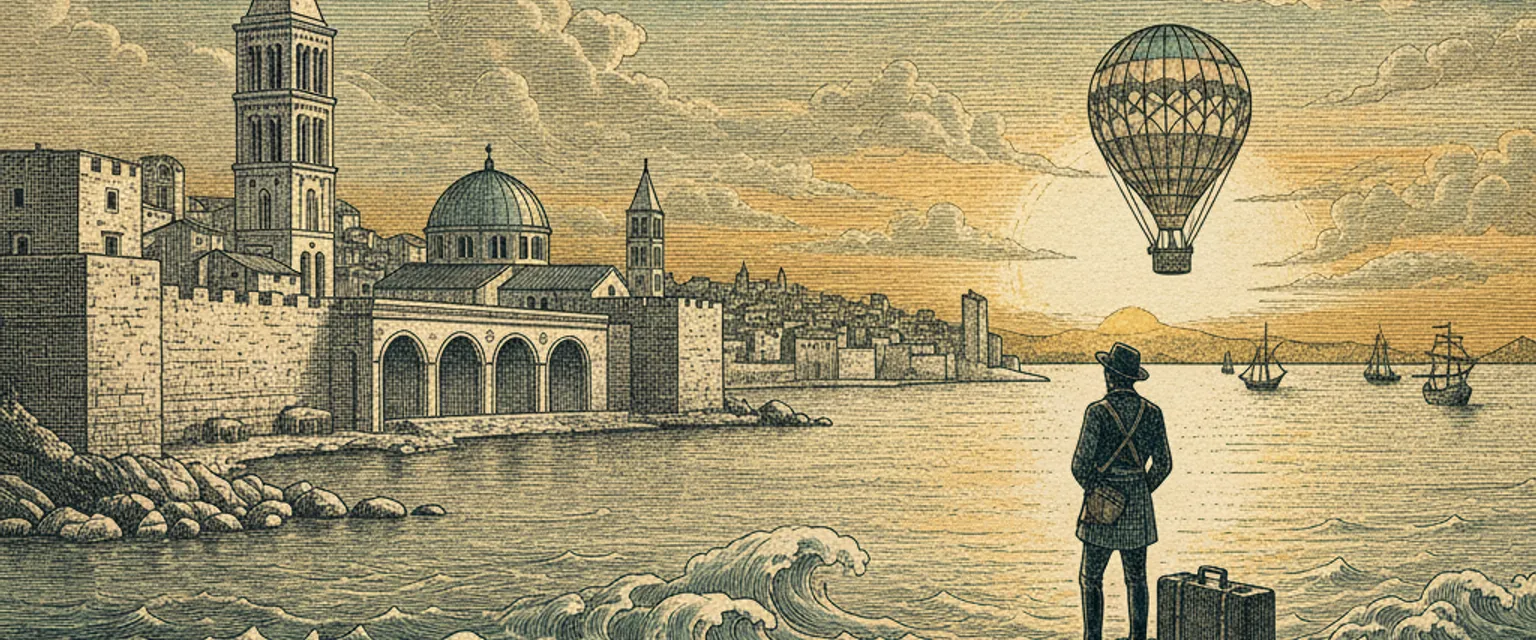
I got hopelessly lost on my first night in Split, which turns out to be the whole point. I had walked in through a gate looking for my apartment and suddenly I was inside a Roman emperor's living room, except it was full of bars, washing lines, a busker singing klapa, and a cat asleep on a 1,700-year-old column. Diocletian's Palace is not a ruin you visit; it is a neighbourhood you wander into and cannot find your way out of. I gave up, ordered a glass of Plavac in a tiny stone courtyard, and decided I was in no hurry at all. Split does that to people.
Two days covers the essentials: wandering Diocletian's Palace, climbing the cathedral bell tower, a sunset hike up Marjan hill, and an evening stroll along the palm-lined Riva. Split is compact and made for aimless wandering, so a weekend gives you the living-museum heart of the city without rushing.
Do this one thing: hike up Marjan hill at sunset for the view back over the terracotta old town and the islands.
Adding an island day to Hvar
A third day buys you the fast catamaran to Hvar, the chic lavender island of stone streets, a hilltop fortress and some of Croatia's best swimming. You trade the city for sea, sun and a taste of Dalmatian island glamour, all an easy hour away by boat.
City, island and Krka's waterfalls
Four days adds a trip to Krka National Park's tumbling travertine waterfalls, plus time for the palace museums and a proper konoba dinner. My recommended length: enough to balance Split's Roman core with the nature and islands that make Dalmatia special.
Split as a base for the whole Dalmatian coast
A week opens the region: more islands (Brac and its Zlatni Rat beach, the Pakleni isles), the Roman ruins of Salona, the fortress town of Trogir, and lazy beach days. Seven days is for travellers who want to use Split as a launchpad for all of central Dalmatia.
Estimated budget:$300-$600
Estimated budget:$450-$900
Estimated budget:$600-$1200
Estimated budget:$1200-$2500
Day 1
Diocletian's Palace
Get lost inside a living Roman monument
Diocletian's Palace
A 4th-century imperial palace that is still a living city.
Built around 305 AD as the Roman emperor's retirement home, the palace is not a museum but the city's beating heart, packed with homes, bars and shops within its walls. Start at the Peristyle, the colonnaded central square, then drift through the labyrinth of marble lanes. Pop into the eerie underground cellars beneath.
Cathedral of St Domnius
A Roman mausoleum turned cathedral, with a climbable tower.
Diocletian persecuted Christians, so there is delicious irony in his octagonal mausoleum becoming one of the world's oldest working cathedrals. Climb the slender Romanesque bell tower for a vertiginous view over the old town's rooftops to the sea. The carved 13th-century wooden doors are a masterpiece worth lingering over.
The Riva Promenade
The palm-lined seafront where Split goes to stroll.
The marble Riva runs along the harbour beneath the palace's southern wall and is the social engine of the city. Join the evening passeggiata, grab a coffee or an Aperol at a waterfront table, and watch the ferries come and go. It is people-watching of the highest order, especially as the stone glows at sunset.
Day 2
Marjan & the City Beaches
A green hike and a swim with a view
Marjan Hill
Split's pine-covered peninsula and lookout park.
The forested Marjan peninsula is the city's lungs and best viewpoint. Climb the steps from Varos up to the Telegrin summit or the cafe at Vidilica for a panorama over the palace, the harbour and the islands. Tiny hermit chapels are tucked into the cliffs along the trails. Go early before the heat builds.
Bacvice Beach
The famous sandy city beach and home of picigin.
A short walk east of the centre, Bacvice is a rare sandy beach in pebbly Dalmatia, with shallow warm water. It is the birthplace of picigin, a local ball game played in the shallows that you will see all summer. Bars and cafes line the bay, so it doubles as a sunset spot once the swimmers thin out.
Dinner in Varos
Old fishermen's quarter konobas and Dalmatian classics.
Climb into Varos, the steep maze of old stone fishermen's cottages on Marjan's lower slopes, for the city's most atmospheric dining. Family-run konobas like Konoba Marjan or Konoba Fetivi serve grilled fish, octopus salad and peka, the slow-cooked-under-a-bell dish you must order hours ahead. Honest food, low prices, no tourist gloss.
Day 3
Hvar Island
The lavender island by fast catamaran
Hvar Town
Stone streets, a hilltop fortress and chic harbour cafes.
The fast catamaran reaches Hvar Town in about an hour. Wander the marble main square, the largest in Dalmatia, climb to the Spanish Fortress for a view over the Pakleni islands, and swim off the rocks. Hvar is Croatia's glamour island, so prices bite, but the light and the lavender-scented air are worth it.
Pakleni Islands Swim
Tiny offshore islets with the clearest coves.
Just off Hvar Town, a constant shuttle of small boats runs to the Pakleni archipelago, a scatter of low pine-covered islets ringed by impossibly clear coves. Palmizana has a sandy bay and good lunch spots; the smaller beaches are quieter. It is the perfect afternoon escape before catching the catamaran back to Split.
Day 4
Krka Waterfalls
Travertine cascades and forest boardwalks
Krka National Park
Tiered waterfalls you can walk above on boardwalks.
About an hour north of Split, Krka's series of travertine waterfalls tumble through a green river canyon. Wooden boardwalks loop above and beside the cascades at Skradinski Buk, the showpiece. Swimming near the falls is now restricted, so check current rules. Go early to beat the bus tours; the park gets very busy by late morning.
Sibenik
A handsome coastal town with a UNESCO cathedral.
On the way back from Krka, stop in Sibenik to see the Cathedral of St James, a UNESCO gem built entirely of interlocking stone with no mortar, ringed by 71 carved heads of ordinary 15th-century townsfolk. The steep old town below it is largely tourist-free and a lovely, low-key counterpoint to busy Split.
Day 5
Brac Island
Croatia's most famous beach
Zlatni Rat Beach
The shape-shifting golden horn of pebbles at Bol.
A short ferry to Brac and a bus or walk to Bol brings you to Zlatni Rat, the tongue-shaped pebble spit that appears on every Croatia postcard, its tip shifting with the wind and currents. The water is electric blue and great for windsurfing. Rent a sunbed, swim, and lunch in pretty Bol town behind the beach.
Skrip & Brac Stone
The island's oldest village and its famous white stone.
Inland, the ancient hilltop village of Skrip houses a small island museum and a sense of how Brac lived before tourism. The island's prized white limestone built Diocletian's Palace and, legend has it, parts of the White House. A quiet, authentic contrast to the beach crowds at Zlatni Rat.
Day 6
Trogir & Roman Salona
A walled island town and ancient ruins
Trogir
A UNESCO-listed medieval town on its own little island.
Half an hour west of Split, Trogir is a perfectly preserved walled town packed onto a tiny island, all Romanesque and Renaissance stone, linked to the mainland by short bridges. The Cathedral of St Lawrence and its carved Radovan portal are the highlights. Walk the seafront, climb the Kamerlengo fortress, and eat at a quiet konoba.
Salona
The ruined Roman capital of Dalmatia.
Between Split and Trogir lie the sprawling ruins of Salona, once the Roman provincial capital and Diocletian's birthplace. You can wander the amphitheatre, basilicas and necropolis largely alone among the cypresses and wildflowers. It is raw and unpolished compared to Split's living palace, which is exactly its charm.
Day 7
Markets & Farewell
One last slow morning in the city
Pazar Green Market
Split's noisy open-air fruit, veg and flower market.
Just east of the palace walls, the Pazar is a sprawling daily market of fragrant peaches, tomatoes, figs, cheese and flowers, where local nonnas haggle and the whole city does its shopping. Grab fruit for the road and soak up the unvarnished daily life. The nearby fish market, the Peskarija, is equally lively at dawn.
Matejuska Harbour
The old fishermen's harbour and a farewell sunset spot.
End where Split began as a fishing town: the tiny Matejuska harbour just off the western Riva, still lined with working boats. Locals gather on the breakwater at golden hour with a drink and their feet over the water. Pick up a beer from a nearby shop, find a spot on the stone, and say a slow goodbye to Dalmatia.
Split gets unfairly cast as the ferry port you pass through on the way to the islands, and that does it a real disservice. This is one of the most extraordinary city centres in Europe: an entire neighbourhood living inside a 1,700-year-old Roman palace, where you eat dinner against an emperor’s wall and hang your washing from a colonnade. It is loud, sun-baked, salty and completely unpretentious, a working Dalmatian city rather than a museum. And it happens to sit at the dead centre of Croatia’s best coast.
How to use this plan
Treat Split as both a destination and a base. Two days is enough to get gloriously lost in Diocletian’s Palace, climb the cathedral tower, walk the Riva and hike Marjan hill at sunset, which is the single view you should not miss. Three adds the fast catamaran to glamorous Hvar for an island day. Four, my recommended length, brings in Krka National Park’s tumbling waterfalls so you balance the Roman stone with Dalmatia’s nature.
The 7-day plan turns Split into a launchpad for central Dalmatia: the postcard beach at Zlatni Rat on Brac, the walled island town of Trogir, the ancient Roman ruins of Salona, and time for proper beach days. With a week you can travel at the islands’ own unhurried pace.
A few honest notes
Stay inside or right beside the palace walls if you can; the old town is the whole experience and it is magical early and late when the day-trippers have gone. Book the popular island catamarans (especially to Hvar) in advance in summer, as they sell out. Eat in the Varos quarter rather than on the main tourist drags, and order peka hours ahead if you want the local slow-cooked specialty. And do not over-schedule the islands; one well-chosen day beats three rushed boat trips, and Split itself rewards the time you give it.
This article contains affiliate links marked with rel="sponsored". We may earn a commission at no extra cost to you.