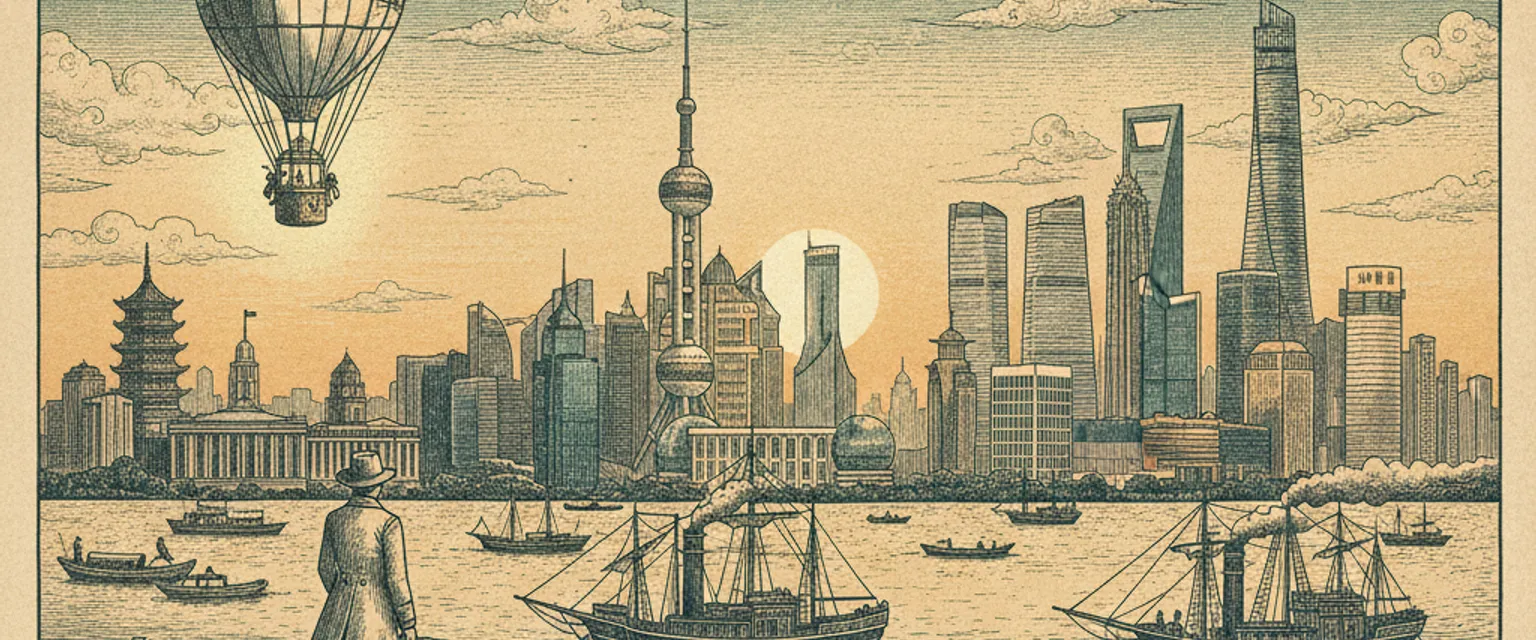
I stood on the Bund my first night in Shanghai and genuinely laughed out loud, because the skyline across the river looks less like a city and more like someone's idea of one — too tall, too bright, too obviously the future. Then I turned around and behind me were 1920s stone banking houses, gas lamps, and a string quartet drifting out of a hotel bar. That is Shanghai in one 180-degree turn: the colonial past at your back and the neon future across the water, and you somehow standing in both at once. No city on earth does this trick, and it does it every single night.
Two days hits the icons: the Bund waterfront and its colonial architecture, the classical Yu Garden and old town bazaar, and a sunset crossing to Pudong for the skyline towers. Add one long walk through the French Concession and you have the essential Shanghai. Get a metro card on arrival — it is fast, cheap, and goes everywhere.
Set up Alipay or WeChat Pay before you arrive, linked to a foreign card. Cash is nearly extinct here and it makes everything frictionless.
72 Hours: Add the Museum and the Old Lanes
Three days lets you slow down for the superb Shanghai Museum, a deeper wander through the plane-tree lanes of the former French Concession, and an evening on the river. This is the pace where Shanghai stops being a postcard and starts being a place with neighbourhoods.
4 Days: A Water Town and the City's Edges
Four days earns a day trip to a canal water town — Zhujiajiao or Qibao — where the China-of-the-imagination of stone bridges and willow-lined canals still exists an hour from the skyscrapers. Day four also covers Shanghai's contemporary art scene at the West Bund or M50, the side of the city locals are proudest of.
7 Days: Shanghai Deep and a Suzhou Day
A week lets Shanghai unfold properly: the markets and temples most visitors miss, a high-speed-rail day to the classical gardens of Suzhou, the propaganda poster museum, the food streets, and enough unscheduled time to follow your own curiosity down a lane. Shanghai rewards a week more than almost any city in Asia.
Estimated budget:$200-$420
Estimated budget:$300-$640
Estimated budget:$420-$900
Estimated budget:$800-$1800
Day 1
The Bund and the Old Town
Colonial waterfront by day, garden bazaar by afternoon
The Bund
A mile of grand 1920s European architecture facing the futuristic Pudong skyline across the river.
Shanghai's signature waterfront promenade is a row of stately stone banking and trading houses from the city's freewheeling colonial heyday, all looking across the Huangpu at the space-age towers of Pudong. Walk it in the morning when it is calm, then come back after dark when both sides light up. It is the defining Shanghai view and it lives up to itself.
Yu Garden and Old Town Bazaar
A 16th-century classical Chinese garden surrounded by a maze of curved-roof market lanes.
Yu Garden is a beautifully preserved Ming-dynasty scholar's garden of rockeries, ponds, and pavilions in the heart of the old town. The surrounding bazaar is touristy but fun, and it hides the city's most famous xiaolongbao at Nanxiang Mantou Dian — go upstairs to skip the worst of the queue. Eat the soup dumplings carefully; they are scalding and worth it.
Bund Night View and Riverside Drinks
The skyline at full neon blast, best with a cocktail above the waterfront.
Return to the Bund after dark for the city's signature spectacle — the Pudong towers in full light show across the water. For the best of it, go up to a rooftop bar on the Bund side, where you look across at the skyline rather than standing under it. Bar Rouge and the rooftops of the heritage hotels are the classic spots.
Day 2
Pudong and the French Concession
Up a supertall tower, then down into the leafy old lanes
Shanghai Tower Observation Deck
The world's second-tallest building, with the fastest elevators on earth to a 118th-floor deck.
Cross to Pudong for the Shanghai Tower, a 632-metre twisting glass column with an observation deck that puts the whole megacity at your feet. The elevator ride alone — over 20 metres per second — is an experience. Go on a clear day, ideally late afternoon, so you catch the city shifting from day to neon. The nearby Jin Mao and World Financial Center towers are alternatives if the line is brutal.
The Former French Concession
Plane-tree-shaded lanes of art deco villas, boutiques, and cafes — Shanghai's most charming district.
The French Concession is the city's most walkable, atmospheric neighbourhood: leafy streets of 1920s villas now full of independent boutiques, third-wave coffee, and lane-house bars. Wander Wukang Road and the Tianzifang lanes, then drift wherever looks good. This is where modern Shanghai feels most livable, and it is the antidote to the skyscrapers.
Xintiandi
Restored shikumen stone-gate houses turned into a stylish dining and nightlife block.
Xintiandi is a polished, pedestrianised district where old shikumen lane houses have been converted into restaurants, bars, and shops. It is upscale and a little curated, but the food is excellent and the setting — historic brick lanes lit up at night — is genuinely lovely. A good place for a proper sit-down dinner of regional Chinese cuisine.
Day 3
The Museum and the Old Lanes
China's treasures by day, river by night
Shanghai Museum
One of China's finest collections of bronzes, ceramics, calligraphy, and jade — and free to enter.
On People's Square, the Shanghai Museum is a world-class, free collection that walks you through thousands of years of Chinese art: ancient bronzes, exquisite porcelain, ink painting, and ethnic minority crafts. The bronze and ceramics galleries alone justify a morning. Reserve a slot online in advance, as same-day entry can be limited.
Tianzifang
A warren of narrow concession-era lanes packed with tiny galleries, craft shops, and teahouses.
Tianzifang is a dense maze of restored lane houses in the French Concession, now filled with artist studios, design shops, and hole-in-the-wall cafes. It is touristy and tight, but getting genuinely lost in its alleys is half the charm. Come mid-afternoon, browse the crafts, and stop for tea or a beer on a rooftop above the lanes.
Huangpu River Cruise
See both skylines glide past from the water on an evening boat.
An evening cruise on the Huangpu is the lazy, lovely way to take in both sides of the city — the colonial Bund and the neon Pudong — from the middle of the river. It is unashamedly touristy, but the lights at night make it worth it. Boats leave regularly from the Bund-side docks; the standard hour-long loop is plenty.
Day 4
Water Town and Contemporary Art
Canals and stone bridges, then the city's cutting edge
Zhujiajiao Water Town
A thousand-year-old canal town of stone bridges and wooden boats, an hour from downtown.
Zhujiajiao is the most accessible of Shanghai's ancient water towns — canals lined with Ming and Qing era houses, humpbacked stone bridges, and gondola-style boats poling through the willows. It is the postcard old China that the megacity erased downtown, and it is a refreshing change of pace. Go early to beat the day-tripper crowds and ride a boat through the canals.
West Bund Art District
Riverside museums and galleries that are the centre of China's contemporary art world.
Back in the city, the West Bund along the Huangpu is a string of major contemporary art museums — the Long Museum and the Yuz Museum among them — set in dramatic modern architecture beside the river. The riverside promenade itself is one of the nicest urban walks in Shanghai. This is the side of the city its young creatives are proudest of.
Day 5
Suzhou — Gardens and Canals
A high-speed-rail day trip to the Venice of the East
Humble Administrator's Garden, Suzhou
China's most celebrated classical garden, half an hour from Shanghai by bullet train.
Suzhou is 30 minutes from Shanghai by high-speed rail and is famous for the finest classical gardens in China. The Humble Administrator's Garden is the masterpiece — a 16th-century landscape of ponds, pavilions, and borrowed views composed like a scroll painting. Go early; it is deservedly popular. The whole city is a UNESCO-listed lesson in Chinese garden design.
Pingjiang Road, Suzhou
A perfectly preserved canal street of teahouses, silk shops, and stone bridges.
Pingjiang Road is Suzhou's best-preserved old canal lane — water on one side, whitewashed Ming houses on the other, dotted with teahouses where you can hear traditional Pingtan storytelling. Stop for a pot of local green tea, buy some Suzhou silk, and walk the length of it before catching the train back to Shanghai for the evening.
Day 6
Temples, Markets, and Old Shanghai
The quieter, deeper city most visitors skip
Jade Buddha Temple
A working Buddhist monastery housing two serene jade Buddhas brought from Burma.
An active temple amid the high-rises, the Jade Buddha Temple centres on two beautiful Buddha statues carved from a single block of white jade. It is peaceful, incense-scented, and a genuine place of worship rather than a museum piece. The vegetarian restaurant on site does an excellent, cheap lunch of monastery cooking that is worth staying for.
Shanghai Propaganda Poster Art Centre
A small, fascinating basement collection of Mao-era propaganda art.
Tucked into the basement of a residential block, this quirky private museum holds hundreds of original propaganda posters from the 1950s to 70s — a vivid, sometimes unsettling window into 20th-century China. It is hard to find on purpose, so note the address and ask the gate guard. One of the most memorable small museums in the city.
Yunnan Road Food Street
A neon-lit lane of regional Chinese restaurants for a deep-dive food crawl.
Yunnan Road is one of central Shanghai's classic food streets, packed with restaurants serving regional specialties from across China — Cantonese roast meats, spicy Sichuan, and local Shanghainese braised dishes. Order family-style, try the red-braised pork (hongshao rou) that is the city's signature, and graze your way down the street.
Day 7
Slow Shanghai and Departure
A last park, a last dumpling, and the maglev out
Jing'an Temple
A golden-roofed temple gleaming incongruously amid the skyscrapers of downtown.
Jing'an Temple is a striking gilded Buddhist temple sitting right in the heart of the modern commercial district, its bright roofs framed by glass towers — a perfect final image of Shanghai's contradictions. Pop in for a quiet last moment, then explore the upscale shopping and cafes of the surrounding Jing'an neighbourhood before you have to leave.
Maglev to Pudong Airport
Hit 430 km/h on the world's fastest commercial train on the way out.
End the trip in style: the Shanghai Maglev whisks you from Longyang Road station to Pudong International Airport in eight minutes, peaking at 430 km/h, and it is gloriously fun. Have a last basket of xiaolongbao before you go, watch the numbers climb on the cabin speedometer, and start plotting how soon you can come back for longer.
Shanghai is the most exhilarating city in China and the easiest to fall for, because it wears its contradictions on the surface. On one bank of the Huangpu River you have the Bund, a mile of grand 1920s European architecture from the city’s wild colonial era. On the other you have Pudong, a skyline of supertall towers that looks like it was rendered rather than built. The whole place is the past and the future staring each other down across the water, and you get to stand in the middle.
Practically, Shanghai is a dream to navigate. The metro is enormous, cheap, fast, and signed in English. The single most important piece of prep is to set up Alipay or WeChat Pay linked to a foreign card before you arrive, because the city has gone almost entirely cashless — with mobile payment working, everything from street food to taxis is frictionless. Without it, you will struggle.
How to use this plan
The days nest, so a weekend takes the first two days, three days adds the superb Shanghai Museum, and a full week reaches a canal water town and a high-speed-rail day trip to the gardens of Suzhou. The two halves of the city, the colonial Bund and futuristic Pudong, are best seen at night when both light up, so build at least one evening around the river.
Come in spring or autumn — April-May or September-November — when the weather is mild and the plane trees of the French Concession are at their best. Avoid the muggy peak of summer if you can. Above all, give Shanghai more than a weekend if you possibly can: it is a city that keeps revealing quieter, stranger, more human layers the longer you stay, and a week here barely scratches it.
This article contains affiliate links marked with rel="sponsored". We may earn a commission at no extra cost to you.