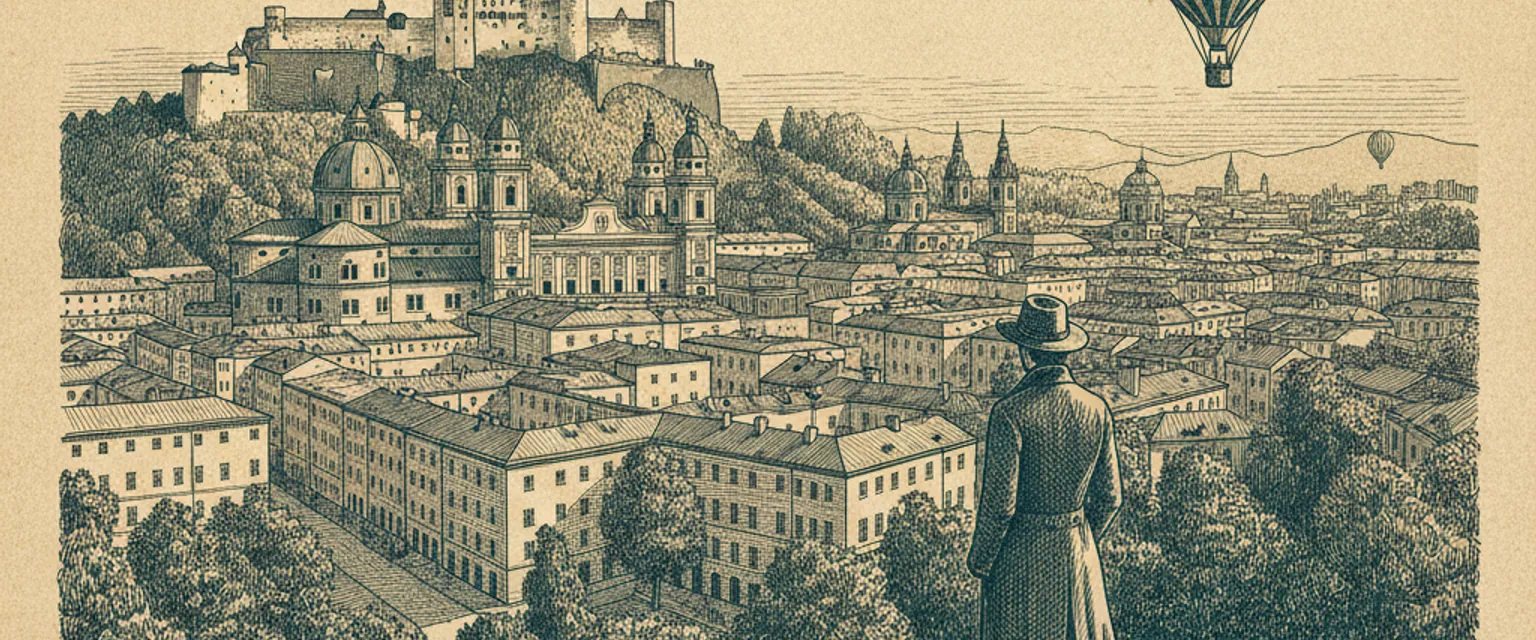
I took the funicular up to Hohensalzburg at 9 AM and had the ramparts to myself for twenty minutes — the whole Baroque old town laid out below, the green Salzach river curling through it, the Alps stacked behind like a painted backdrop. A church bell started somewhere and then another answered it across the valley. Salzburg is small enough that you can hold the entire city in one view, and somehow that makes it feel bigger.
48 Hours: Fortress, Old Town, and One Perfect Lookout
Two days is the fortress, the Baroque old town across the river, Mozart's birthplace, and the climb up the Mönchsberg for the view. Walk everything — Salzburg's centre is tiny and almost entirely pedestrian. Eat one proper Wiener schnitzel and drink one beer in a monastery garden.
Buy the Salzburg Card if you'll hit three or more sights — it covers transport, the funicular, and most museums.
72 Hours: Add the Gardens, the Sound of Music, and Hellbrunn
Three days lets you add Mirabell Gardens, the Sound of Music sights people actually came for, and Hellbrunn Palace with its trick fountains south of town. You also get a slower morning in a coffee house, which is the whole point of central Europe.
4 Days: A Lake or a Salt Mine in the Mountains
Four days earns a day trip into the Salzkammergut lake district — Hallstatt or the Königssee — or down into the Hallein salt mine that gave Salzburg its name and its wealth. The Alps are an hour away in any direction and the train does most of the work.
7 Days: Salzburg as a Base for the Alps
A week turns Salzburg into a basecamp. You do the city properly, then fan out: Hallstatt, Berchtesgaden and the Eagle's Nest, the Werfen ice caves, a day in the Gasteinertal. By the end you understand why composers and film crews both kept coming back here.
Estimated budget:$320-$520
Estimated budget:$470-$760
Estimated budget:$640-$1020
Estimated budget:$1150-$1900
Day 1
Hohensalzburg Fortress + Old Town
The fortress on the hill and the Baroque streets below it
Hohensalzburg Fortress
One of the largest fully preserved medieval castles in Europe, never once taken by force.
Take the funicular up the Festungsbahn first thing — the fortress opens early and the morning light on the old town below is the best view in Salzburg. Inside, the Golden Hall and the Prince-Archbishop's chambers are worth the audio guide, and the panorama from the ramparts stretches to the Alps. It has guarded the city since 1077 and never fell to a siege.
Getreidegasse + Mozart's Birthplace
The famous wrought-iron-sign shopping street and the yellow house where Mozart was born.
Getreidegasse is the spine of the old town, lined with the iron guild signs that hang over every shop — even McDonald's had to make one. Halfway down is Mozarts Geburtshaus, the yellow house where he was born in 1756, now a small museum with his childhood violin. It is touristy and also genuinely moving. Duck into the side passages between buildings to escape the crowds.
Dinner at Stiftskeller St. Peter
Said to be the oldest restaurant in central Europe, in the monastery cellar since 803 AD.
St. Peter Stiftskulinarium sits in the vaults of St. Peter's Abbey and claims a continuous history back to 803 AD, which would make it the oldest restaurant on the continent. The schnitzel and the Tafelspitz are excellent and the cellar setting is unbeatable. Book ahead. For something cheaper and just as old in spirit, the abbey also runs a bakery using a wood-fired oven from the Middle Ages.
Day 2
Mönchsberg + Across the River
The cliff-top walk, the cathedral, and the right bank
Mönchsberg + Museum der Moderne
A cliff-top forest walk over the city, with the best modern art museum and terrace café.
Ride the MönchsbergAufzug lift up the cliff and walk the wooded ridge that runs above the old town. The Museum der Moderne sits on top with a terrace café whose view rivals the fortress for far less effort. The path winds past lookouts the whole length of the mountain — this is where locals go to escape the tourists without leaving town.
Salzburg Cathedral + Residenzplatz
A vast early-Baroque cathedral where Mozart was baptised, on the city's grandest square.
The Salzburger Dom is the white-and-grey early-Baroque heart of the old town — Mozart was baptised at the font just inside the door and later played the organ here. The square outside, Residenzplatz, holds the horse fountain and the DomQuartier museum complex linking the cathedral, the Residenz palace and the abbey terraces in one ticket.
Augustiner Bräustübl
A monastery beer hall where you rinse your own stein and drink in a chestnut garden.
Augustiner Bräustübl is a working monastery brewery in Mülln, a short walk from the centre. You buy a token, rinse your stone stein at the fountain, fill it from the tap, and carry it out to the chestnut beer garden. The food comes from independent stalls along the corridor — pretzels, roast pork, smoked fish. It is the most authentic evening in Salzburg and costs almost nothing.
Day 3
Mirabell Gardens + Sound of Music + Hellbrunn
Gardens, film locations, and the trick fountains of the prince-archbishops
Mirabell Palace + Gardens
Symmetrical Baroque gardens with the Pegasus fountain and the Do-Re-Mi steps.
Mirabell Gardens are free, immaculate, and unmistakable to anyone who has seen The Sound of Music — the Pegasus fountain, the rose garden, and the staircase from the Do-Re-Mi sequence. Inside the palace, the Marble Hall is one of the most beautiful wedding venues in the world and free to peek into when no ceremony is on. Go early before the tour groups arrive.
Hellbrunn Palace + Trick Fountains
A pleasure palace where a 17th-century archbishop installed fountains to soak his dinner guests.
Hellbrunn, just south of the city, was built as a summer pleasure palace by Prince-Archbishop Markus Sittikus, who had a strange sense of humour — the trick fountains spray water at unsuspecting guests from hidden jets in the stone dining table and along the garden paths. The guided tour will get you wet; that is the point. The gazebo from Sixteen Going on Seventeen lives in the park.
Coffee at Café Tomaselli
Austria's oldest coffee house, pouring since 1700, with a marble-tray cake parade.
Café Tomaselli on the Alter Markt has been serving since 1700 and claims to be the oldest coffee house in Austria. The Einspänner — a strong coffee under a cap of whipped cream — is the order, and the cakes come around on a marble tray for you to point at. The wood- panelled rooms upstairs are quieter. Sit, read the newspaper on a wooden holder, and do nothing for an hour.
Day 4
Salzkammergut Lake Day Trip
Hallstatt and the lake district that the Alps keep for themselves
Hallstatt
The pastel lakeside village so photogenic that China built a full-scale replica of it.
Hallstatt is about 90 minutes from Salzburg by bus or train-and-ferry, and it earns its fame — a tiny village of wooden houses stacked against a cliff above a glassy lake, with the oldest salt mine in the world up the funicular above it. Go early or stay late to dodge the day-tour crush. The Skywalk viewing platform and the Beinhaus (bone house) by the church are the two essential stops.
Hallstatt Salt Mine
The world's oldest salt mine, with a wooden miners' slide and a 7,000-year history.
A funicular climbs from Hallstatt to the Salzwelten, the salt mine that has been worked for 7,000 years — the white gold that made this whole region rich. The tour goes deep into the mountain on a wooden miners' slide and includes an underground salt lake and the preserved finds of the Iron Age Hallstatt culture. Wear closed shoes and a jacket; it is cold underground.
Lakeside Fish Lunch
Fresh-caught Reinanke whitefish from the lake, grilled and eaten over the water.
Before heading back, eat at one of the lakeside terraces — the local Reinanke (a delicate Alpine whitefish) comes straight from the lake, grilled simply with butter and lemon. Restaurant Braeugasthof and the Seehotel terrace both serve it with the full lake view. Pair it with a Grüner Veltliner and watch the ferries cross.
Day 5
Berchtesgaden + the Eagle's Nest
Over the German border for the Königssee and a mountaintop with a dark past
Königssee Boat Trip
An emerald fjord-like lake crossed by electric boats, with an echo and a red-domed chapel.
Just over the German border, the Königssee is a deep emerald lake pinched between sheer cliffs, crossed only by silent electric boats. Halfway across, the captain stops and plays a flugelhorn so you can hear the echo bounce off the rock walls. The boat lands at St. Bartholomä, the red-onion-domed pilgrimage chapel on a small peninsula. It is the most beautiful lake in the Alps and barely an hour from Salzburg.
The Eagle's Nest (Kehlsteinhaus)
A mountaintop lodge reached by a brass-lined tunnel lift, now a museum and café.
The Kehlsteinhaus sits at 1,834 metres above Berchtesgaden, reached by a special bus up a dizzying road and then a brass-panelled lift bored through the mountain. Built as a Nazi-era retreat, it is now run honestly as a café and historical site with one of the great Alpine panoramas. The Dokumentation Obersalzberg museum below the mountain handles the difficult history with seriousness. Open roughly mid-May to October only.
Day 6
Werfen + the Castle and the Ice Caves
A clifftop fortress and the largest ice cave in the world
Eisriesenwelt Ice Caves
The largest ice cave on Earth, a frozen underworld inside a mountain above Werfen.
Eisriesenwelt, about 40 minutes south of Salzburg, is the largest ice cave in the world — a cathedral of frozen waterfalls and ice formations carved into the Tennengebirge massif. Getting there is part of the day: a road, a cable car, and a steep walk before you even reach the entrance. You carry a carbide lamp through the ice on a guided tour. Bring warm layers; it is below freezing inside in July.
Hohenwerfen Castle + Falconry
A 900-year-old fortress on a crag with a live birds-of-prey flying show.
Hohenwerfen Fortress sits on a rock spur in the valley below the ice caves, a 900-year-old castle used as the location for several films. Its highlight is the historical falconry centre, which puts on daily flying demonstrations with eagles, vultures and falcons over the ramparts and the valley. The view down the Salzach valley from the walls is worth the climb on its own.
Day 7
Slow Salzburg + a Final Climb
The places you skipped, a market lunch, and one last view
Nonnberg Abbey
The oldest continuously running convent in the German-speaking world, where Maria really was a novice.
Nonnberg Abbey, founded around 714, is the oldest continuously operating convent in the German-speaking world — and the real convent where Maria von Trapp was a novice before the story that became The Sound of Music. The little church and the courtyard, tucked behind the fortress, are free, quiet and almost always empty of tour groups. The walk up from the old town is short but steep.
Grünmarkt + Universitätsplatz Market
The open-air farmers' market behind the Kollegienkirche for a stand-up lunch.
The Grünmarkt on Universitätsplatz, behind the soaring Baroque Kollegienkirche, is the city's daily market — stalls of Alpine cheese, cured meats, pretzels, and the famous Bosna sausage stand that locals queue for. Build a picnic, or eat the Bosna standing up the way you are supposed to, then sit on the steps of the church.
Kapuzinerberg Climb
The wooded hill on the right bank for the postcard view back at the fortress.
For your last afternoon, climb the Kapuzinerberg on the right bank — the wooded hill opposite the fortress, threaded with quiet paths past the Capuchin monastery and old city watchtowers. The lookout at the Hettwer Bastei gives you the classic photograph: the whole old town with Hohensalzburg crowning it. The writer Stefan Zweig once lived in a villa up here, and you will see why.
Salzburg is the rare city that delivers exactly what the postcard promises and then quietly gives you more. The fortress really does loom over a perfect Baroque old town, Mozart really was born on the main shopping street, and yes, the Sound of Music really was filmed in the gardens you are standing in. But behind all of that is a working Alpine town with a monastery beer hall, a 300-year-old coffee house, and the whole Salzkammergut lake district an hour away.
This itinerary is built around the fact that Salzburg’s centre is tiny and almost entirely pedestrian. You will walk everywhere in the city, which means the day trips are where you spend your transport money — and they are worth it. Two days is the fortress and the old town. A full week turns Salzburg into a basecamp for some of the most dramatic scenery in the Alps.
The honest advice: get the Salzburg Card if you plan to see three or more sights, because it covers the funicular, the Mönchsberg lift, and most museums plus public transport. Go early to the headline sights — the fortress at opening, Mirabell before the tour buses — and you will have them nearly to yourself.
Use the duration filter above to see your version of Salzburg, from a focused weekend to a full Alpine week.
How to use this plan
Each day nests inside the longer trips, so the 2-day plan is the first two days, the 4-day plan adds a lake or salt mine, and the 7-day plan fans out across the mountains. Pick your length, follow the timings loosely, and leave room for one long lunch you did not plan.
This article contains affiliate links marked with rel="sponsored". We may earn a commission at no extra cost to you.