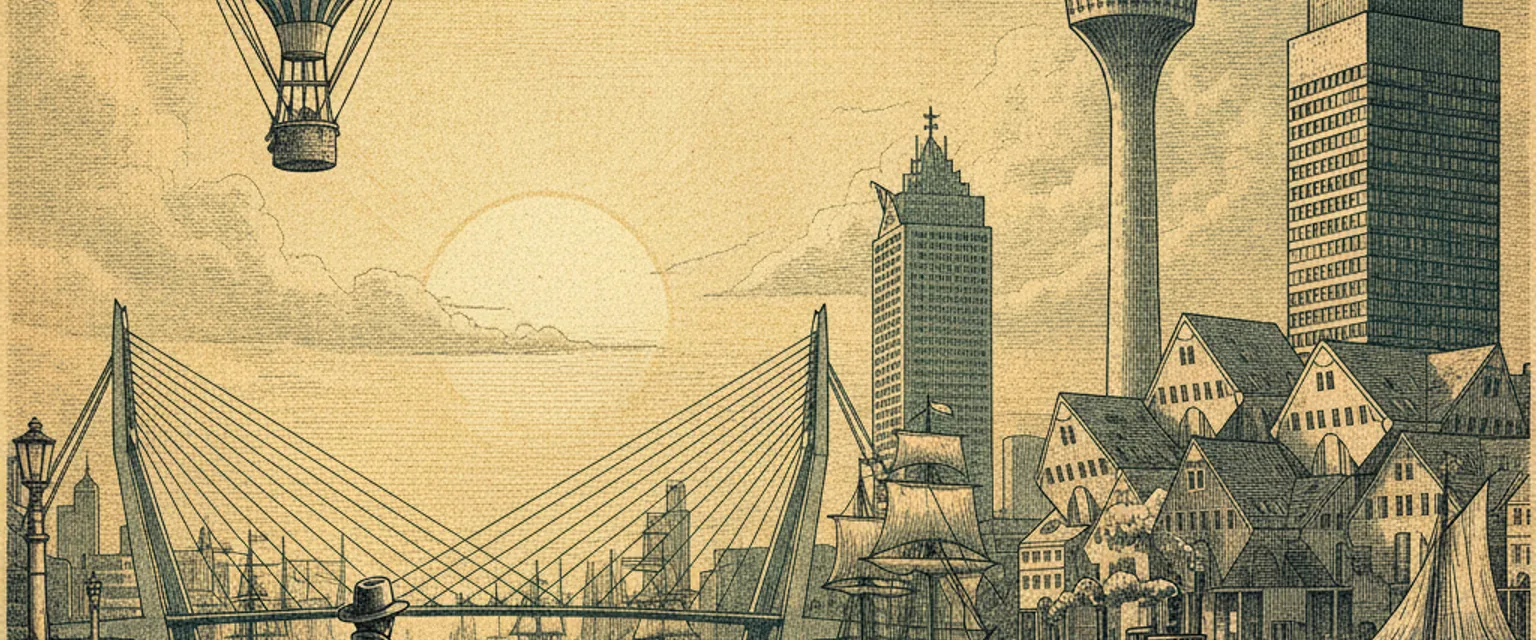
I told an Amsterdammer I was spending a week in Rotterdam and she physically recoiled, the way you might at someone who orders milk with a steak. Then I got off the train under that absurd, brilliant Centraal Station roof, looked up at a skyline that has no business existing in the flat Netherlands, and understood the rivalry completely. Rotterdam doesn't want your approval. It bulldozed its own ruins and built something stranger.
The Perfect Rotterdam Itinerary (2, 3, 4 & 7 Days)
Two days is the architecture greatest-hits run: the cube houses, the Markthal arch, a walk across the Erasmusbrug, and the Depot — the world's first fully public art storage building. Stay near the centre; everything is walkable or a quick metro hop.
Book a Depot timeslot online — the mirrored bowl on the roof fills up fast on weekends.
72 Hours: Add the Harbour and Delfshaven
Three days adds the working port on a Spido harbour boat and the only surviving slice of old Rotterdam, Delfshaven, where the Pilgrims left for America. You start to feel the split personality: relentlessly new, with one carefully kept ghost.
4 Days: The Slow Rotterdam Version
Four days lets you cross the Maas to Katendrecht for the Fenix food hall, cycle the river, and spend a proper afternoon at Museum Boijmans-adjacent galleries. This is where Rotterdam stops being a day trip and starts being a city you'd live in.
7 Days: Live Like a Rotterdammer
A week means a day trip to Kinderdijk's windmills, the beach at Hoek van Holland, and enough time to find the bar you return to. By Day 5 you stop comparing it to Amsterdam, which is when the city finally lets you in.
Estimated budget:$280-$480
Estimated budget:$430-$720
Estimated budget:$580-$960
Estimated budget:$980-$1700
Day 1
Cube Houses, Markthal & the Maritime Heart
The bold rebuilt centre, in the order it makes sense
Cube Houses (Kijk-Kubus)
Piet Blom's tilted yellow cubes — a forest of houses standing on their corners.
Architect Piet Blom tilted 38 cubes 45 degrees onto hexagonal pylons in 1984, calling them trees in an urban forest. One unit, the Kijk-Kubus, is open to walk through and the angled walls are genuinely disorienting. It is gimmicky and I loved it anyway. Go early before the tour groups clog the narrow stairs.
Markthal
A horseshoe of apartments arching over a food market and Europe's biggest artwork.
The 2014 Markthal is an apartment block bent into a giant arch over a covered market, its inner ceiling painted with a 11,000-square-metre mural of fruit and flowers. Eat here: Polish pierogi, Surinamese roti, Dutch cheese, fresh stroopwafels. Skip the chain stalls near the entrance and head deeper in.
Depot Boijmans Van Beuningen
A mirrored bowl on the skyline that lets you walk through an entire museum's storage.
This reflective MVRDV building is the first art depot in the world open to the public — you wander through actual climate-controlled storage, seeing the 95 percent of a collection most museums hide. The rooftop forest and restaurant give the best free-ish panorama of the city. Book a slot in advance.
Day 2
Erasmusbrug, the Skyline & Kop van Zuid
Crossing the river that splits the city in two
Erasmusbrug (The Swan)
The asymmetric white bridge that became the city's logo overnight.
Locals call the 1996 cable-stayed bridge De Zwaan, the Swan, for its single angled pylon. Walk across it rather than tram over it — the view back at the skyline is the postcard, and the south bank's Kop van Zuid towers are best appreciated on approach. Sunset light hits the white steel beautifully.
Hotel New York (lunch)
The old Holland-America Line HQ where emigrants sailed for Ellis Island.
This grand 1901 building was the headquarters from which a million Europeans departed for America. It is now a hotel and brasserie on the water; the oysters and the harbour terrace are the draw. Pure atmosphere, slightly touristy, worth it once for the history alone.
Euromast
A 1960 observation tower with a glass capsule that rotates to 185 metres.
The Euromast predates most of modern Rotterdam and gives a 360-degree read on how comprehensively the city reinvented itself. The Euroscoop capsule spirals up the mast for the top view. If two days, this is your optional skip; if you have the time, the perspective is worth it.
Day 3
The Working Port & Old Delfshaven
Europe's biggest harbour, and the one corner that survived 1940
Spido Harbour Tour
A boat ride through the largest port in Europe, all cranes and container giants.
Rotterdam's port stretches 40 kilometres to the sea and handles more cargo than anywhere else in Europe. The 75-minute Spido cruise takes you past dry docks, container terminals, and ships the size of city blocks. It is genuinely awe-inspiring industrial theatre. Dress warm; the river wind is real.
Historic Delfshaven
The only old Dutch quarter the bombs missed — gabled houses and the Pilgrim Fathers' church.
Delfshaven is where Rotterdam looks like the Holland of postcards: 17th-century canal houses, a working windmill, and the Pilgrimfathers Church from which the Pilgrims sailed in 1620 before transferring to the Mayflower. After the relentless modernity of the centre, this single preserved sliver hits hard.
Brewery De Pelgrim, Delfshaven
A microbrewery beside the windmill, pouring beer named for the Pilgrims.
De Pelgrim brews on-site next to the Delfshaven windmill and pours its ales on a canal-side terrace. Order the Mayflower tripel and sit by the water as the light goes. It is the most relaxed hour in a city that is otherwise built to impress.
Day 4
Katendrecht & the River South Bank
The reinvented red-light docks, now the city's best eating
Fenix Food Factory
A warehouse food hall on the Katendrecht pier — local cheese, beer, roasters.
Once a rough sailors' quarter, Katendrecht is now where Rotterdammers go to eat. The Fenix Food Factory packs a former warehouse with a cheesemonger, a craft brewery, a bakery, and a coffee roaster, all opening onto the water. Graze across stalls and take a beer onto the quay facing the skyline.
SS Rotterdam
A retired 1959 ocean liner, now a floating hotel you can tour.
The former flagship of the Holland-America Line is permanently moored at Katendrecht as a hotel. The guided tours through the engine rooms, art-deco lounges, and bridge are a time capsule of mid-century luxury liner travel. The deck bar has skyline views few tourists find.
Rijnhaven floating park & sunset
A floating swimming spot and park in the old harbour basin.
Summer afternoons, Rotterdammers swim and sprawl at the Rijnhaven floating structures with the towers reflected in the water. Even out of swimming season it is the best low-key place to watch the city light up. Grab takeaway from Fenix and claim a spot on the pontoon.
Day 5
Day Trip — Kinderdijk Windmills
The Holland cliche, done exactly right, 30 minutes away
Kinderdijk Windmills
Nineteen 18th-century windmills in a UNESCO row, reachable by waterbus.
The Kinderdijk windmills, built around 1740 to drain the polder, are a UNESCO World Heritage site and the single most photogenic spot in the region. Take the Waterbus down the river rather than driving — arriving from the water is half the pleasure. Walk the dike, tour one working mill, and go early before coach groups.
Cycle the polder
Rent a bike at Kinderdijk and ride the dead-flat dikes between the mills.
Bikes are available at the visitor centre and the whole site is best covered on two wheels along the water channels. The polder is so flat and quiet you can hear the sails turning. Loop the far mills the walking crowds never reach, then waterbus back to the city.
Day 6
Museumpark & Modern Art
The cultural quarter the centre is built around
Kunsthal Rotterdam
Rem Koolhaas's deliberately rough exhibition hall — no permanent collection, all energy.
The Kunsthal, designed by hometown architect Rem Koolhaas, has no fixed collection; it runs a fast rotation of design, photography, and pop culture shows across split-level ramps. Check what is on before you go — the programming swings from fashion to Banksy to architecture — and give it ninety minutes.
Het Nieuwe Instituut
The national museum of architecture and design, with the Sonneveld House next door.
This is the institute for architecture, design, and digital culture, and its real treasure is the adjacent Sonneveld House, a perfectly preserved 1933 functionalist villa you can walk through. For a city this obsessed with building, it is the ideal place to understand why.
Witte de Withstraat (dinner & bars)
Rotterdam's loudest, best street for eating and drinking.
The Witte de With is the cultural-and-nightlife spine of the city: galleries, ramen bars, natural wine spots, and the kind of crowd that makes Rotterdam feel younger than Amsterdam. Eat at Bokaal or grab Indonesian, then bar-hop. This is where the week's energy peaks.
Day 7
Slow Rotterdam — Coast, Coffee, Goodbye
The last day, taken at a Rotterdammer's pace
Hoek van Holland beach
The North Sea beach at the end of the metro line, where the port meets the dunes.
The B metro line now runs all the way to the coast, so Rotterdam has a proper North Sea beach 40 minutes from the centre. Watch the giant container ships file into the port channel while you walk the sand. A beach pavilion lunch and a swim if the weather plays along.
Coffee at Man Met Bril Koffie
A local roaster under the railway arches — your last proper Rotterdam flat white.
Man Met Bril roasts under the old railway viaduct in the north of the city, the kind of place where the staff know the regulars. After a week of architecture and harbours, a slow coffee here is the right way to stop. Buy beans for the journey home.
Rotterdam Centraal — departure
The station whose soaring steel roof is the city's mission statement in one building.
The 2014 Centraal Station, with its enormous angled stainless-steel canopy pointing at the centre, is the perfect last image: confident, forward-leaning, completely unlike anywhere else in the Netherlands. Walk under it slowly before your train. Schiphol airport is 25 minutes by intercity.
Rotterdam is the city that most rewards arriving with no expectations. The Luftwaffe flattened the medieval centre in May 1940, and rather than rebuild a copy, the city decided to use the blank slate as a permanent invitation to its architects. The result is the only genuinely modern skyline in the Netherlands, a place where every decade since has left a confident, occasionally show-off building, and where the word “old” applies to almost nothing.
That is also why first-time visitors sometimes leave underwhelmed. If you come looking for Amsterdam’s gabled canal romance, you will be disappointed. Come instead for the cube houses, the arching Markthal, the mirrored Depot, and Europe’s largest working port, and you will find a city that is doing its own thing with total conviction. The single preserved historic quarter, Delfshaven, lands all the harder for being the exception.
This plan stacks the architectural greatest hits into the first two days, then layers on the harbour, the reinvented south bank at Katendrecht, and the day trips a longer stay deserves. The two-day version is dense and central. The seven-day version gives you windmills, a North Sea beach, and the time it takes to stop comparing Rotterdam to its famous neighbour.
How to use this plan
Each day is tagged with the trip lengths it belongs to, so a two-day visitor sees only the essential central days and a week-long stay unlocks the river trips and the coast. Rotterdam is flat, compact, and built for bikes and a clean metro — you will rarely need more than fifteen minutes to get anywhere on this list.
This article contains affiliate links marked with rel="sponsored". We may earn a commission at no extra cost to you.