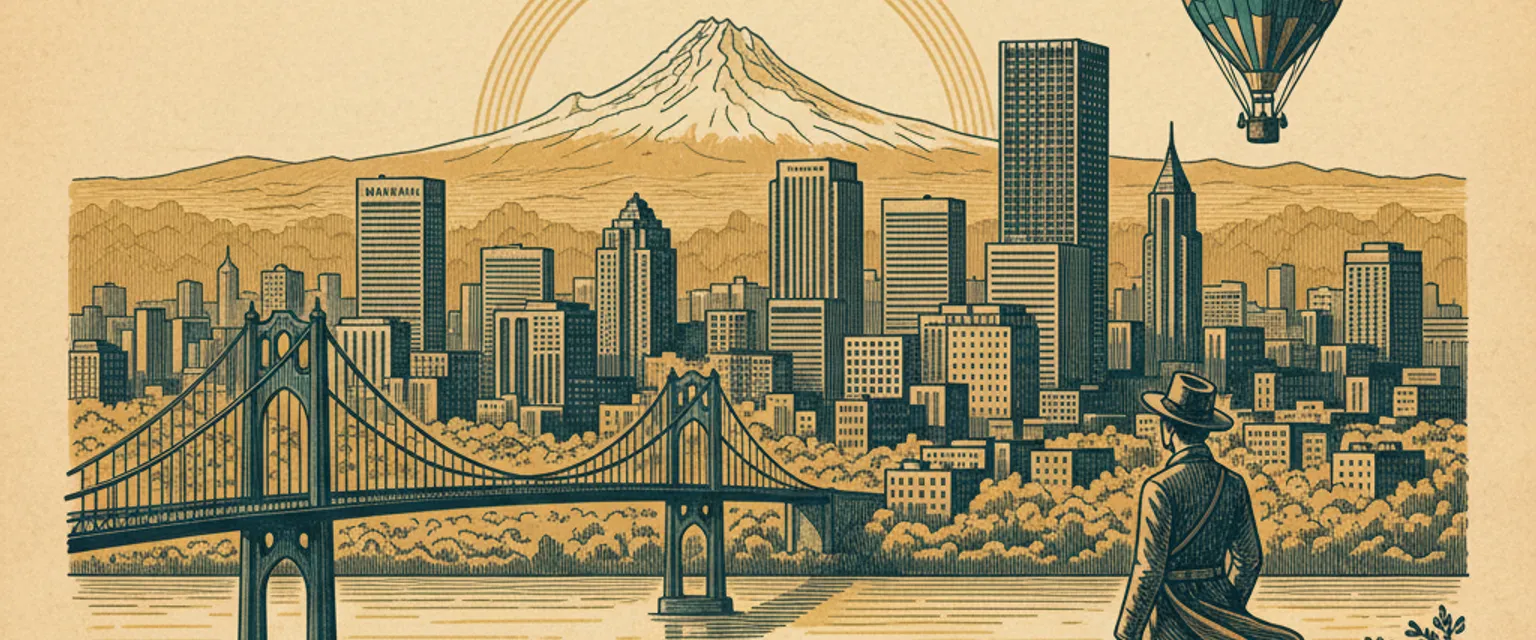
I went into Powell's City of Books to buy one paperback and emerged ninety minutes later, faintly disoriented, clutching four books and a hand-drawn map a bookseller had sketched for me on a receipt to find the rare-book Pearl Room. "You'll be back tomorrow," she said, not unkindly, like a woman who had watched this happen ten thousand times. She was right. Portland is a city that absorbs you sideways, one detour at a time, and the detours are the point.
Two days is peak Portland — a long browse in Powell's, a graze through a food-cart pod, and a brewery crawl through the easygoing eastside. It is a city built for ambling, and a weekend is enough to fall for the rhythm.
Build your day around a food-cart pod and a bookstore. That's the city's whole personality.
72 Hours: Gardens and the Forest in the City
Three days adds the green side — the Japanese Garden and Rose Test Garden up in Washington Park, and a walk into Forest Park, the largest urban forest in the country. You start to see why the slogan is, sincerely, about trees.
4 Days: Into the Columbia River Gorge
Day 4 leaves the city for the Columbia River Gorge — a string of waterfalls including the 189-metre Multnomah Falls, all within an hour's drive. It is the most jaw-dropping scenery within reach, and it makes the perfect day trip.
7 Days: Mountains, Wine and the Whole Weird City
A week lets Portland sprawl out — a day on Mount Hood, an afternoon in the Willamette Valley wine country, and enough neighbourhood mornings that you develop strong opinions about which coffee roaster is correct. By Day 7 you've stopped pretending you're not looking at apartments.
Estimated budget:$360-$560
Estimated budget:$520-$800
Estimated budget:$700-$1,080
Estimated budget:$1,250-$2,100
Day 1
Downtown + Powell's + Pearl District
The bookstore, the food carts and the warehouse-cool Pearl
Start at Powell's, graze a downtown food-cart pod for lunch, then walk the galleries and breweries of the Pearl District.
No agenda — lose a whole morning in Powell's, then drift through the Pearl at your own pace.
Powell's City of Books
A full city block of new and used books across nine colour-coded rooms — the largest indie bookstore on earth.
Powell's City of Books occupies an entire downtown block with more than a million volumes, new and used shelved together, across rooms named by colour. The Rare Book Room upstairs holds first editions and oddities. Grab the free store map and resign yourself to staying longer than planned — everyone does. It is the soul of literary Portland.
Downtown food-cart pod lunch
Clusters of food carts serving everything from Thai to Georgian khachapuri for under fifteen dollars.
Portland practically invented the modern food-cart scene, and pods of them dot the city. Downtown, head to the carts around the South Park Blocks or to the long-running pods on Hawthorne across the river. The range is global and the prices are gentle — try Nong's khao man gai chicken and rice if you can find the cart. Eat at a picnic table in the sun.
Pearl District galleries + breweries
Former rail yards turned loft district, with galleries, design shops and pioneering craft breweries.
The Pearl District is Portland's converted-warehouse neighbourhood — art galleries, the flagship Powell's, design shops, and some of the breweries that started the craft revolution. Deschutes and 10 Barrel have big taprooms here. On the first Thursday of the month the galleries open late for an art walk. It is polished Portland, done well.
Day 2
Eastside — Hawthorne, Division and the breweries
The neighbourhoods that hold the city's beating, beer-soaked heart
Cross the river to the eastside — vintage shops on Hawthorne, the food and restaurants of Division, and a brewery crawl to finish.
A slow eastside day — browse, eat, nap, repeat, and end at whichever brewery patio is catching the sun.
Hawthorne Boulevard
Vintage clothing, record shops, the Bagdad Theater and the most quintessentially Portland strip going.
Hawthorne Boulevard is old Portland weirdness intact — vintage stores, dusty record shops, the 1927 Bagdad Theater (where you can watch a film with a beer), and House of Vintage's overwhelming racks. Browse, buy a strange souvenir, and watch the city's free-range eccentricity on full display. This is the Portland of the bumper stickers.
SE Division + Clinton dining
One of the best restaurant strips in the country, from Pok Pok wings to Salt & Straw scoops.
SE Division Street is a dense, walkable food destination — Pok Pok put Portland Thai on the map with its fish-sauce wings, Ava Gene's does standout Italian, and Salt & Straw's Division flagship has lines for its inventive ice cream (try the honey lavender). Walk it slowly and eat in stages.
Eastside brewery crawl
More breweries per capita than almost any US city, walkable across the eastside neighbourhoods.
Portland has one of the highest brewery counts per capita in America, and the eastside is the playground. Cascade Brewing for sour ales, Base Camp for the outdoorsy crowd, Hair of the Dog for big bottle-aged beers. Most pour generous flights. Pace yourself — this is a marathon city, not a sprint, in beer as in everything.
Day 3
Washington Park + Forest Park
Japanese gardens, roses, and the largest urban forest in America
Spend the day in the green hills above downtown — the gardens of Washington Park, then a forest walk.
With a week, go deep into Forest Park on a longer trail after the gardens.
Portland Japanese Garden
Widely called the most authentic Japanese garden outside Japan, terraced into a forested hillside.
The Portland Japanese Garden sits in the wooded hills of Washington Park and is regularly cited as the finest of its kind outside Japan — eight garden styles across twelve acres, a tea house, and a Kengo Kuma cultural village. It is meditative and impeccably maintained. Go early and let the moss, maples and raked gravel do their slow work.
International Rose Test Garden
Ten thousand rose bushes terraced above the city, free, with Mount Hood on the horizon.
Portland is the City of Roses, and the International Rose Test Garden is why — more than 10,000 plants and 600 varieties terraced down a hillside with the downtown skyline and, on clear days, Mount Hood beyond. Peak bloom is June. It is free, fragrant, and one of the great civic gifts of any American city.
Forest Park — Wildwood Trail
Over 5,000 acres of forest inside the city, with 130km of trails starting minutes from downtown.
Forest Park is the largest forested urban park in the United States — more than 5,000 acres of Douglas fir and fern laced with trails. Pick up the Wildwood Trail near the gardens or at the Pittock Mansion, where a short detour gives you the best skyline-and-mountain view in the city. You can walk for hours and forget there's a city below.
Day 4
Columbia River Gorge waterfalls
A string of cascades within an hour of the city
A full day chasing waterfalls in the Gorge — the Historic Columbia River Highway strings them together.
With more time, add a Gorge hike like Angel's Rest for the big payoff view.
Vista House at Crown Point
A 1918 stone rotunda on a basalt cliff with a sweeping view down the Columbia River Gorge.
Start the Gorge day on the Historic Columbia River Highway at Vista House, an Art Nouveau stone observatory perched 220 metres above the river on Crown Point. The view east down the Gorge is the establishing shot for the whole day. It is often windy enough to lean into — that's part of the fun.
Multnomah Falls
Oregon's tallest waterfall, 189 metres in two tiers, crossed by an iconic stone footbridge.
Multnomah Falls drops 189 metres in two dramatic tiers and is the most-visited natural site in the Pacific Northwest. The Benson Footbridge spans the lower falls for the classic photo; a paved (steep) trail switchbacks to the top. A timed-entry permit is required in peak season — book ahead. Even with crowds, it is genuinely breathtaking.
Wahkeena, Horsetail + Bridal Veil Falls
A cluster of shorter, quieter falls strung along the old highway for a half-day waterfall crawl.
Beyond Multnomah, the old highway links a string of quieter cascades — Wahkeena, the lava-tube spout of Horsetail Falls, and Bridal Veil with its short forest trail. Each is a five-minute walk or less, so you can collect several in an afternoon. Bring a picnic and pull over often. This is the Gorge at its most generous.
Day 5
Mount Hood day
An hour and a half to a glaciated volcano and a historic lodge
Drive up to Mount Hood — the Timberline Lodge, alpine meadows, and a mountain that's visible from the whole city.
Timberline Lodge
A 1937 WPA mountain lodge at 1,800 metres, famous as the exterior of The Shining's hotel.
Timberline Lodge sits at 1,800 metres on Mount Hood's south flank, a hand-built 1937 masterpiece of Cascadian craftsmanship (and the exterior of the Overlook in The Shining). Skiing runs nearly year-round here. Even non-skiers can ride the chairlift, walk the alpine meadows, and have lunch by the great stone fireplace with the volcano outside the window.
Trillium Lake
A mirror-still lake with the postcard reflection of Mount Hood, plus an easy loop trail.
Trillium Lake delivers the single most photographed view of Mount Hood — the peak mirrored in still water, framed by firs. An easy, mostly flat 3km loop circles the lake. In summer you can swim, paddle a rented canoe, or just sit on the dam and watch the mountain. Come on a calm morning for the glassiest reflection.
Government Camp
A tiny alpine village at the base of Hood for a post-mountain meal and a local brew.
Government Camp is the little ski village at the mountain's base — a good spot to refuel before the drive home. Mt. Hood Brewing pours alpine-named ales by the fire, and the diners do hearty après-everything food. Eat, warm up, and time the descent so the farm valleys are catching the evening light on the way back.
Day 6
Willamette Valley wine country
World-class Pinot Noir an hour south of the city
A leisurely day among the vineyards of the Dundee Hills — tastings, valley views, and a long lunch.
Dundee Hills tasting
The heart of Oregon Pinot Noir, with hilltop tasting rooms and Coast Range views.
The Dundee Hills, an hour southwest of Portland, are Oregon's premier Pinot Noir country — cool-climate reds that rival Burgundy. Domaine Drouhin and Sokol Blosser have hilltop tasting rooms with sweeping valley views. Book a couple of tastings, hire a driver if you can, and let the afternoon unwind across the vines.
McMinnville's Third Street
A charming wine-country main street of bistros, tasting rooms and the quirky Evergreen aviation museum.
McMinnville anchors the valley with a walkable, tree-lined Third Street of wine bars, bistros and shops. Lunch at a sidewalk table, then if you've energy left, the Evergreen Aviation Museum nearby houses Howard Hughes's enormous Spruce Goose flying boat. A relaxed, unpretentious counterpoint to the formal tasting rooms.
Farm-to-table valley dinner
The Willamette Valley's bounty on a plate, paired with the wine that grew up the road.
The valley is farm country as well as wine country, and the local restaurants lean hard into it. Have an early dinner at a winery restaurant or a McMinnville bistro — salmon, hazelnuts, summer vegetables, all sourced within miles, paired with a glass of the local Pinot. Drive back to the city full and a little sun-drunk.
Day 7
Saturday Market + Mississippi Avenue
A riverside craft market and one last weird-and-wonderful neighbourhood
A gentle final day — the open-air market by the river, then the indie shops and food of Mississippi Avenue.
Portland Saturday Market
The largest continuously operating outdoor crafts market in the US, by the Willamette River.
Running weekends from March to December under the Burnside Bridge, the Portland Saturday Market is the country's largest outdoor arts-and-crafts market — handmade everything, buskers, and food carts along the river. It is the best place to buy a genuinely local souvenir and to feel the city's craft-and-community ethos in person.
Lan Su Chinese Garden
A walled Ming-dynasty-style garden and tea house tucked into downtown's Old Town.
A few blocks from the market, the Lan Su Chinese Garden is a serene walled Suzhou-style garden built by artisans from Portland's sister city — covered walkways, a koi pond, rockeries, and a teahouse serving proper Chinese tea. A quiet, fragrant pause before the afternoon, and a lovely contrast to the bustle outside.
N Mississippi Avenue
A revived strip of indie shops, a food-cart pod and breweries for a final, very Portland afternoon.
Finish on North Mississippi Avenue, a once-faded strip reborn as a string of independent shops, the Prost! food-cart pod, vintage stores and StormBreaker Brewing. It is creative, walkable Portland in miniature. Grab a last cart meal and a beer on a patio, and toast a city that rewarded every detour you took.
Portland is a city that rewards wandering more than planning, which makes writing an itinerary for it faintly paradoxical. Its best moments arrive sideways — a bookstore you meant to visit for ten minutes, a food cart you stumbled on, a brewery patio that turned into the whole evening. The official slogan is “Keep Portland Weird,” and the weirdness is not a marketing gimmick; it is a genuine civic commitment to bookstores, bicycles, eccentric local businesses and trees.
This itinerary gives that aimlessness a loose shape. The first two days are the cultural core — Powell’s, the food carts, the eastside neighbourhoods where Portland’s beer-and-vintage soul lives. Day three turns to the famously green side of the city, with the Japanese Garden and a forest you could get lost in for hours without leaving the city limits. And from Day four on, the surrounding landscape takes over: the waterfalls of the Columbia Gorge, the glaciers of Mount Hood, and the Pinot Noir vineyards of the Willamette Valley, all within easy reach.
How to use these plans
The days nest, so the two-day plan is the foundation and each longer trip layers on outward and upward. Portland is compact and bike-friendly downtown but spread out at the edges, so the day trips from Day four onward really do want a car.
A couple of honest notes. There is no sales tax in Oregon, which makes the bookstores and the gear shops dangerous. The food-cart pods are the city’s signature value — find one, graze widely, spend almost nothing. The Columbia Gorge and Multnomah Falls now use timed-entry permits in summer, so book those ahead. And don’t try to optimise Portland too hard. The best souvenir you’ll bring home is the habit of following the detour — the booksellers here will tell you, with the patience of long experience, that you’ll be back tomorrow.
This article contains affiliate links marked with rel="sponsored". We may earn a commission at no extra cost to you.