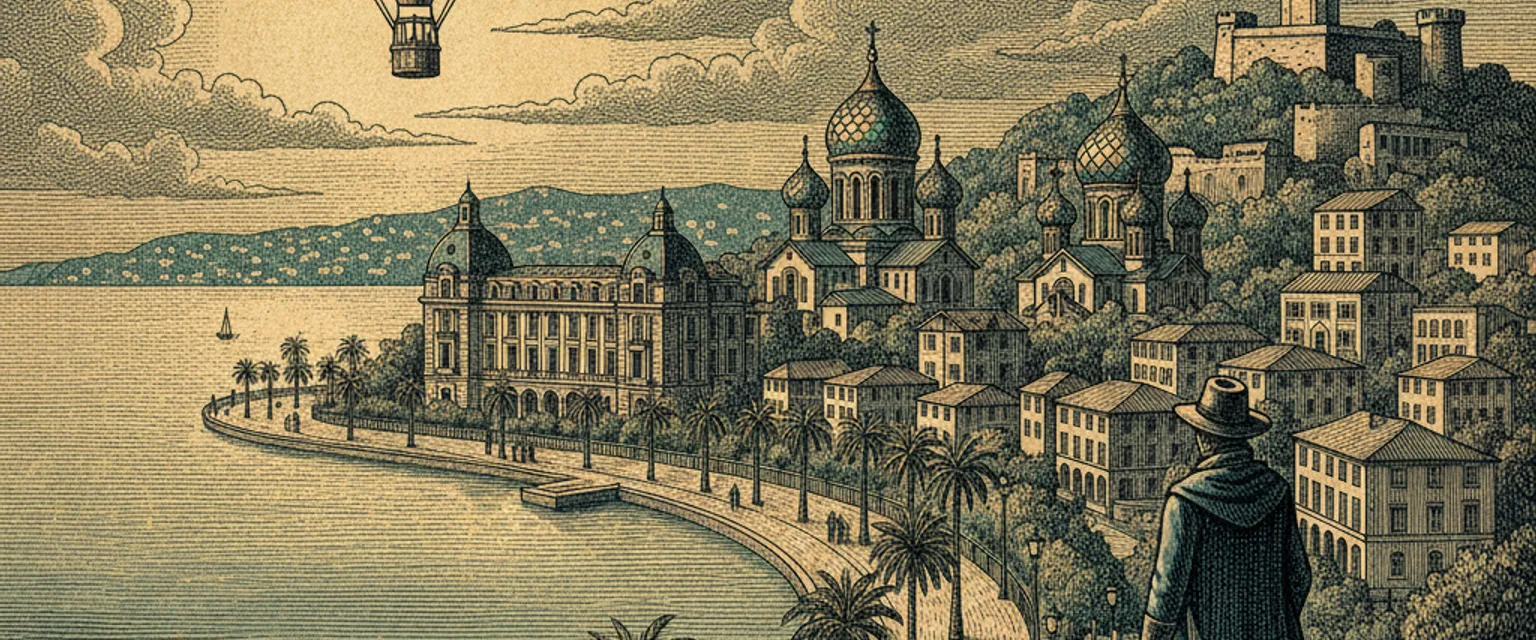
My first morning in Nice I tried to eat a socca with dignity and failed completely. The vendor at Chez Pipo handed over this floppy, blistered chickpea pancake on a scrap of paper, dusted it with pepper, and watched me fold it wrong, drop half, and burn my fingers. An old woman next to me, eating hers like a professional, just laughed and showed me: tear, don't fold, eat it too hot, accept the mess. Then she told me Nice belongs to the Niçois first and the Riviera second, and I should remember that. I have.
Two days is the essential Nice — the ochre maze of Vieux Nice, the Cours Saleya flower market, the climb up Castle Hill for the iconic bay view, and a sunset stroll along the Promenade des Anglais. Pack a swimsuit; the sea is always part of the plan here.
The beaches are pebbles, not sand — bring or buy a pair of cheap water shoes and your feet will thank you.
72 Hours: Add Cimiez, Matisse & a First Day Trip
Three days lets you climb the hill to Cimiez for the Matisse and Chagall museums and Roman ruins, then take your first easy train escape — most likely to Monaco or Èze. Nice's genius is how many other places it puts within twenty minutes.
4 Days: Antibes, Markets & the Slow Riviera
Four days adds Antibes and its Picasso museum, more time in the markets, and the unhurried café rhythm the Côte d'Azur does better than anywhere. You stop sightseeing and start living it — long lunches, an afternoon swim, an aperitif as routine.
7 Days: The Whole Côte d'Azur
A week makes Nice the perfect Riviera base. Day-trip to glamorous Cannes, perfumed Grasse, medieval Saint-Paul-de-Vence, and the over-the-top gardens of Cap Ferrat. Back in the city you'll have time for hidden beaches, the best socca spots, and a proper opinion on pan bagnat. By the end the Mediterranean blue stops looking real.
Estimated budget:$330-$550
Estimated budget:$490-$810
Estimated budget:$640-$1,050
Estimated budget:$1,150-$1,950
Day 1
Vieux Nice, Cours Saleya & Castle Hill
The old town, the market and the city's best view
Cours Saleya flower & food market
The beating heart of Vieux Nice — flowers, produce and Provençal everything.
Start at the Cours Saleya, the long market square that anchors the old town. Every morning except Monday (which is antiques) it fills with flower sellers, fruit stalls, olives, spices and socca vendors. Buy a pan bagnat — the local tuna-and-egg sandwich soaked in olive oil — for later, grab a coffee at a terrace, and let the colour and noise wake you up. This is the most Niçois corner of the city.
Vieux Nice & the Baroque churches
A sun-faded ochre maze of laundry lines, tiny squares and gelato.
Lose yourself deliberately in Vieux Nice, the old town's tangle of narrow lanes painted in faded ochre, red and yellow. Duck into the Cathédrale Sainte-Réparate and the dazzling Chapelle de la Miséricorde for some of the best Baroque interiors on the coast. Stop at Fenocchio on Place Rossetti for an outrageous flavour of gelato (lavender, tomato, olive — they have it all). Don't rush; the joy is in getting pleasantly lost.
Colline du Château (Castle Hill)
The viewpoint that launches a thousand postcards — and a free lift to the top.
The Colline du Château has no castle anymore (Louis XIV demolished it), but the wooded park on top delivers the definitive view: the curving Baie des Anges, the terracotta roofs of the old town, and the port on the other side. There's a man-made waterfall and plenty of shade. Climb the steps if you're keen, or take the free lift near the eastern end of the beach. Time it for late afternoon, when the light goes gold.
Port Lympia for dinner
Bobbing yachts, painted Italianate façades and the city's freshest seafood.
As the day cools, walk down the far side of Castle Hill to Port Lympia, ringed by tall red-and-yellow buildings and lined with seafood restaurants. It's quieter and more local than the old-town tourist drag. Order a plateau de fruits de mer or grilled daurade, watch the boats, and ease into the Riviera evening rhythm. Reserve in summer; the good waterfront tables go fast.
Day 2
Promenade des Anglais, Beaches & Mont Boron
The seafront the city is famous for
Promenade des Anglais
Seven kilometres of palm-lined seafront built, originally, by homesick English aristocrats.
The Promenade des Anglais is Nice's grand seafront boulevard, paid for in the 1820s by the city's wintering English community. Rent a bike or just walk it past the iconic blue chairs and the candy-pink Hotel Negresco. Stop for a swim — public beaches alternate with private loungers — and remember it's pebbles, so water shoes help. The light off the water in the morning is the Côte d'Azur at its most cinematic.
Beach club lunch or a market picnic
Eat with your feet near the water — splurge on a lounger or do it the cheap, local way.
For lunch, either splash out at a private beach club like Castel Plage (a lounger, a salade niçoise and rosé by the water — pricey but memorable) or do it the Niçois way: a pan bagnat and a bottle of water from the morning market, eaten on the public pebbles for nothing. Both are correct. The salade niçoise here, by the way, never has cooked vegetables — locals are fierce about it.
Mont Boron walk
A pine-scented hill walk to the best sunset panorama over the bay and Villefranche.
For sunset, head to Mont Boron, the wooded headland east of the port. A network of shaded trails climbs through Aleppo pines to viewpoints over the whole Baie des Anges on one side and the deep blue cove of Villefranche-sur-Mer on the other. It's a proper little hike but not strenuous, and far quieter than the seafront. Bring water and time it for golden hour.
Day 3
Cimiez — Matisse, Chagall & Roman Nice
The hilltop quarter of museums and antiquity
Musée Matisse
A red Genoese villa full of the work of the artist who called Nice home for decades.
Henri Matisse lived in Nice for the last 37 years of his life, drawn by its light, and the Musée Matisse in the leafy hilltop quarter of Cimiez holds a rich collection spanning his whole career — paintings, the cut-out gouaches, sketches for the Vence chapel. It sits in a 17th-century red villa among Roman ruins and olive groves. It's an easy bus ride up from the centre and rarely crowded. A genuine highlight.
Musée National Marc Chagall
The largest public collection of Chagall's work, in a purpose-built light-filled space.
A short walk downhill, the Musée National Marc Chagall holds the world's largest public collection of his work, centred on the luminous Biblical Message cycle of seventeen large canvases. The building was designed with Chagall's input to show them in soft natural light, and there's a stained-glass concert hall and a peaceful garden. Combine it with the Matisse for one of the best art half-days on the Riviera.
Train to Monaco & Monte-Carlo
Twenty minutes by train to the casino, the harbour and the world's most concentrated wealth.
Late afternoon, hop the train to Monaco — it's barely twenty minutes and one of the most scenic rides anywhere, hugging the coast. Wander up to the Casino de Monte-Carlo (just gawp at the Ferraris if you don't gamble), look down over the superyacht-packed harbour, and stroll the old town of Monaco-Ville to the Prince's Palace. Have an aperitif somewhere wildly overpriced, then take the easy train back.
Day 4
Antibes & the Coastal Train
A walled seaside town and its Picasso
Antibes old town & ramparts
A honey-stone walled town with the Riviera's best Provençal market.
Antibes, 25 minutes west by train, is a walled old town of honey-coloured stone wrapped by sea ramparts. The covered Marché Provençal is one of the finest food markets on the coast — go for the cheeses, olives, tapenade and candied fruit. Walk the ramparts for views back to the snow-capped Alps behind the sea. It's smaller and more relaxed than Nice, and easy to fall for.
Musée Picasso, Antibes
A clifftop château where Picasso worked in 1946 — and left the work behind.
The Musée Picasso occupies the Château Grimaldi on the Antibes ramparts, where Picasso was given a studio in 1946 and produced a burst of joyful, Mediterranean-themed work — much of which he donated to the city. The collection is intimate, the terrace looks straight out to sea, and the sculpture garden is gorgeous. It's the perfect size: enough to move you, not enough to exhaust you. A short walk from the market.
Juan-les-Pins beach & aperitif
A sandy beach (a rarity here) and the jazzy resort next door to Antibes.
A short walk or one train stop from Antibes, Juan-les-Pins has something Nice doesn't — actual sand. It's a buzzy little resort with a famous summer jazz festival and a string of beach bars. Have a late swim and an aperitif as the sun drops, then head back to Nice for dinner. After a few days on pebbles, the sand feels like a small luxury.
Day 5
Èze & the Corniche
A clifftop medieval village and the great coastal road
Èze village & the Jardin Exotique
A medieval eagle's-nest village clinging to a cliff 400 metres above the sea.
Èze is the postcard hilltop village of the Riviera — a near-vertical tangle of stone lanes, galleries and flowers crowned by the Jardin Exotique, a cactus garden on the ruins of a castle with a dizzying view straight down to the Mediterranean. Reach it by the 82 bus along the high Grande Corniche road. Go early to beat the coach tours, and walk the Nietzsche Path down toward the sea if you've got the legs.
Villefranche-sur-Mer
A jewel-box fishing harbour with a deep blue bay and waterfront tables.
Drop back toward Nice via Villefranche-sur-Mer, a perfect horseshoe harbour of pastel houses around one of the deepest natural bays in the Mediterranean. The old town's stepped lanes include the covered Rue Obscure, and the waterfront restaurants serve the day's catch with their feet practically in the water. Have a long, lazy lunch here — it's one of the most beautiful spots on the entire coast.
Day 6
Cannes & Grasse
Red-carpet glamour and the perfume capital
Cannes — La Croisette & Le Suquet
The film-festival seafront, plus the old town hill most visitors skip.
Cannes is 30 minutes by train and full of contrasts: stroll La Croisette past the grand hotels and the Palais des Festivals (find the handprints of the stars), then climb up to Le Suquet, the genuinely old, genuinely charming hilltop quarter with the best views over the bay. The covered Marché Forville is excellent for lunch supplies. Skip the designer shopping unless that's your thing; the hill is the real reward.
Grasse — perfume houses
The world capital of perfume, where you can blend your own scent.
Inland and uphill, Grasse has been the heart of the perfume industry for centuries, surrounded by fields of jasmine and rose. Tour a historic house like Fragonard or Galimard — many run workshops where you create and bottle your own custom scent to take home. The old town itself is a steep, atmospheric tumble of medieval lanes. It pairs well with Cannes if you've a car or a willing bus connection.
Day 7
Saint-Paul-de-Vence & a Last Niçois Day
An artists' village, then a final socca by the sea
Saint-Paul-de-Vence
A fortified hill village beloved by Chagall, Matisse and a century of artists.
Saint-Paul-de-Vence is the most famous of the Riviera's artist villages, a fortified hilltop maze of galleries, fountains and cobbled lanes where Chagall lived and is buried. Just outside is the Fondation Maeght, one of the great private modern-art museums in Europe, with Giacometti and Miró sculptures in pine-shaded gardens. Go early before the day-trippers arrive. It's reachable by bus from Nice via Cagnes-sur-Mer.
Chez Pipo for socca
The legendary socca counter near the port — the city's signature snack, done right.
Back in Nice, make your pilgrimage to Chez Pipo near the port, a decades-old institution serving socca — the thin, blistered chickpea pancake cooked in a wood oven, scattered with black pepper and eaten scalding hot. Order it with a glass of rosé and the pissaladière onion tart on the side. This is the taste you'll miss most. Eat it with your fingers and don't apologise for the mess.
Last sunset on the Promenade
One final blue-chair sunset to seal the trip.
End your week the only proper way: on the Promenade des Anglais at sunset, claiming one of the iconic blue chairs as the sky and the Baie des Anges turn pink and gold. Buy an ice cream, watch the rollerbladers and the swimmers, and understand why people have wintered here for two centuries. Nice doesn't shout for your love the way Cannes does; it just quietly earns it, and by now it has.
Nice is the rare resort city that has a real life of its own. While Cannes performs and Monaco counts its money, Nice gets on with being a proper Mediterranean town — Italian-flavoured, faintly scruffy in the best way, with a fierce local identity that long predates the Riviera’s invention as a playground. The Niçois eat their own food, speak their own dialect, and treat the postcard sea view as just the backdrop to ordinary Tuesday life.
This itinerary balances the city itself against the embarrassment of riches around it. The first days root you in Nice — the old town, Castle Hill, the Promenade, the markets and the socca — before the longer plans turn the city into the basecamp it was born to be. From the train station you can be in Monaco, Antibes, Èze, Cannes or a perfumery in Grasse within half an hour, which is the single best argument for staying put and day-tripping out.
A few practical truths: the beaches are pebbles, so pack or buy water shoes. The salade niçoise here contains no cooked vegetables and the locals will correct you. Lunch is a long, unhurried, rosé-shaped event, not a pit stop — lean into it. And the regional trains along the coast are cheap, frequent and gorgeous, so use them rather than fighting for a parking space.
Use the duration filter above to find your version, from a quick old-town-and-sea weekend to a full week working your way along the whole Côte d’Azur.
This article contains affiliate links marked with rel="sponsored". We may earn a commission at no extra cost to you.