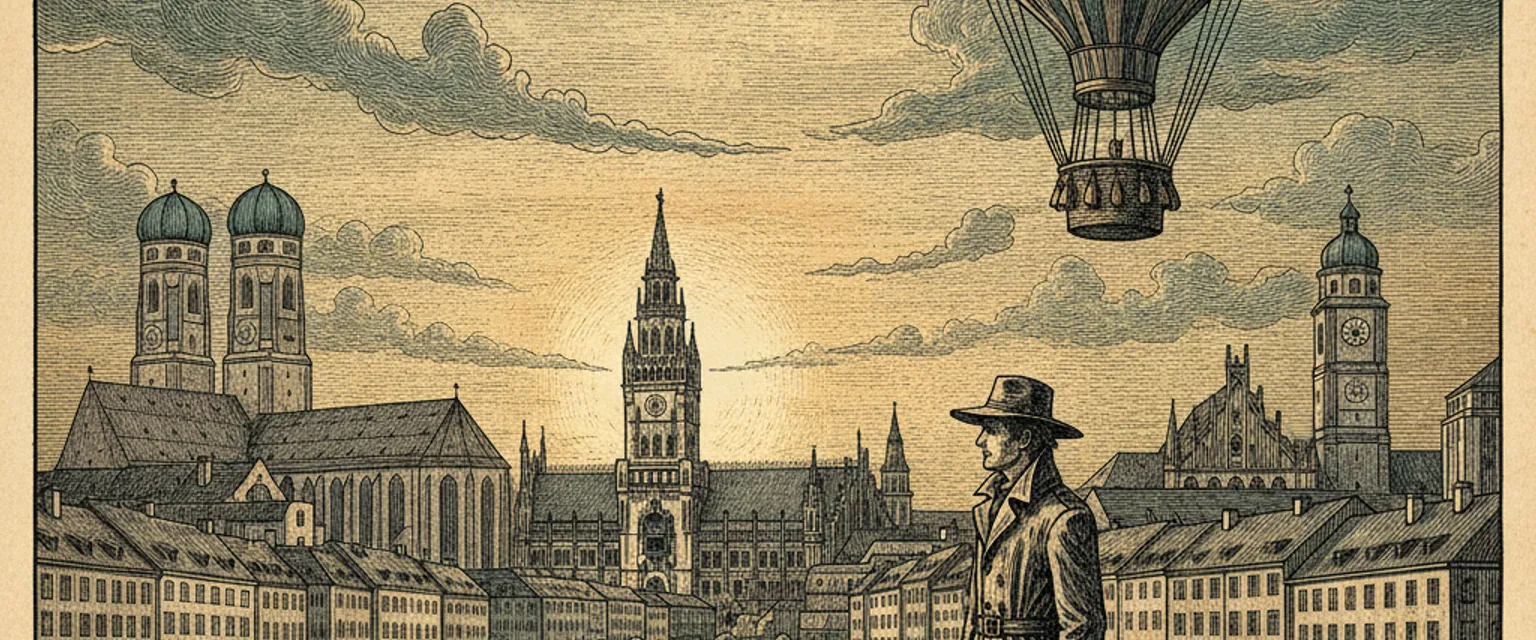
I sat down at a random spot at a shared table in the Hofbräuhaus, fully braced for the tourist-trap experience, and ended up three hours deep in a conversation with a retired Bavarian carpenter who insisted on teaching me the correct way to clink a Maß without spilling it. Eye contact, he said, always eye contact, or seven years of bad luck. By the second litre I was singing along to a song I didn't know. Munich is buttoned-up and proper right up until it decides, very suddenly, that you're family.
The Perfect Munich Itinerary (2, 3, 4 & 7 Days)
📅 Planning your dates? See the best time to visit Munich — season-by-season weather, crowds, and prices.
Two days is classic Munich — the Marienplatz glockenspiel at 11 AM, the Viktualienmarkt for lunch, a wander through the English Garden to watch the river surfers, and a proper beer-hall night. Tight, but it hits every note the city is famous for.
Book a beer-hall table for a group, but solo travellers can always grab a seat at a shared Stammtisch — just ask first.
72 Hours: Add the Residenz and the Museums
Three days lets you slow down and go indoors — the opulent Residenz palace, one of the Pinakothek art museums, and the Asamkirche, a tiny Baroque explosion most visitors walk straight past. You start to see the wealthy, cultured Munich behind the lederhosen.
4 Days: Nymphenburg, Olympiapark & BMW
Four days adds the grand and the modern — Schloss Nymphenburg's summer-palace gardens, the 1972 Olympiapark, and BMW Welt for the petrolheads. It's Munich showing off its money and its design pedigree, both of which it has in abundance.
7 Days: The Alps Within Reach
A week turns Munich into a basecamp. Day-trip to fairy-tale Neuschwanstein, sobering Dachau, and the mountain air of Garmisch or the Zugspitze. Back in the city you'll have time for the Deutsches Museum, a swim in the Eisbach, and beer gardens you'd never otherwise find. By the end the Alps feel like your back garden.
Estimated budget:$340-$560
Estimated budget:$500-$820
Estimated budget:$650-$1,060
Estimated budget:$1,150-$1,900
Day 1
Marienplatz, Viktualienmarkt & the English Garden
The old town heart, then Munich's beloved green lung
Marienplatz & the Glockenspiel
The city's central square, where 43 mechanical figures dance at 11 AM daily.
Marienplatz has been Munich's beating heart since 1158. The neo-Gothic New Town Hall dominates it, and its Glockenspiel performs a clattering, slightly creaky carillon show at 11 AM (and noon, and 5 PM in summer). It's gloriously kitsch — watch it once. Then climb the New Town Hall tower or the nearby St. Peter's (Alter Peter) for the best rooftop view of the old town and, on clear days, the Alps.
Viktualienmarkt
A 200-year-old open-air food market with its own beer garden in the middle.
The Viktualienmarkt is Munich's daily gourmet market — 140 stalls of cheese, charcuterie, spices, flowers and Bavarian specialities. Build a picnic of Leberkäse, a pretzel and a Weisswurst (eaten before noon, by tradition, never with a knife), then sit in the central beer garden, where you're allowed to bring your own food and just buy the beer. It's the most local lunch in the city centre.
Englischer Garten & the Eisbach surfers
One of the world's largest urban parks, with a permanent standing wave full of surfers.
The English Garden is bigger than New York's Central Park, and at its southern tip the Eisbach river forms a standing wave where wetsuited surfers ride year-round — utterly surreal and free to watch. Walk north to the Chinese Tower beer garden, sprawl on the grass, and don't be startled by the nudists; this is a clothing-optional park and the Bavarians are entirely relaxed about it.
Hofbräuhaus or Augustiner-Keller
The world's most famous beer hall — and a quieter, better-loved local alternative.
The Hofbräuhaus is touristy, loud and undeniably fun, with an oompah band and litre Maß steins under vaulted, painted ceilings. For something more local, the Augustiner-Keller serves what many Münchners swear is the city's best beer in a vast chestnut-shaded garden. Either way: order a half-chicken (Hendl) or pork knuckle (Schweinshaxe), make eye contact when you toast, and settle in.
Day 2
Residenz, Odeonsplatz & Baroque Churches
The Wittelsbach dynasty's palaces and hidden chapels
Munich Residenz
The Wittelsbachs' city palace — 130 rooms of staggering Bavarian wealth.
The Residenz was the seat of Bavaria's royal Wittelsbach family for over 400 years and is one of Europe's great palace complexes. The highlights are the barrel-vaulted Antiquarium (Germany's largest Renaissance hall) and the Treasury, glittering with crowns and reliquaries. It's vast, so the audio guide is essential to avoid drift. Give it a solid two hours and don't skip the Cuvilliés Theatre if it's open.
Odeonsplatz & the Asamkirche
Italianate grandeur, then a jewel-box Baroque church the brothers built for themselves.
From the Residenz, walk to Odeonsplatz with its Italian-style Feldherrnhalle loggia and the yellow Theatinerkirche. Then make a beeline for the Asamkirche on Sendlinger Strasse — a tiny, almost overwhelming Baroque church the Asam brothers built next to their own home in the 1730s. Every surface drips with gold, frescoes and twisting columns. Most tourists walk right past the modest façade; don't.
Glockenbachviertel
Munich's most stylish quarter — small-plate restaurants, cocktail bars and a buzzy nightlife.
The Glockenbachviertel is Munich's hip, design-conscious district and the centre of its LGBTQ+ scene. The streets around Gärtnerplatz fill with neighbourhood restaurants, natural-wine bars and late-night spots that feel a world away from the beer halls. Have dinner at one of the small-plates places, then drift between bars. It's where younger Münchners actually spend their nights.
Day 3
The Pinakotheks & Maxvorstadt
World-class art and the student quarter
Alte or Pinakothek der Moderne
Three great art museums on one block — pick by century and don't overdo it.
The Kunstareal in Maxvorstadt packs three major galleries together. The Alte Pinakothek holds Old Masters — Dürer, Rubens, Rembrandt. The Pinakothek der Moderne spans 20th-century art, design and architecture. The Neue Pinakothek (check its reopening status) covers the 19th century. Choose one according to taste; on Sundays many charge just one euro entry. Two focused hours beats a forced marathon.
Maxvorstadt cafés
The university quarter — cheap eats, good coffee and a student-paced afternoon.
Maxvorstadt is home to Munich's universities, which means good, affordable food and proper coffee. Grab lunch around Türkenstrasse or Schellingstrasse, where döner, Vietnamese spots and old-school cafés sit side by side. The Schelling-Salon is a historic café-billiards hall where Lenin and Hitler both once played; today it's just a great, unfussy place for schnitzel and a beer.
Königsplatz & the museums of antiquity
A neoclassical square the Nazis used for rallies — now reclaimed by Greek and Roman art.
Königsplatz is a grand neoclassical square modelled on the Athenian Acropolis, flanked by the Glyptothek (Greek and Roman sculpture) and the Antikensammlungen (classical antiquities). The square has a darker history as a Nazi parade ground; the nearby NS-Dokumentationszentrum confronts that past head-on and unflinchingly. It's a thoughtful, layered afternoon for anyone wanting the full Munich, light and shadow.
Day 4
Nymphenburg, Olympiapark & BMW Welt
Summer palace, Olympic legacy and Bavarian engineering
Schloss Nymphenburg
A Baroque summer palace with a canal out front and gardens you can get lost in.
Schloss Nymphenburg was the Wittelsbachs' summer residence, a broad Baroque palace with a grand central hall and the famous Gallery of Beauties — 36 portraits of women commissioned by King Ludwig I. The real draw is the enormous park behind, with pavilions, a cascade and tree-lined canals where Münchners ice-skate in winter. Take the tram out (it's a few stops from the centre) and give the gardens an unhurried morning.
Olympiapark
The tent-roofed site of the 1972 Games, now a park for concerts, climbing and views.
Olympiapark, built for the 1972 Summer Games, is defined by Frei Otto's sweeping, transparent tent-canopy roofs — radical then, still striking now. You can climb the roof on a guided tour, zip-line across the stadium, or just hike up the Olympiaberg, a grassy hill of wartime rubble, for a panorama back toward the Alps. It's also Munich's main concert and festival venue, so check what's on.
BMW Welt & Museum
The bowl-shaped museum and gleaming delivery centre of Bavaria's most famous brand.
Right next to Olympiapark, BMW Welt is the brand's futuristic showroom-and-delivery hub, free to enter and full of gleaming cars and motorbikes you can sit in. Across the bridge, the bowl-shaped BMW Museum (ticketed) traces a century of design and engineering. Even if you're not a car person, the architecture alone justifies the stop. Petrolheads should budget extra time and self-control.
Day 5
Neuschwanstein Day Trip
The fairy-tale castle that inspired Disney
Neuschwanstein Castle
Mad King Ludwig's hilltop fantasy — the most photographed castle on earth.
Neuschwanstein, about two hours south of Munich, is King Ludwig II's extravagant 19th-century fantasy castle, the model for Disney's Sleeping Beauty palace. Entry is by timed guided tour only, so book online well ahead. The interior is opulent but the real magic is the setting and the view from the Marienbrücke bridge across the gorge. Reach it by guided coach tour or train to Füssen plus a bus — either way, plan the whole day.
Hohenschwangau & the lakes
Ludwig's childhood castle and two alpine lakes at the foot of the mountains.
In the valley below sits Hohenschwangau, the warmer, lived-in castle where Ludwig grew up — well worth a combined ticket if you have time. The two lakes, Alpsee and Schwansee, are gorgeous for a lakeside lunch or a short walk with the Alps reflected in the water. The village restaurants are touristy but fine; better to pack something and eat by the Alpsee shore.
Day 6
Dachau & the Deutsches Museum
Remembrance in the morning, science in the afternoon
Dachau Concentration Camp Memorial
The first Nazi concentration camp — a sobering, essential half-day.
Dachau, the first Nazi concentration camp, opened in 1933 and is now a memorial site about 30 minutes from Munich by S-Bahn and bus. The preserved gate, barracks reconstructions, and museum document the camp's history with unsparing clarity. It is harrowing and important; the free two-and-a-half-hour guided tour gives crucial context. Go in the morning, allow it your full attention, and don't try to pair it with anything frivolous straight after.
Deutsches Museum
The world's largest science and technology museum, on an island in the Isar.
The Deutsches Museum is the largest science and technology museum on earth — aircraft hung from the ceiling, full-size mining tunnels, a planetarium and hands-on demonstrations including a genuinely loud lightning show. It's vast and currently part-modernised, so target a few halls rather than all of them. After the weight of the morning, its curiosity and noise feel almost cleansing. The island setting on the Isar is lovely too.
Day 7
Isar River, Beer Gardens & a Slow Goodbye
The river city at its most relaxed
Isar riverbanks & a swim
Munich's wild river, where locals tube, sunbathe and swim all summer.
The Isar runs green and surprisingly wild through the middle of the city, and in summer Münchners colonise its gravel banks to sunbathe, barbecue and swim in the brisk current. Walk or cycle the renaturalised stretch south from the Deutsches Museum toward the Flaucher, an island beer-garden idyll. Bring a towel and swim if you're brave — the water is cold, clean and properly refreshing.
Hirschgarten beer garden
The world's largest beer garden, complete with a herd of resident deer.
The Hirschgarten seats around 8,000 people under chestnut trees and is the largest beer garden in the world, yet it stays genuinely local. It even has a fenced deer enclosure that gives it its name. Order a Maß and a roast chicken, claim a bench, and have the slow, beery, deeply Bavarian lunch that a final day deserves. Self-service is cheaper; the waiter-served section costs a little more.
Viktualienmarkt maypole & a farewell beer
Back where you started — for a last pretzel under the blue-and-white maypole.
Loop back to the Viktualienmarkt for a final, fitting goodbye beneath the blue-and-white Maibaum (maypole), whose painted panels show the city's trades and traditions. Buy a last giant pretzel, sit in the beer garden one more time, and watch the after-work crowd roll in. Munich is a city that rewards repetition; ending where you began feels exactly right.
Munich is the great contradiction of German cities: deeply traditional and seriously rich, conservative in its lederhosen yet quietly one of the design and engineering capitals of Europe. It throws the world’s biggest beer party every autumn and houses some of its finest art the rest of the year. Most visitors come for the clichés — steins, pretzels, oompah — and leave surprised by how cultured, green and genuinely warm the place turns out to be.
This itinerary leans into both sides. The early days cover the postcard Munich — Marienplatz, the beer halls, the English Garden — then steer you toward the palaces, the Pinakotheks and the engineering temples that show where Bavaria’s confidence comes from. The longer plans use the city as it’s meant to be used: as a launchpad to Neuschwanstein, the Alps, and the hard, necessary history at Dachau.
Practically: Munich is compact and the public transport is superb, so buy a day pass and skip the taxis. Beer gardens follow one beautiful rule — you can bring your own food and just buy the drinks — so a market picnic plus a Maß is the best-value meal in town. And eat your Weisswurst before noon if you want the locals to take you seriously.
Use the duration filter above to find your version, from a brisk beer-and-Marienplatz weekend to a full week with the Alps in arm’s reach.
This article contains affiliate links marked with rel="sponsored". We may earn a commission at no extra cost to you.