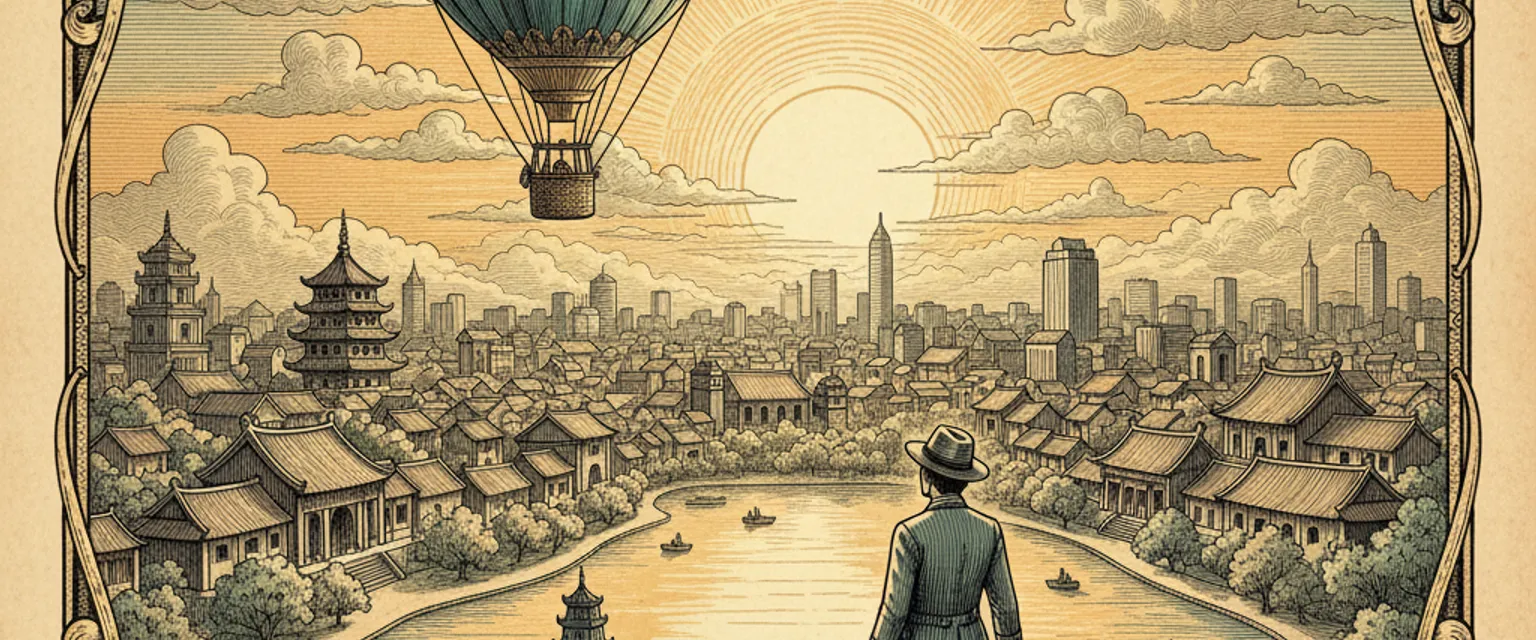
My first morning in Hanoi I stood frozen at the edge of a road, watching an unbroken river of motorbikes pour past, certain that crossing it meant death. An old woman carrying baskets on a pole simply stepped off the kerb and walked through it at a steady pace, the bikes flowing around her like water around a rock. She glanced back at me, amused, and waved me on. I closed my eyes, walked, and lived. Hanoi runs on that exact logic: total apparent chaos that somehow works perfectly, as long as you stop hesitating and join it. By day three I was crossing without looking.
Two days throws you into the deep end: the chaotic, wonderful Old Quarter, the lake at its heart, and a relentless campaign of eating pho, bun cha, and egg coffee. It's intense and a little overwhelming, in the best way. You'll leave with your senses scrambled and a new addiction to Vietnamese coffee.
Do this one thing: eat bun cha for lunch where Obama and Bourdain did, then keep eating everything.
Add the history and the temples
A third day adds the city's serious history: the Ho Chi Minh Mausoleum complex, the thousand-year-old Temple of Literature, and the haunting old prison. You move past the street-food blur into the layers, dynastic, colonial, and revolutionary, that made this complicated, fascinating capital.
Hanoi plus Ha Long Bay
Four days lets you escape to Ha Long Bay, the limestone-karst seascape that's one of Asia's great sights, ideally on an overnight cruise. You balance the frenetic city with kayaking among islands and a night on the water. This is my recommended length for a first visit to the north.
Hanoi as a base for the north
A week opens up northern Vietnam: the rice terraces and hill tribes around Sapa or Mai Chau, the quieter karst landscapes of Ninh Binh, and time to dig deep into Hanoi's food, coffee, and craft villages. Seven days is for travellers who want the north, not just its capital.
Estimated budget:$120-$300
Estimated budget:$180-$450
Estimated budget:$300-$700
Estimated budget:$550-$1300
Day 1
The Old Quarter and the Lake
Dive into the chaos and start eating
The Old Quarter
A thousand-year tangle of trade streets, each named for its old guild.
The historic heart of Hanoi is a sensory assault of 36 ancient guild streets, where Hang Bac still sells silver and Hang Ma sells paper offerings. Just walk and get lost, dodge the motorbikes, peer into the narrow tube houses, and stop for an egg coffee whenever your nerves need it. There's no better introduction to the city's controlled chaos.
Hoan Kiem Lake
The serene green heart of the city, with a legend of a magic sword.
The lake is Hanoi's calm centre, ringed by a leafy path where locals do tai chi at dawn. Cross the red Huc Bridge to Ngoc Son Temple on its tiny island. The legend says a giant turtle reclaimed an emperor's sword here. At weekends the surrounding streets close to traffic and the whole city comes out to stroll. A breather between food stops.
Cafe Giang Egg Coffee
The birthplace of Hanoi's famous whipped-yolk coffee.
Egg coffee (ca phe trung) sounds wrong and tastes like liquid tiramisu: strong Vietnamese coffee under a thick, sweet, whipped egg-yolk cream. Cafe Giang, down a hidden alley, invented it in 1946 when milk was scarce. Climb to the cramped upper floor, order one hot, and understand why this city is obsessed with coffee. A perfect afternoon ritual.
Day 2
Street Food and the West Lake
Eat like a local, then find some quiet
Bun Cha Huong Lien
Grilled pork and noodles, made famous by Obama and Bourdain.
Bun cha is Hanoi's signature lunch: smoky grilled pork patties and belly in a sweet-sour fish-sauce broth, with rice noodles and herbs to dunk. Huong Lien is where Anthony Bourdain shared a meal with Barack Obama, and they've kept the table as a shrine. It's touristy now but still genuinely good. Order the nem (crab spring rolls) too.
Hanoi Train Street
Cafes packed inches from a working railway line.
On a narrow residential lane, the daily trains thunder past just centimetres from cafe tables crammed against the houses. It's become a viral sensation, and the authorities periodically close it for safety, so check before going. When it's open, sitting with a coffee as a train roars by is a uniquely Hanoi thrill. Respect the residents and the timetable.
West Lake & Tran Quoc Pagoda
The city's largest lake and its oldest Buddhist temple at sunset.
Escape the Old Quarter crush to the breezier, more upscale West Lake. The 6th-century Tran Quoc Pagoda sits on a causeway out into the water, gorgeous in the low evening light. The surrounding streets have the city's best craft beer and lakeside restaurants. A calmer, leafier side of Hanoi to end a full day of eating.
Day 3
History and Temples
The dynastic, colonial, and revolutionary layers
Ho Chi Minh Mausoleum Complex
The embalmed founder of modern Vietnam, in a stark granite monument.
Go early; it closes by late morning and the queues are long. Ho Chi Minh's embalmed body lies in state in a solemn Soviet-style mausoleum (he wanted to be cremated, ironically). The complex includes his modest stilt house and the One Pillar Pagoda. Dress respectfully, no shorts. It's a powerful window into the country's revolutionary identity.
Temple of Literature
Vietnam's first university, founded in 1070, a serene Confucian oasis.
A beautifully preserved complex of courtyards, ponds, and pavilions dedicated to Confucius, this was Vietnam's first national university. The stone stelae mounted on turtles record centuries of doctoral graduates. It's a calm, ordered counterpoint to the street chaos, and you'll see students taking graduation photos. One of the loveliest spots in the city.
Hoa Lo Prison
The grim colonial jail sardonically nicknamed the Hanoi Hilton.
Built by the French to hold Vietnamese political prisoners, later used for captured American pilots including John McCain. The exhibits are unmistakably one-sided propaganda, which is itself fascinating, but the colonial-era cells and guillotine make for a sobering, essential visit. Allow an hour. It puts the city's 20th-century history in stark, uncomfortable focus.
Day 4
Ha Long Bay
Out to the karst islands of the sea
Ha Long Bay Cruise
Thousands of limestone karsts rising from emerald water.
One of Asia's iconic seascapes, about 2.5 hours from Hanoi: nearly 2,000 jungle-topped limestone islands jutting from jade-green water. Do an overnight cruise rather than a rushed day trip; the bay is at its best at dawn and dusk when the day boats have gone. Choose a reputable operator and consider quieter Lan Ha or Bai Tu Long Bay to dodge the crowds.
Kayaking & Sung Sot Cave
Paddle through lagoons and explore a vast grotto.
Cruises include kayaking or bamboo-boat trips through hidden lagoons and floating fishing villages, plus a walk into a cavern like the cathedral-sized Sung Sot (Surprise) Cave. Swimming off the boat in the warm bay and watching the sun set behind the karsts is the whole point. This is the trip people remember most from northern Vietnam.
Day 5
Ninh Binh Day Trip
The inland Ha Long among the rice fields
Tam Coc
A rowboat through karst caves and flooded rice paddies.
Two hours south of Hanoi, Ninh Binh is the dry-land version of Ha Long: the same dramatic limestone peaks, but rising from green rice fields and rivers. At Tam Coc, local women row you (often with their feet) through low river caves between the towers. Go when the rice is golden, around May or June, for the most beautiful version.
Trang An & Hang Mua
A UNESCO boat route and a 500-step climb to a dragon-topped peak.
Trang An offers a longer, quieter boat journey through caves and past ancient temples, a UNESCO site used as a Kong: Skull Island film location. Then climb the roughly 500 steps up Hang Mua for a sweeping panorama of the Tam Coc valley with its winding river. The viewpoint at the top, crowned by a stone dragon, is one of Vietnam's best.
Day 6
Mountains and Hill Tribes
Up into the terraced highlands
Mai Chau Valley
A peaceful valley of stilt houses and White Thai villages.
Closer and gentler than far-flung Sapa, Mai Chau is a green valley of rice paddies and traditional White Thai stilt-house villages, about three hours from Hanoi. Cycle the flat lanes between the fields, visit a weaving village, and stay overnight in a homestay if you can. It's an easy, authentic taste of highland Vietnam without the long journey north.
Lac Village Homestay Dinner
A communal stilt-house meal of grilled fish and rice wine.
Eating with a White Thai family in Lac Village is the highlight: sticky rice cooked in bamboo, grilled river fish, local greens, and the inevitable rounds of ruou can rice wine sipped through long communal straws. There's often music and dancing. It's warm, unpretentious, and a complete contrast to Hanoi's frenzy. The best night of the week.
Day 7
Crafts, Coffee, and Farewell
One last loop through the city's pleasures
Bat Trang Ceramic Village
A 700-year-old pottery village on the city's edge.
Half an hour from the centre, Bat Trang has been making ceramics since the 14th century. Wander the workshops and the market of bowls, vases, and tea sets, try your hand at the wheel, and buy gifts far better and cheaper than the Old Quarter tourist shops. A relaxed, hands-on morning and a window into Hanoi's craft traditions.
Pho Gia Truyen
A last bowl of Hanoi's legendary beef noodle soup.
End where Hanoi food begins: a bowl of pho at Pho Gia Truyen on Bat Dan street, a no-frills institution where you queue, pay, and squeeze onto a shared bench. The broth is clear, deep, and beefy, the result of decades of practice. There's no better farewell to the city than its defining dish, slurped elbow to elbow with locals.
Hanoi does not ease you in. It grabs you by the collar at the airport and doesn’t let go: a thousand-year-old capital where motorbikes flow like rivers, where the food is some of the best on the planet and costs almost nothing, where French-colonial shophouses crumble elegantly under a tangle of electrical wires. It is loud, hot, chaotic, and utterly intoxicating. You come thinking you’ll see a city and you leave realising you’ve eaten your way through a culture.
How to use this plan
The first rule is to surrender to the chaos, especially the traffic: cross the road at a slow, steady pace and let the bikes flow around you, and never freeze halfway. Two days is enough to dive into the Old Quarter, circle Hoan Kiem Lake, and launch a serious eating campaign through pho, bun cha, and egg coffee. Three adds the heavy history, the Ho Chi Minh complex, the Temple of Literature, and the grim old prison, that gives the city its depth. Four, my recommended length, gets you out to Ha Long Bay for an overnight among the limestone karsts.
The 7-day plan turns Hanoi into a base for the whole north: the inland karst landscapes and rice fields of Ninh Binh, a homestay in the Mai Chau highlands among the White Thai villages, and the ceramic and craft villages on the city’s edge. With a week you get a genuine slice of northern Vietnam, not just its frenetic capital.
A few honest notes
Time it right: October to December and March to April are the comfortable windows, avoiding both the punishing summer heat and the cold, grey drizzle of deep winter. Eat at the busy street stalls, that’s where the best, freshest food is, and follow the crowds of locals to the right ones. Use Grab (the local ride app) for honest fares, carry small notes for street food, and pace your coffee intake, because the Vietnamese stuff is rocket fuel. Above all, lean into the energy rather than fighting it. Hanoi rewards the bold and bewilders the timid.
This article contains affiliate links marked with rel="sponsored". We may earn a commission at no extra cost to you.