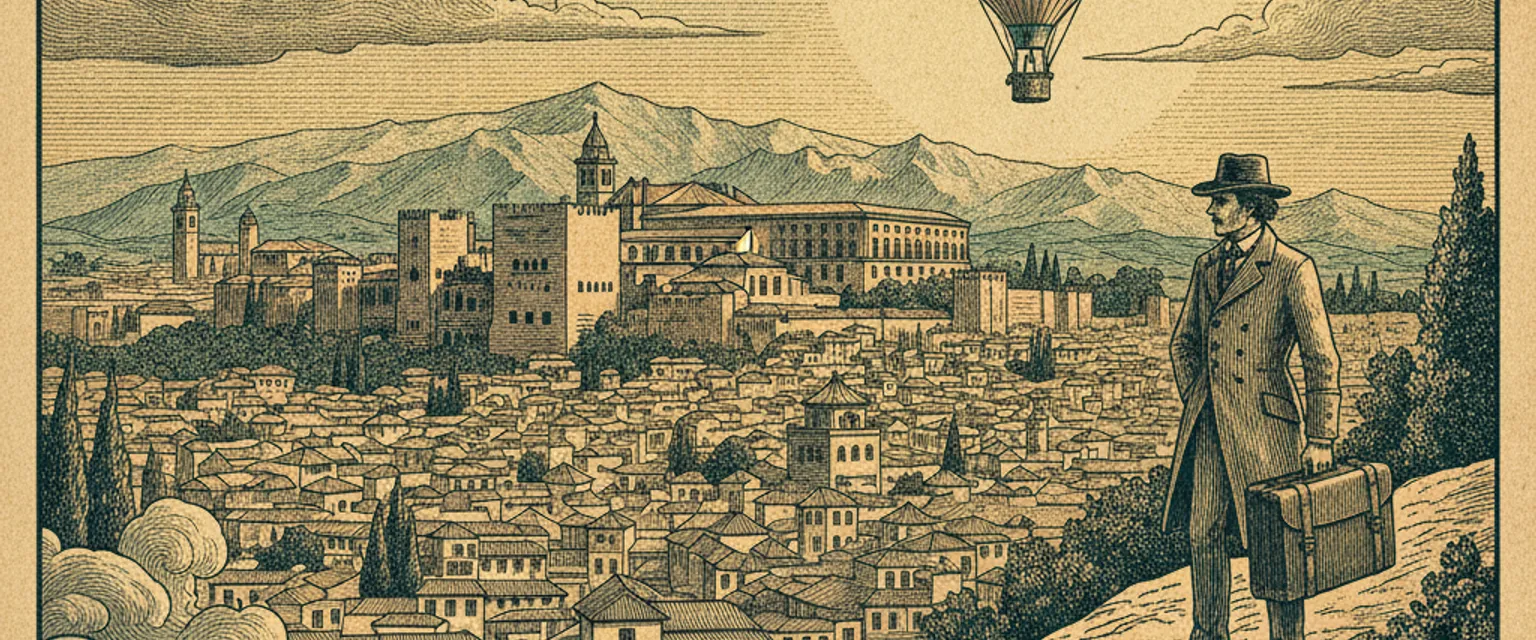
I ordered a beer at a tiny bar in the Albaicín and the waiter set down a plate of jamón and a wedge of tortilla without my asking. I ordered another, and a different plate appeared. In Granada the tapas are still free — a custom that vanished from the rest of Spain decades ago — and by the third round I realised I had eaten dinner and spent six euros. Then the sun hit the Alhambra across the ravine and turned the whole fortress the colour of rust and fire, and I understood why nobody here is ever in a hurry.
Two days is the Alhambra — book it weeks ahead — and the Albaicín, the old Moorish quarter, with sunset from the Mirador de San Nicolás. In between, you tapas-crawl your way through the lower town, where a drink still comes with free food. That is genuinely enough to fall in love.
Alhambra tickets sell out weeks ahead and your Nasrid Palaces slot is timed to the minute. Book first, plan everything else around it.
72 Hours: Add the Cathedral, the Royal Chapel, and Sacromonte
Three days adds the Cathedral and the Royal Chapel where Isabella and Ferdinand are buried, the Arab baths, and a flamenco night in the cave bars of Sacromonte. You also get an unhurried morning in a teteria, the Moroccan-style tea houses that fill the streets below the Alhambra.
4 Days: Into the Sierra or the White Villages
Four days earns a trip into the mountains that frame the city — skiing or hiking the Sierra Nevada depending on the season, or a drive into the Alpujarras, the chain of white villages where the last Moors retreated and where they still weave rugs and cure ham the old way.
7 Days: Granada and the Soul of Andalusia
A week lets Granada breathe. You do the city slowly, hike a Sierra trail, spend a night in an Alpujarras village, and still have time for a day trip to the cliff-hanging town of Ronda or the caves of Guadix. By the end the free-tapas rhythm has rewired your whole sense of how to eat.
Estimated budget:$260-$440
Estimated budget:$380-$640
Estimated budget:$520-$880
Estimated budget:$950-$1650
Day 1
The Alhambra
A full day inside the last and greatest Moorish palace in Europe
Nasrid Palaces
The carved-stucco, tile-and-water heart of the Alhambra and the finest Islamic interior in Europe.
The Nasrid Palaces are the reason the Alhambra is the most visited monument in Spain — room after room of carved stucco, honeycombed ceilings, calligraphy, and the Court of the Lions with its alabaster fountain. Your entry is timed to the half hour and strictly enforced, so build your day around that slot. Go as early as you can; the light through the lattice windows in the morning is unforgettable.
Generalife Gardens
The sultans' summer gardens, all cypress, running water, and clipped hedges above the city.
The Generalife was the summer estate of the Nasrid sultans — terraced gardens of roses, cypress, and pools where water runs along the banisters of the staircases. The Patio de la Acequia, a long courtyard with arcing fountain jets, is the most photographed garden in Spain. It is a short walk uphill from the palaces and included in your ticket.
The Alcazaba
The oldest part of the Alhambra — a military fortress with the best view in the city.
The Alcazaba is the original fortress of the complex, all reddish ramparts and ruined towers. Climb the Torre de la Vela, the watchtower where the cross and the Castilian flag were raised in 1492, for a 360- degree view over Granada, the Albaicín on the facing hill, and the Sierra Nevada behind. This is the highest, oldest, and quietest corner of the Alhambra.
Tapas Crawl on Calle Navas
Granada's famous free-tapas street, where every drink comes with a plate.
Calle Navas, near Plaza del Carmen, is the classic tapas street — a long pedestrian run of bars where ordering a caña (small beer) or a glass of wine gets you a free plate of food. Hop between three or four: Los Diamantes for fried fish, Bodegas Castañeda for vermouth and a board of cheese and ham. By the fourth bar you have eaten a full meal.
Day 2
The Albaicín + Sunset
The old Moorish quarter, the Arab baths, and the great sunset lookout
Albaicín Walk + Calle Calderería
A UNESCO maze of whitewashed houses, hidden carmen gardens, and a Moroccan tea street.
The Albaicín is the old Moorish quarter, a UNESCO-listed tangle of steep cobbled lanes, whitewashed houses, and walled carmen gardens climbing the hill opposite the Alhambra. Calle Calderería Nueva is the atmospheric tea street, lined with teterias and Moroccan shops selling lamps and slippers. Get deliberately lost; that is how you find the quiet plazas and the hidden views.
Hammam Al Ándalus
Andalusian Arab baths near the cathedral, restoring a tradition the city perfected centuries ago.
Granada has revived its Arab bath tradition, and Hammam Al Ándalus, just below the Albaicín, is the loveliest — candlelit rooms of warm, hot, and cold pools under horseshoe arches, with the option of a massage. Book a slot in advance. It is the perfect midday reset before the climb to the sunset lookout, and a quiet counterpoint to the tapas-bar evenings.
Mirador de San Nicolás
The lookout where all of Granada gathers to watch the Alhambra glow at sunset.
The Mirador de San Nicolás, at the top of the Albaicín, is the most famous viewpoint in the city — a terrace facing the Alhambra straight on, with the Sierra Nevada rising white behind it. As the sun drops, the whole fortress turns red-gold and a crowd of travellers, buskers, and locals fills the square. Arrive 45 minutes before sunset for a spot on the wall, then have a drink at a nearby carmen restaurant.
Day 3
Royal Granada + Flamenco
The Christian city, the Catholic monarchs, and the caves of Sacromonte
Royal Chapel (Capilla Real)
The marble tombs of Isabella and Ferdinand, who finished the Reconquista right here in 1492.
The Capilla Real holds the tombs of Isabella and Ferdinand, the Catholic Monarchs who took Granada in 1492 and chose to be buried in their final conquest. The marble effigies, the lead coffins in the crypt below, and Isabella's personal art collection (including Botticelli and Memling) make this a richer stop than the cathedral attached to it. Small, dense, and historically enormous.
Granada Cathedral
A vast Renaissance cathedral built atop the city's great mosque, blazing white inside.
Granada Cathedral was begun in 1523 on the site of the main mosque and is one of the great Renaissance churches of Spain — enormous, luminous, with soaring white columns and a gilded main chapel. It feels almost aggressively bright after the intimate spaces of the Moorish city, a deliberate statement of the new order. The surrounding Alcaicería, the old silk-market alleys, is good for a wander afterward.
Sacromonte Flamenco Caves
Zambra flamenco in the whitewashed cave houses of the historic Roma quarter.
Sacromonte, the hillside quarter beyond the Albaicín, is the home of the zambra — the distinctive Granada style of flamenco performed in the whitewashed cave houses dug into the hill. Venues like Cuevas Los Tarantos and Venta El Gallo put on intimate, raw shows; book one that includes the walk up or a transfer, because the climb is steep and the lanes are dark. The Sacromonte Caves Museum nearby explains the history by day.
Day 4
The Alpujarras
The white villages where the last Moors retreated into the mountains
Pampaneira, Bubión + Capileira
Three flat-roofed white villages stacked up a gorge in the high Alpujarras.
About 90 minutes south of Granada, the Poqueira Gorge holds three stacked white villages — Pampaneira, Bubión, and Capileira — with flat clay roofs, chimney pots, and streets threaded with running water channels, an architecture brought from the Berber Atlas. Pampaneira is the easiest to reach and the best for craft shops; Capileira, highest of the three, is the trailhead for serious Sierra Nevada hikes.
Plato Alpujarreño Lunch
The mountain feast plate — cured ham, blood sausage, fried egg, potatoes, and chorizo.
Lunch in the Alpujarras means the plato alpujarreño, a hearty mountain plate of locally cured jamón serrano, morcilla (blood sausage), chorizo, fried potatoes, and a fried egg. The village of Trevélez, higher up the range, is famous across Spain for curing ham in its cold dry air. Pair it with a rough local rosé and you will not need dinner.
Day 5
Sierra Nevada
Up into mainland Spain's highest mountains, by ski or by trail
Sierra Nevada
Europe's southernmost ski resort in winter, high-altitude hiking the rest of the year.
The Sierra Nevada rises directly behind Granada and holds mainland Spain's highest peak, Mulhacén, at 3,479 metres. In winter it is Europe's southernmost ski resort, less than an hour from the city — you can genuinely ski in the morning and be on the coast by afternoon. In summer the high lifts open for hikers and the alpine meadows fill with rare wildflowers. Check the season; the resort road closes in shoulder months.
Los Cahorros de Monachil
A gorge hike with hanging bridges, just twenty minutes from the city centre.
If you want the mountains without the altitude, the Cahorros de Monachil gorge is a 20-minute drive from Granada — a dramatic walk through a narrow canyon on rope-and-plank hanging bridges over the rushing Monachil river. The full loop takes a few hours and ends in the pretty village of Monachil, where you can have a late lunch. It is the locals' favourite easy escape.
Day 6
Day Trip to Guadix or Ronda
Cave dwellings on the high plateau, or Spain's most dramatic cliff town
Guadix Cave Houses
A whole district of whitewashed cave homes dug into pink rock pinnacles on the plateau.
Guadix, about an hour east of Granada, has one of Europe's largest communities still living in cave houses — thousands of homes carved into the soft pink rock of the Hoya de Guadix, marked only by white chimneys poking out of the hillsides. The Barrio de las Cuevas has a cave museum you can tour, and a few caves operate as quirky hotels. The town also has a striking sandstone cathedral. A genuinely otherworldly half day.
Badlands Viewpoint + Lunch
The Mirador del Fin del Mundo over the cave-dotted desert badlands of Guadix.
Just outside Guadix, the Mirador del Fin del Mundo — the End of the World viewpoint — looks out over the eroded clay badlands studded with white cave-house chimneys and the Sierra Nevada beyond. It is one of the strangest landscapes in Spain. Have lunch back in town at a traditional venta before the drive back; the local lamb is the thing to order.
Day 7
Slow Granada
The corners you skipped, a long tea, and a last sunset
Carmen de los Mártires
A romantic free garden estate beside the Alhambra, with peacocks and Alhambra views.
Just past the Alhambra entrance, the Carmen de los Mártires is a 19th-century garden estate that is free and almost always quiet — terraced gardens, a small lake, fountains, and peacocks wandering the paths, with views across to the Sierra. It is the antidote to the Alhambra crowds and one of the best-kept secrets in the city.
Teteria on Calle Calderería
Moroccan-style mint tea and pastries in a cushioned, lantern-lit tea house.
For your last slow afternoon, settle into a teteria on Calle Calderería Nueva — cushioned alcoves, brass lanterns, and a menu of dozens of teas, the classic being fresh mint poured from a height into a glass. Order a plate of Arab pastries and a pot of té moruno and stay for an hour. This street smells of spice and orange blossom and is the most atmospheric corner of the lower town.
Paseo de los Tristes + Final Drink
The riverside promenade below the Alhambra walls, golden at the end of the day.
End where the city is at its most romantic: the Paseo de los Tristes, a riverside promenade along the Darro at the foot of the Alhambra walls, with terrace bars looking straight up at the floodlit fortress. Have a final glass of Andalusian wine here as the lights come on. The name means the Walk of the Sad Ones because funeral processions once passed this way; it is now anything but.
Granada is the city where Moorish Spain made its last stand, and it has never quite stopped being two cities at once. On one hill sits the Alhambra, the greatest Islamic palace in Europe; on the facing hill is the Albaicín, a UNESCO maze of whitewashed Moorish lanes. Between them runs a lower town where, almost uniquely in Spain, a drink still comes with a free plate of food — a small daily miracle that reshapes how you eat for the whole trip.
This itinerary is built around one non-negotiable: the Alhambra sells out weeks ahead and your Nasrid Palaces entry is timed to the minute. Book that first and plan everything else around it. Beyond the headline, Granada rewards slowness — the teterias, the sunset crowd at San Nicolás, the unhurried tapas crawl that turns six euros into dinner.
The honest take: two days covers the essentials and will leave you plotting a return. Four days gets you into the Alpujarras white villages and the Sierra Nevada that frame every view. A full week lets you reach the cave town of Guadix and a real mountain village, and by then the city’s rhythm will have completely won you over.
Use the duration filter above to see your version of Granada, from a tight weekend to a slow Andalusian week.
How to use this plan
The days nest inside the longer trips, so the 2-day plan is the Alhambra and the Albaicín, the 4-day plan adds the mountains, and the 7-day plan reaches the wider region. Pick your length, book the Alhambra immediately, and leave your evenings free — the best of Granada happens after dark, one tapa at a time.
This article contains affiliate links marked with rel="sponsored". We may earn a commission at no extra cost to you.