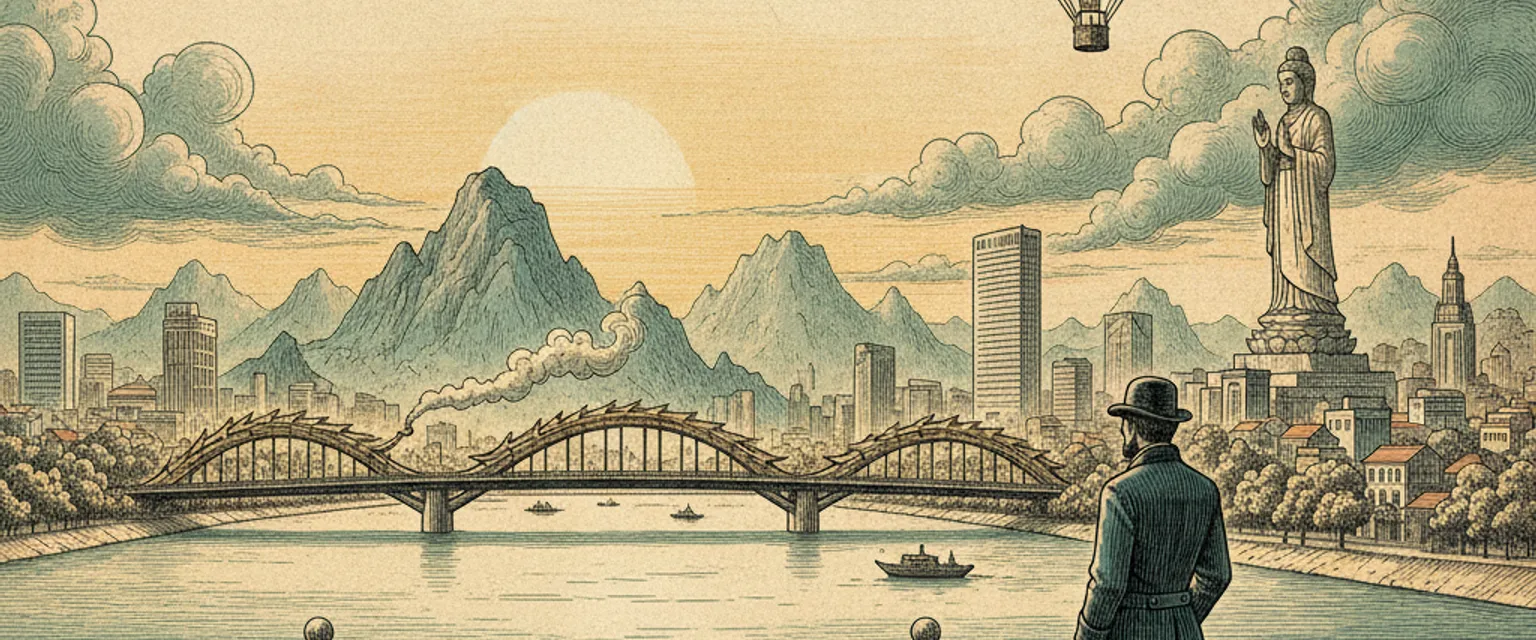
I came to Da Nang expecting a transit stop on the way to Hoi An and stayed five nights. The thing nobody warns you about is the beach: My Khe is a six-kilometre stretch of clean sand with almost no one on it at 6 AM, when the local swimming clubs are out doing their morning laps and selling coffee from baskets. I joined them on day two, badly, and never quite left the rhythm of it.
The Perfect Da Nang Itinerary (2, 3, 4 & 7 Days)
📅 Planning your dates? See the best time to visit Da Nang — season-by-season weather, crowds, and prices.
48 Hours: Beach, Marble Mountains & the Han River at Night
Two days is My Khe Beach at sunrise, the cave temples of the Marble Mountains before the heat, a bowl of mi quang for lunch, and the Dragon Bridge breathing actual fire on a weekend night. Tight, but it hits every signature note Da Nang has.
The Dragon Bridge only breathes fire and water Saturday and Sunday nights at 9 PM. Plan a weekend if you can.
72 Hours: Add Ba Na Hills and the Golden Bridge
Three days buys you a full day up at Ba Na Hills — the cable car, the surreal French village, and the Golden Bridge held up by two giant stone hands that launched a thousand photos. Go early; the queues by noon are brutal and the summit clouds over by afternoon.
4 Days: A Day Trip to Hoi An
Four days means you finally surrender to Hoi An, 40 minutes south. Spend the afternoon and evening there when the lantern-lit Old Town comes alive, eat cao lau where it was invented, then come back to Da Nang for the beach. Hoi An at night beats Hoi An at noon.
7 Days: The Full Central Coast — Hue, Son Tra & Slow Beach Days
A week lets central Vietnam unfold properly: the Hai Van Pass by motorbike, the imperial city of Hue, the Son Tra peninsula and its Lady Buddha, plus the unhurried beach mornings that are the real reason to base yourself here. This is the Da Nang regulars know.
Estimated budget:$90-$170
Estimated budget:$150-$280
Estimated budget:$220-$420
Estimated budget:$450-$850
Day 1
My Khe Beach, Marble Mountains & Dragon Bridge
Da Nang's signature trio, sunrise to fire-breathing night
Start at the beach before sunrise, hit the Marble Mountains before 10 AM while the caves are still cool, and save the Dragon Bridge for after dinner.
My Khe Beach at sunrise
Six kilometres of clean sand and the best swimming club energy in Vietnam.
My Khe (the GIs called it China Beach) is genuinely one of Asia's great urban beaches, and dawn is when it belongs to locals doing laps and drinking coffee from baskets. The water is warm and the undertow is real, so swim near the lifeguard flags. Grab a ca phe sua da from a beachfront cart afterward.
Marble Mountains (Ngu Hanh Son)
Five marble outcrops riddled with cave pagodas and Cham shrines.
Take the elevator up Thuy Son, the largest of the five, then climb down through Huyen Khong cave, a vast chamber where light shafts hit a hidden Buddha altar and the smoke from incense makes the whole thing feel staged by a film crew. Wear shoes with grip; the marble steps are slick. Skip the stone-carving shops unless you fancy hauling a Buddha home.
Mi Quang at Ba Mua
The turmeric noodle dish that belongs to this province and nowhere else.
Mi quang is Da Nang's dish: flat turmeric-yellow rice noodles with just enough broth to slick them, topped with shrimp, pork, peanuts, herbs, and a shard of toasted rice cracker you crumble in. Ba Mua does the classic version for around 40,000 dong. It is not pho and you should not order it expecting pho.
Dragon Bridge fire show
A 666-metre steel dragon that breathes real fire over the Han River.
The Cau Rong is a working road bridge shaped like a dragon, and on Saturday and Sunday nights at 9 PM its head shoots actual flames followed by jets of water that soak the front row of spectators (this is a feature). Stand on the east bank for the cleanest view. On weeknights it just glows, which is still worth a wander.
Day 2
Ba Na Hills & the Golden Bridge
Cable car to a French fantasy village in the clouds
Be at the cable car station by 8 AM. The whole site is a theme park, but the Golden Bridge and the views over the jungle are worth the kitsch.
Ba Na Hills cable car
One of the world's longest non-stop cable cars, 20 minutes over rainforest.
The ascent climbs roughly 1,400 metres over dense jungle and is genuinely spectacular when the cloud cooperates. The summit holds a full mock-French village, gardens, and a frankly bizarre indoor games arcade. It is a resort, not a wilderness, so set expectations accordingly and lean into the strangeness.
The Golden Bridge (Cau Vang)
A golden walkway cradled by two enormous weathered stone hands.
Yes, the hands are concrete and fibreglass made to look ancient, and yes, it is mobbed. Come right at opening or wait until late afternoon for a photo without forty strangers in it. On a clear day the view down the valley earns the hype; in cloud you are basically inside a postcard you cannot see.
Lunch in the French Village
Buffet food with a cathedral-square backdrop.
Dining options up top are theme-park-priced and theme-park-quality, so manage expectations. The buffet at the village square is the safest bet and the setting (a fake but charming Gothic plaza) makes up for the average food. Eat, then keep exploring the gardens and the Debay wine cellar carved into the mountain.
Day 3
Hoi An Day Trip
Lantern-lit Old Town, 40 minutes south
Go in the afternoon and stay through the evening. Hoi An's Old Town is magic after dark and merely pretty at midday under the tour-bus crowds.
Hoi An Ancient Town
A 15th-century trading port frozen, tastefully, in amber.
The UNESCO-listed Old Town is a maze of ochre merchant houses, the Japanese Covered Bridge, and tailor shops that can run up a suit overnight. Buy the town ticket for access to the heritage houses, but the real pleasure is just wandering the riverfront lanes. Avoid weekends if you can; the crowds are intense.
Cao lau at Thanh Cao Lau
A noodle found only here, made with water from one specific well.
Cao lau is Hoi An's signature dish and supposedly only authentic when made with water from the ancient Ba Le well and ash from a particular island. Thick noodles, slices of char siu pork, crunchy croutons, and greens, with almost no broth. It tastes like nothing else in Vietnam, which is rather the point.
Lantern boats on the Thu Bon
Float a paper lantern downriver and pretend you are above the cliche.
After dark, the riverfront glows with thousands of silk lanterns and you can take a sampan out to release a paper lantern onto the water. It is unapologetically touristy and somehow still beautiful. Haggle the boat price before you step in, then surrender to it.
Day 4
Son Tra Peninsula & the Lady Buddha
Monkeys, a giant white statue, and empty coast roads
Rent a scooter or hire a driver and loop the Son Tra peninsula in the morning before the heat builds.
Lady Buddha at Linh Ung Pagoda
A 67-metre white Bodhisattva watching over the bay.
The tallest Lady Buddha statue in Vietnam stands on the Son Tra slopes facing the sea, and the temple grounds give you the best panorama of the whole Da Nang coastline. Cover your shoulders and knees. Go early, before the tour buses and before the marble plaza turns into a frying pan.
Son Tra peninsula loop
Jungle switchbacks, langur monkeys, and viewpoints with no one on them.
The road around Son Tra (locals call it Monkey Mountain) climbs through protected forest where rare red-shanked douc langurs actually live. Ride carefully; the bends are sharp and the surface is patchy in spots. The eastern viewpoints over the sea are some of the quietest, finest spots near the city.
Seafood lunch at Tho Quang
Point at the tank, eat it 20 minutes later.
The Tho Quang fishing harbour area has open-air seafood restaurants where you choose your clams, mantis shrimp, or snails from tanks and they cook them simply with garlic, chilli, and lime. It is loud, cheap by Western standards, and exactly the unfussy meal you want after a morning on a scooter.
Day 5
The Hai Van Pass
Vietnam's most cinematic stretch of road
If you do one big drive in central Vietnam, make it this one. Hire a driver for the day if you are not confident on a motorbike.
Hai Van Pass
The cloud-wrapped mountain road Top Gear called the best in the world.
The pass climbs over a spur of the Truong Son range between Da Nang and Hue, with hairpins, old French and American bunkers at the summit, and views that drop straight down to the South China Sea. The new tunnel takes the trucks, so the old road is blissfully quiet. Stop at the gate ruins at the top.
Lang Co Beach
A crescent of sand and lagoon on the far side of the pass.
Just over the Hai Van on the Hue side, Lang Co is a long sweep of beach between a turquoise lagoon and the sea. It is a fine place to break the drive, swim, and eat fresh oysters at one of the simple lagoon-side stalls before turning back or pushing on to Hue.
Suoi Voi (Elephant Springs)
Cold mountain pools and an elephant-shaped boulder to swim around.
Tucked off the road between the pass and Hue, these freshwater springs run through the forest with natural pools cool enough to be a genuine relief after a hot day. A large rock shaped vaguely like an elephant gives the place its name. Bring water shoes; the riverbed is rocky.
Day 6
Hue, the Imperial City
Nguyen-dynasty citadels and royal tombs
A full day trip to Hue, two and a half hours north. The Imperial City is enormous; pace yourself and bring sun cover.
The Imperial City (Dai Noi)
A walled Nguyen-dynasty citadel, half-restored and wholly atmospheric.
Modelled loosely on Beijing's Forbidden City, Hue's citadel was the seat of Vietnam's last emperors and still bears the scars of the 1968 battle. The restored throne hall and the moss-covered ruins side by side make it more moving than a polished site would be. Budget at least two hours and start before the midday heat.
Tomb of Tu Duc
A poet-emperor's lakeside retreat that doubled as his grave.
Set among pines and a lotus lake outside the city, the Tu Duc tomb complex was built as a pleasure palace where the emperor wrote poetry long before he died. It is the most serene of Hue's royal tombs and far less crowded than the citadel. Pair it with the Khai Dinh tomb nearby if you have energy.
Bun bo Hue, on its home turf
The fiery lemongrass beef noodle soup tastes different where it was born.
Bun bo Hue is everywhere in Vietnam, but in Hue it is spicier, more lemongrass-forward, and served with cubes of congealed pig blood that you can leave or embrace. Any busy local spot near Dong Ba market will do it justice. It is the perfect refuel before the drive back to Da Nang.
Day 7
Slow Da Nang & Departure
A final beach morning and one last bowl of noodles
No big drives today. A swim, a coffee, a last good meal, and out.
Last swim at My Khe
End where you started, with the swimming clubs.
Go back to the beach one more time at dawn. By now the rhythm makes sense: the lap swimmers, the coffee baskets, the slightly amused lifeguards. This is the version of Da Nang you will actually miss, more than any bridge or cable car.
Con Market browse
A chaotic local market for last-minute snacks and gifts.
Cho Con is a sprawling indoor market where locals buy everything from dried mango and cashews to fabric and kitchenware. The food court at the back is a good cheap breakfast and a fine place to stock up on snacks for the flight. Haggle gently; prices soften fast.
Da Nang International Airport
One of the few major airports actually inside the city it serves.
Da Nang's airport sits barely three kilometres from the beach, so a taxi or Grab from anywhere central takes ten to fifteen minutes. There is no need to leave hours early the way you would in Hanoi or Saigon. Grab a final ca phe sua da landside before you go through.
Da Nang spends its whole life being underestimated. It is the airport you fly into for Hoi An, the city you mean to skip, the place tour itineraries treat as a transit lounge. That reputation is doing it a disservice. This is a genuine beach city with a six-kilometre sweep of clean sand, a mountain pass behind it that people drive across the world to ride, and two of central Vietnam’s most photographed sights within an hour of the centre.
What makes Da Nang work as a base is the geography. From here, Hoi An is forty minutes south, Hue is two and a half hours north over the Hai Van Pass, and the Marble Mountains and Ba Na Hills are short hops out of town. You can spend your days range-roaming the central coast and your mornings and evenings back at the beach, which is more than either Hoi An or Hue can offer on their own.
How to use this plan
The structure nests, so the two-day version is the city core, and each longer trip adds a layer outward. Two days covers the beach, the Marble Mountains, and the Dragon Bridge. Three adds Ba Na Hills. Four hands you Hoi An. The full week brings in Son Tra, the Hai Van Pass, and the imperial city of Hue, plus the slow beach mornings that are honestly the best part.
A few practical notes. Da Nang has a wet season roughly September through December, with real flooding risk in October and November, so the best months are the dry spell from February to July. Get a Grab account; it works for both cars and motorbikes and removes all the taxi haggling. And do not leave without eating mi quang at least twice. It is the dish this province gave the world, and you will not find a better version anywhere else.
This article contains affiliate links marked with rel="sponsored". We may earn a commission at no extra cost to you.