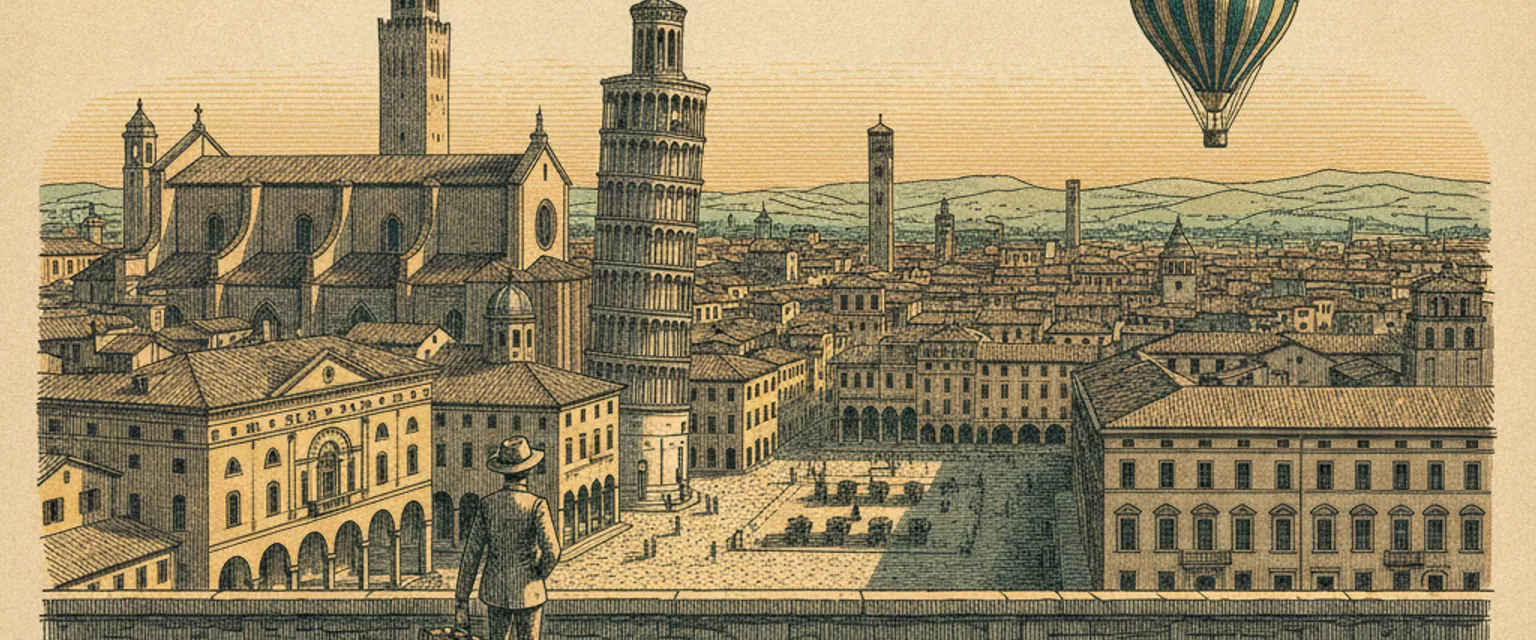
I came to Bologna for a weekend and the rain started, so I ducked under a portico to wait it out. Forty minutes later I realised I had walked nearly a kilometre, completely dry, past a market, two churches, and a bar where I drank a Negroni - all without leaving the arcade. Bologna has 38 kilometres of these porticoes, and they are the secret to the place: a city built for lingering in any weather. Then I ate tagliatelle al ragu - what the world wrongly calls bolognese - and understood why Italians make pilgrimages here. It is Italy's greatest food city, and almost nobody abroad knows.
The Perfect Bologna Itinerary (2, 3, 4 & 7 Days)
📅 Planning your dates? See the best time to visit Bologna — season-by-season weather, crowds, and prices.
Two days is enough to fall hard for Bologna: climb the leaning Asinelli tower, graze the Quadrilatero food market, eat tagliatelle al ragu where it was invented, and walk the endless porticoes. It is a compact, walkable city - you can see the heart of it on foot - so keep your shoes comfortable and your appetite enormous.
Skip a museum on a two-day trip and add a second long lunch instead. Bologna's real art is on the plate.
Add the porticoes, San Luca, and a food tour
Day three earns its keep. Walk (or take the little train) up the world's longest portico to the hilltop San Luca sanctuary for the best view of the city, then do a proper food tour or a pasta-making class to learn why this region is the source of so much you love to eat. This is the day Bologna stops being a stopover and becomes the point of the trip.
A day trip to Modena or Parma
Four days lets you raid the Food Valley. Take the 30-minute train to Modena for balsamic vinegar aged 25 years and Massimo Bottura's world-famous Osteria Francescana, or to Parma for the ham and Parmigiano that bear its name. Either turns Bologna into the gateway to Italy's richest food region, which is exactly what it is.
Live like a Bolognese for a week
A full week lets you go deep. You add the university quarter's anatomy theatre and bookshops, day trips to Ferrara and Ravenna's golden mosaics, a Lamborghini or Ferrari museum run in the Motor Valley, slow aperitivo evenings, and the unhurried repeat visits - the same bar, the same fresh-pasta counter - that turn a holiday into a small, delicious life.
Estimated budget:$320-$580
Estimated budget:$470-$860
Estimated budget:$620-$1140
Estimated budget:$1120-$2150
Day 1
Piazza Maggiore and the towers
The medieval core, climbed and eaten
Piazza Maggiore and Basilica di San Petronio
The grand square and a cathedral they never finished
Start in Bologna's vast main square, dominated by the basilica of San Petronio - one of the largest brick churches in the world, its facade left half-clad in marble after the money ran out in the 1600s. Inside, find the meridian line scratched into the floor, once used to set the city's clocks. The square is the city's living room; come back at aperitivo hour.
Torre degli Asinelli
Climb 498 steps up a leaning medieval skyscraper
Of the dozens of towers medieval Bologna's feuding families built, two famously lean survivors remain. Book ahead and climb the taller Asinelli's 498 worn wooden steps for a heart-stopping view over the terracotta rooftops to the hills. It tilts noticeably and the stairs are steep and narrow, which only adds to the thrill. Not for the faint-hearted or claustrophobic.
The Quadrilatero
The ancient market lanes where Bologna shops for lunch
Just off the main square, this dense grid of medieval market streets overflows with deli counters of mortadella, fresh tortellini, towering parmesan wheels, and seafood stalls. Graze your way through - a glass of Pignoletto and a plate of cured meats at Tamburini or Simoni - rather than sitting down. This is the edible, beating heart of Italy's food capital.
Day 2
Pasta, churches, and the old university
Ragu, a holy maze, and an anatomy theatre
Trattoria Anna Maria
Tagliatelle al ragu where it actually belongs
Sit down for the dish the world butchers as bolognese: in Bologna it is tagliatelle al ragu, ribbons of egg pasta with a slow-cooked meat sauce, and it is sublime. Anna Maria, run for decades by its namesake, is a homely classic - order the tagliatelle and the tortellini in brodo. Book ahead; locals fill it. There is no spaghetti bolognese here, and there never was.
Santo Stefano (Seven Churches)
A labyrinth of interlocking churches from the 5th century
This extraordinary complex stitches together several ancient churches, courtyards, and a cloister into one rambling, atmospheric maze, parts of it built over a Roman temple. The Romanesque courtyard with its basin is quietly beautiful and almost always calm. It sits on one of the city's loveliest sloping piazzas - a perfect place to sit afterwards with a coffee.
Archiginnasio and the Anatomical Theatre
The old university's wood-carved dissection hall
Bologna's university is the oldest in the Western world, founded in 1088, and its former main building hides a jewel: the Teatro Anatomico, a 17th-century lecture theatre carved entirely from spruce, where students once watched human dissections beneath statues of flayed men. The surrounding halls are coated in thousands of student coats of arms. A genuinely unique, slightly macabre half-hour.
Day 3
Up to San Luca and a pasta class
The longest portico and learning to roll sfoglia
Portico di San Luca and the Sanctuary
The world's longest portico, climbing to a hilltop church
From the Meloncello arch, a covered walkway of 666 arches snakes nearly 4km uphill to the Sanctuary of the Madonna di San Luca. Walk it for the pilgrim's payoff, or take the open-top San Luca Express tourist train if the legs protest. From the top, the view back over Bologna and the Apennine foothills is the best in the city. Bring water either way.
A fresh-pasta class or food tour
Learn to roll tortellini from a Bolognese nonna
Spend the afternoon with your hands in flour: book a class where you roll out sfoglia by hand and fold tortellini and tagliatelle the traditional way, or join a guided tasting tour through the salumerie and cheese shops. You will eat what you make and never look at supermarket pasta the same way again. It is the most fun you can have indoors here.
Day 4
Day trip into the Food Valley
Balsamic and ham at Modena or Parma
Modena
Balsamic vinegar, Pavarotti, and a UNESCO cathedral
Half an hour by train, elegant Modena gives you a perfect Romanesque cathedral and bell tower (both UNESCO-listed), the gorgeous covered Albinelli market, and the chance to tour a family acetaia where traditional balsamic vinegar is aged in wooden casks for 12 to 25 years. It is also Pavarotti's and Ferrari's home town - food, opera, and engine roar in one walkable centre.
A traditional acetaia tasting
Taste 25-year balsamic, thick as honey
Book a visit to a family acetaia in the hills around Modena to understand real balsamic vinegar - nothing like the supermarket stuff, but a dark, syrupy elixir aged for decades and drizzled over parmesan or strawberries. The tasting, often in the producer's own loft of barrels, is unforgettable and surprisingly affordable. You will leave with a tiny, treasured bottle.
Day 5
Ferrara by train
A Renaissance city of bikes and a castle with a moat
Castello Estense, Ferrara
A moated Renaissance castle in a city built for cycling
Half an hour north, the UNESCO-listed Renaissance city of Ferrara centres on a brooding moated castle complete with drawbridges and dungeons you can tour. The whole flat, walled city moves by bicycle - rent one and glide the cobbled streets and the long Addizione Erculea, an early example of planned urban design. It feels a world away from Bologna's medieval density.
Lunch in Ferrara
Pumpkin cappellacci and a curiously bready specialty
Ferrara has its own distinct kitchen: try cappellacci di zucca, pumpkin-stuffed pasta, and the strange, delicious coppia ferrarese, a twisted bread with a UNESCO-protected recipe. Finish with pampepato, a dense chocolate-and-spice cake. Eating your way across Emilia-Romagna town by town is the real joy of basing yourself in Bologna.
Day 6
Motor Valley or Ravenna's mosaics
Supercars or Byzantine gold
Museo Ferrari, Maranello
A temple to red supercars near Bologna
Emilia-Romagna is Italy's Motor Valley, and a short trip brings you to the Ferrari museum at Maranello, packed with gleaming racing legends and road cars, with the option of a simulator or even a passenger lap. The Lamborghini museum at Sant'Agata is nearby too. For petrolheads it is hallowed ground; for everyone else it is a surprisingly joyful morning of pure spectacle.
Ravenna's Byzantine mosaics
1,500-year-old gold mosaics that stop you cold
Alternatively, take the train to Ravenna, once capital of the Western Roman Empire, whose UNESCO-listed churches glitter with the finest Byzantine mosaics on earth. The blue, star-spangled ceiling of the tiny Mausoleo di Galla Placidia is worth the journey alone. It is one of Italy's most jaw-dropping, least crowded sights - and Dante's tomb is here too.
Day 7
A slow last day in Bologna
Art, aperitivo, and a final plate
Pinacoteca Nazionale
Bologna's great gallery of Renaissance and Baroque art
Spend the morning with the city's finest painting collection, strong on the Bolognese masters - Guido Reni, the Carracci, Guercino - alongside a luminous Raphael altarpiece. It sits in the university quarter, so pair it with a wander past the porticoed bookshops and student cafes of Via Zamboni. A calm, cultured counterweight to a week of eating.
Osteria del Sole
A 1465 wine tavern where you bring your own food
End the week at this gloriously old-school osteria, open since 1465, that serves only wine - the tradition is to bring food from the Quadrilatero stalls outside and feast at the communal tables. Buy mortadella, bread, and cheese, order a carafe of Sangiovese, and join the locals. It is the warmest, most Bolognese way to say goodbye to Italy's best-kept secret.
Bologna is the Italian city Italians keep for themselves. Tourists pour into Florence an hour south and Venice two hours east, while this red-brick university town quietly serves the best food in the country to people who actually know. It has three nicknames - la rossa for its terracotta roofs and politics, la dotta for its ancient university, la grassa for its richness - and a week here will earn you all three.
The thing that makes Bologna uniquely livable is the porticoes: 38 kilometres of covered arcades, recently made a UNESCO site, that let you walk almost the entire historic centre sheltered from sun or rain. They turn the city into one continuous, dry, shaded room, and once you notice them you cannot unsee how civilised it is. Pack good walking shoes; this is a city best understood on foot and under arches.
And then there is the food, which is the real reason to come. This is the source - tortellini, tagliatelle al ragu, mortadella, lasagne, all born here or nearby. Forget the spaghetti bolognese you grew up with; it does not exist in Bologna and never did. Eat at the trattorias, graze the Quadrilatero, and use the city as a base to raid the surrounding Food Valley of Parmesan, prosciutto, and balsamic.
How to use this plan
Pick your length and the days build outward: a 2-day trip is the towers, the market, and the ragu, 3 adds the great hilltop portico walk and a hands-on pasta class, 4 sends you into the Food Valley to Modena or Parma, and a full week opens up Ferrara, Ravenna’s golden mosaics, the supercar museums, and the slow art-and-aperitivo days. The centre is compact and walkable, the trains are fast and cheap, so treat Bologna as a delicious home base and let your appetite set the pace.
This article contains affiliate links marked with rel="sponsored". We may earn a commission at no extra cost to you.