
[ DISCOVERY · THE DISPATCH ]
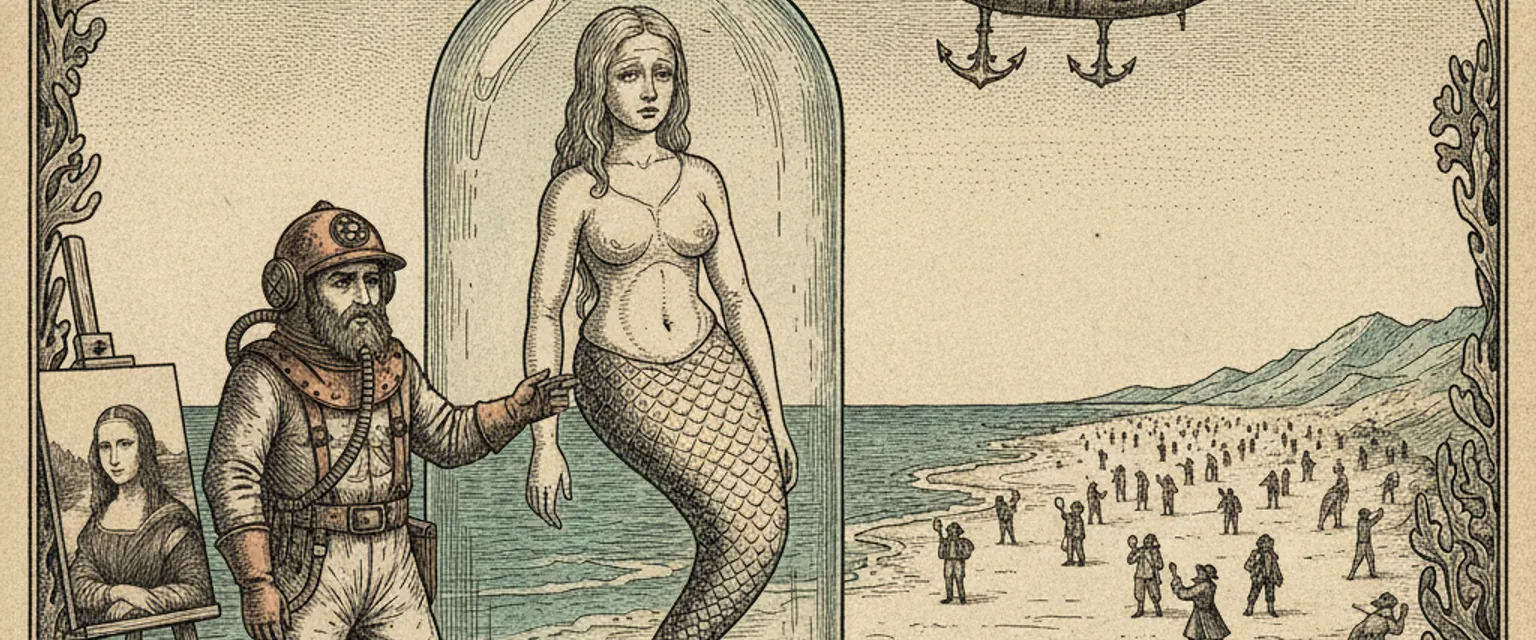
The Real Reason the Mona Lisa, the Mermaid, and That Beach Disappoint Everyone
It's not that the Mona Lisa is bad. It's that there's a specific, repeatable psychology of letdown working against you at the world's most famous sights. Name it, and you can dodge it.
I have watched a grown man, a software engineer from Ohio, deflate like a punctured pool toy in real time. We were in the Salle des États at the Louvre. He had queued forty minutes. He raised his phone over a sea of other phones, took one blurry frame of a painting roughly the size of a placemat, looked at the screen, and said, quietly, “Oh.” Just that. “Oh.” Then he turned around and we left.
That “oh” is the most honest sound in travel. And it is not the painting’s fault.
The letdown isn’t random — it’s a formula
Here’s the thing nobody tells you in the guidebook. Disappointment at famous landmarks isn’t bad luck or jaded taste. It’s a near-mechanical equation, and once you can see the gears you stop getting crushed by them.
The Mona Lisa is the cleanest case. It is 30 by 21 inches. It sits behind anti-reflective glass, behind a wooden barrier, behind a crowd-control railing, behind roughly two hundred people holding phones. You will get, on a good day, eleven seconds and a sightline through somebody’s armpit. The painting your brain promised you was a wall-sized revelation. The painting that exists is small, dim, and far away.
Copenhagen’s Little Mermaid runs the same con. People expect a monument. They get a bronze statue about four feet tall, perched on a rock just offshore, often with her back half-turned to you. She’s been decapitated twice by vandals and doused in paint more times than anyone counts. Tour boats slow down, everyone takes the photo, and there is a collective, unspoken shrug. I watched a Dutch couple at the railing literally check their map to make sure they hadn’t found the wrong mermaid.
You’re not seeing the thing — you’re seeing the photo of the thing
The deeper trap is what I think of as image-debt. You have already seen the Trevi Fountain ten thousand times: shot at golden hour, color-graded, drone-lifted, scrubbed of the gum on the steps and the guy selling selfie sticks. By the time you arrive in person, the place has to compete with its own greatest-hits reel, and reality films in regular daylight with bad extras.
Maya Bay in Thailand — the beach from The Beach — is the textbook example. For years people arrived expecting a private slice of paradise and found 4,000 other people a day and boats packed gunwale to gunwale, until Thai authorities closed it entirely in 2018 to let the reef recover. It has reopened with hard limits now, but the lesson holds: the version that sold you the ticket was a movie, lit and emptied for the camera.
Stonehenge does this too. The postcard frames it alone on Salisbury Plain, ancient and brooding. Stand there and you’ll notice the A303 trunk road humming forty meters away, and the rope keeping you a polite distance from the actual stones. Both can be true: it’s genuinely 5,000 years old and you’re looking at it across a queue rope with traffic noise. The disappointment lives in the gap between the brooding postcard and the roped-off Tuesday.
The crowd is doing something to your brain
Here’s the part I find genuinely fascinating. A crowd doesn’t just block your view — it changes how you feel about what you’re seeing. Psychologists call it social proof gone sideways: when you’re surrounded by hundreds of people performing awe (phones up, jostling, that anxious shuffle), your nervous system reads “stress,” not “wonder.” You can’t have a transcendent moment in a setting that feels like a delayed flight at gate 34.
I felt this hardest at the Blue Grotto on Capri. The cave is real, the water glows an absurd electric blue, and it is legitimately strange and lovely. But you reach it by transferring into a tiny rowboat in a swell, the boatmen are hustling for tips and singing on loop, and you get ninety seconds inside before you’re rotated out for the next boat. The beauty is genuine. The experience of receiving the beauty is a conveyor belt. Your brain remembers the conveyor belt.

How to not say “oh”
The fix isn’t to skip the famous stuff — sometimes the famous stuff earns it. The fix is to defuse the formula. See the marquee sight at the worst time for crowds and the best time for you: the Louvre on a Wednesday or Friday evening, when it stays open late and the Salle des États thins out to something human. Arrive at a viewpoint at first light, before the tour buses, when the only soundtrack is your own footsteps.
And lower the stakes deliberately. The Mona Lisa is a fine painting and a five-minute novelty; the rest of the Denon wing — the colossal Veronese on the opposite wall of that same room, which almost nobody turns around to see — is the actual reason to be there. The trick across the board is to treat the icon as the cover charge and go find the room nobody’s photographing.
Quick Q&A
Is the Mona Lisa worth seeing at all? Yes, but as a quick novelty, not a pilgrimage. Budget five minutes, then spend an hour on the surrounding Italian galleries that are nearly empty.
Which famous landmark disappoints people the most? Anecdotally, Copenhagen’s Little Mermaid and the Mona Lisa tie. Both are far smaller, and far more crowded, than the photos suggest.
How do I avoid the letdown? Check the real-world size beforehand, visit at off-peak hours, and deliberately seek the under-photographed thing next door. The disappointment is a gap between expectation and reality — so close the gap before you go.
This article contains affiliate links marked rel="sponsored". We may earn a commission at no extra cost to you.