
[ GUIDE · THE DISPATCH ]
Where to Stay in Tokyo: Yanaka Calm vs. Nakameguro's River of Cafes
Done Shinjuku and Shibuya? Good. On your second or third Tokyo trip, you want a base with a pulse you can actually feel. Here's where to stay in Tokyo's quieter neighborhoods — Yanaka vs Nakameguro.
For the full day-by-day version of everything below, read the the day-by-day Tokyo itinerary.
The first time you visit Tokyo you stay in Shinjuku or Shibuya, and you should — the neon, the scramble crossing, the train station that swallows you whole. But here’s the thing nobody warns you about: those neighborhoods are exhausting to actually live in for a week. The second or third time around, when you’re thinking about where to stay in Tokyo, you want somewhere you can have a slow coffee and hear birds and still be eleven minutes from the madness when you want it.
I’ve based myself all over this city, and these two — Yanaka and Nakameguro — are the ones I send repeat visitors to. They’re opposites, and which one suits you says a lot about you. Let me lay them out.

Yanaka: the Tokyo that survived
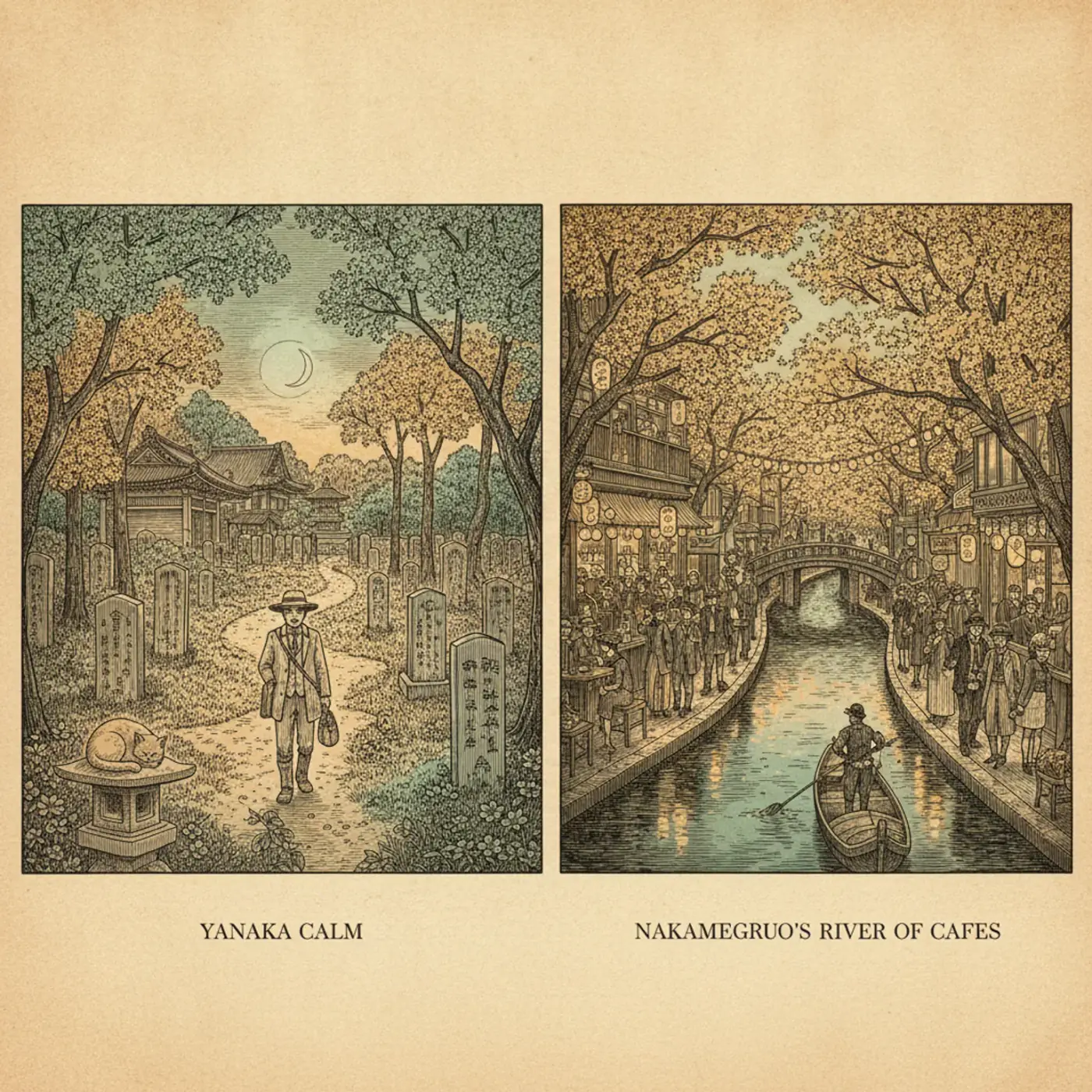
Yanaka is in the northeast, part of the “shitamachi” old-town district that escaped the WWII firebombing and the bubble-era teardowns. So it’s low-rise, wooden, full of temples and cemeteries and tiny family shops — the Tokyo of a hundred years ago, more or less intact. There are wandering cats (the neighborhood is genuinely famous for them), traditional sweet shops, a sentō public bathhouse or two, and a slowness that feels almost impossible inside a 14-million-person city.
The heart of it is Yanaka Ginza, a sloping pedestrian shopping street where old ladies sell croquettes and pickles and you can get a menchi-katsu (fried minced-meat cutlet) for a few hundred yen and eat it on the steps at sunset with everyone else. “Yuyake Dandan,” the staircase at the top, is the spot — go at golden hour.
You stay here for mornings. Slow, quiet, temple-bell mornings with a coffee from a tiny roaster and nowhere you have to be. It’s a writer’s neighborhood, a flâneur’s neighborhood. The trade-off: the nightlife is basically nonexistent and it’s a bit further from the marquee sights — you’re a train ride from Shibuya, not a walk.
Accommodation here leans toward small guesthouses, ryokan-style inns, and a few design-minded hotels. It’s not a luxury-tower neighborhood and that’s the whole point. Book something with tatami at least once.

Nakameguro: the canal of cafés and bars
Nakameguro is the other kind of grown-up Tokyo base. It runs along the Meguro River — a narrow canal lined with cherry trees (it’s THE cherry-blossom spot in spring, so avoid late March/early April unless you want crowds) and, the rest of the year, an endless ribbon of small cafés, natural-wine bars, vintage shops, and good restaurants. It’s stylish without being flashy, the kind of neighborhood where the locals are well-dressed and the coffee is taken seriously.
The energy is completely different from Yanaka. This is a place to be out in the evening — riverside drinks, a tiny six-seat bar down a side street, an izakaya where you point and nod. It feels lived-in and creative rather than touristed, even though it’s right there on the Tokyo radar. And it’s properly central: one stop from Shibuya on the Tokyu Toyoko line and on the Hibiya subway line, so you’re plugged into everything but sleeping somewhere that feels like a neighborhood, not a transit hub.
You stay here if you’re the type who plans a day around which café to work from and which bar to end at. It’s more expensive than Yanaka and the hotel options are more boutique-chic. The downside is it can feel a touch precious, and on a peak cherry-blossom weekend it’s a zoo.

So, which one?
Pick Yanaka if: you want calm, old Tokyo, slow mornings, temples and cats, and you don’t need nightlife on your doorstep. It’s the more affordable, more atmospheric, more “I’ve been to Tokyo before and I want to feel it” choice. Also the smarter pick if you’re flying Narita.
Pick Nakameguro if: you want a stylish, central, café-and-bar base where you can walk out the door into a good evening, and you don’t mind paying a bit more for the address. It’s the better all-rounder for someone who still wants to be near Shibuya’s gravity.
Honestly? On my last trip I split it — three nights in Nakameguro to be out and social, then three in Yanaka to wind down and write. That combination is, I think, the perfect second-visit Tokyo: the river of cafés, then the old town’s hush. You get the city’s two best moods back to back.
One small reality check either way: Tokyo rooms are tiny and you’ll be out all day anyway, so spend on location and atmosphere over square metres. A jewel-box room in the right neighborhood beats a big bland one by a station you don’t love.
A couple of practical notes, because the romance is easier when the logistics work. Both neighborhoods are well-served by 24-hour convenience stores (the Tokyo traveller’s secret weapon — coffee, onigiri, a phone charger, an ATM that actually takes foreign cards, all at 3 a.m.), but Yanaka’s tiny shops shutter early, so don’t expect a late dinner there — eat out toward Nippori or pick up something before the lanes go quiet around 8. Nakameguro stays up later but the good little bars are small and fill fast; if there’s a counter you’ve earmarked, go at opening, not at 10. And for either base, get a Suica or Pasmo IC card on arrival and just tap onto everything — fumbling for ticket-machine change while a Tokyo rush-hour crowd flows around you is its own small nightmare, and the card makes the whole city friction-free.
I’d also gently push you toward at least one slow, unplanned half-day in whichever you choose. The point of skipping Shinjuku as a base isn’t to be efficient — it’s to have mornings where you wander a lane you didn’t research, find a six-seat coffee place, and let Tokyo be a neighborhood instead of a checklist. That’s the whole reward of a second visit, definately the part you’ll remember.
Stay where the city slows down for you. The neon will still be there when you want it.
This article contains affiliate links marked rel="sponsored". We may earn a commission at no extra cost to you.