
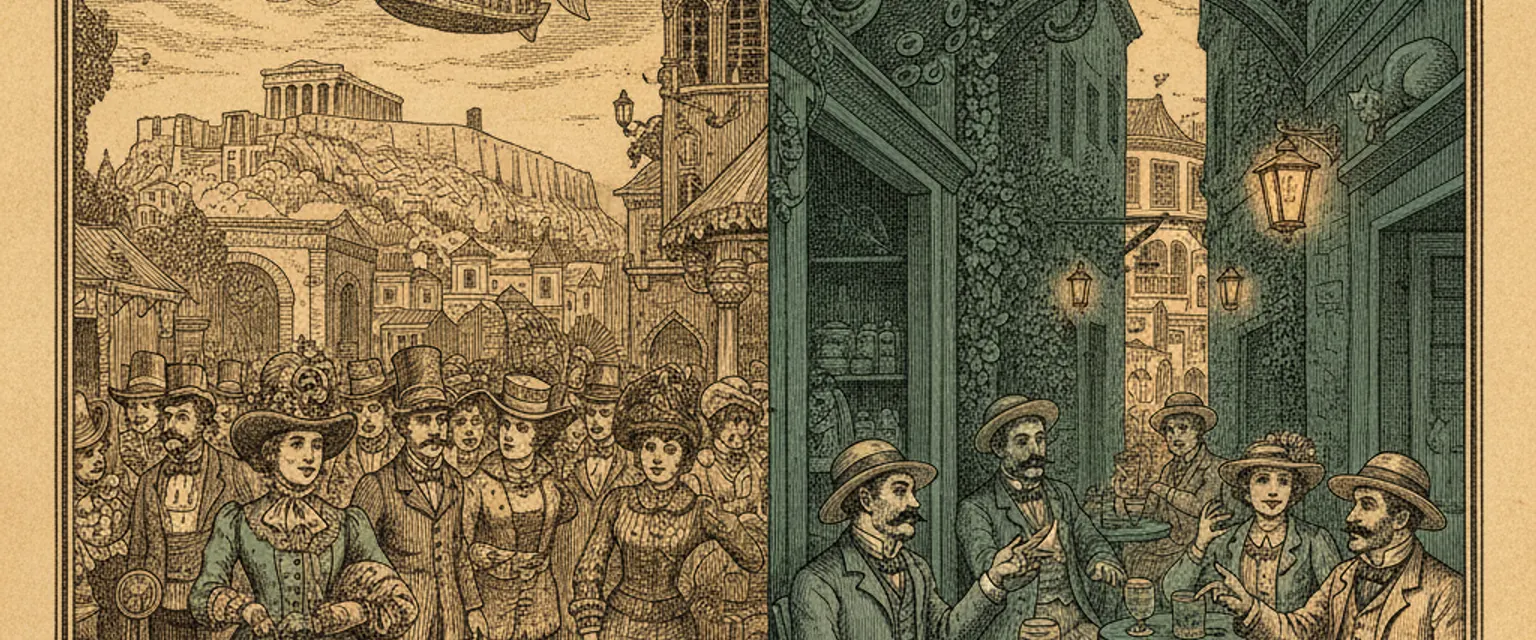
[ GUIDE · THE DISPATCH ]
Where to Stay in Athens: Plaka Tourists vs. Koukaki Locals
Plaka is the postcard: cobbles, bougainvillea, a taverna every six metres charging you for the view. Koukaki is where Athenians actually drink their freddo. Here is which one should get your nights.
The first time I stayed in Plaka I paid four euros fifty for a Greek coffee served by a man who clearly resented me, on a terrace with a view of the Acropolis so good it almost justified the resentment. The second time, I stayed in Koukaki, ten minutes downhill, and paid two euros for a far better freddo espresso from a woman who told me, unprompted, that the place across the road was a tourist trap and I should never go there. I trusted her immediately. I was right to.
This is the whole Athens accommodation question in two coffees. Plaka is gorgeous and it is performing for you. Koukaki is plainer and it is just living its life, and you are welcome to join. Neither is wrong. But they produce very different trips, and most people book Plaka on reflex because it is the name they have heard.
Let me argue you out of the reflex, or into it.

The one-line version
Plaka is for first-timers who want the Acropolis out their window and don’t mind paying the view tax. Koukaki is for the second trip, the longer stay, or anyone who’d rather spend the difference on dinner.

Plaka: the beautiful, expensive postcard
Plaka is the old town that wraps around the northern foot of the Acropolis, all marble lanes, neoclassical houses, and stairs that turn into the Anafiotika quarter — a pocket of whitewashed Cycladic cottages built by island stonemasons in the 1800s that genuinely feels like Santorini fell into the middle of a capital city. It is, no argument, one of the prettiest urban neighborhoods in Europe.
The trade-offs are equally real. The main drags — Adrianou, Kydathineon — are a gauntlet of tavernas with laminated menus in nine languages and a man outside each one inviting you in like you’re a long-lost cousin. Prices run 25 to 30 percent above what the same plate costs four streets south. And at night the souvenir shops glow until late, so a room facing the lane can be loud.
Where Plaka earns its keep is the morning. Get up before nine, walk up through the empty cobbles to the Acropolis entrance, and you’ll have one of the great cities of the world almost to yourself. If you’ll only ever do Athens once, that morning may be worth the coffee surcharge.

Koukaki: where Athens actually hangs out
Cross the wide road past the Acropolis Museum and you’re in Koukaki, which spent decades as an unremarkable residential district and then quietly became one of the most liveable corners of the city. It has no monuments to speak of, which is exactly the point — nobody is performing here.
What it has is Georgiou Olympiou and the streets around the pedestrianised Drakou, lined with cafés full of Athenians working on laptops, low-key wine bars, and neighborhood tavernas where the bill arrives without a single euro of view markup. There’s a proper bakery on most blocks. The metro at Syngrou-Fix gets you to the airport line and the centre in minutes.
The honest downside is that you trade the postcard for the practical. You won’t fling open your shutters to a floodlit Parthenon. You’ll walk ten minutes uphill to it instead — which, frankly, you were going to walk anyway.

The food gap, because it’s the real decision
| Plaka | Koukaki | |
|---|---|---|
| Vibe | Cobbled, touristy, very pretty | Residential, relaxed, local |
| Best for | First trip, short stay, view chasers | Repeat trips, longer stays, eaters |
| Budget | Tourist premium on everything | Honest neighborhood pricing |
| Acropolis | Out the door | A flat ten-minute stroll |
| Nights | Lively, can be loud | Calm with good wine bars |
| Skip if | You hate paying the view tax | You want monuments on your doorstep |
The deciding factor for most people is dinner, repeated across however many nights you’re here. In Plaka you will eat fine, slightly overpriced food in a beautiful setting. In Koukaki you will eat genuinely good food, for less, surrounded by people who live there. Over four nights that gap is the price of a very good lunch somewhere else.

What I actually do
I split the difference, and I think it’s the smart move if your dates allow it. Two nights in Plaka at the start, for the early Acropolis mornings and the novelty of waking up inside the postcard. Then I move to Koukaki for the rest, where my money goes further and my evenings get better. The walk between the two is under fifteen minutes, so it costs you nothing but a suitcase wheel over some cobbles.
If you must pick one and it’s your first Athens, take Plaka and pay the tax with a smile. If it’s your second, or you’re staying five nights or more, Koukaki every time.
Is Koukaki safe to walk back to at night? Yes — it’s a calm residential area and the streets around Drakou stay gently busy with locals until late. It feels noticeably quieter and safer than the Omonia direction.
How far is Plaka from Koukaki on foot? About ten to fifteen minutes, mostly flat, separated by the road past the Acropolis Museum. You can easily base in one and eat or wander in the other.
This article contains affiliate links marked rel="sponsored". We may earn a commission at no extra cost to you.