
[ ITINERARY · THE DISPATCH ]
Two Days in Varanasi: Ganges Dawns, Cremation Ghats, and India's Oldest City
A raw, first-person Varanasi 2 day itinerary — the dawn boat on the Ganges, the cremation ghats where life and death share one staircase, the evening fire ceremony, and how to walk the lanes without losing your mind.
Nothing prepares you for this place, and any Varanasi 2 day itinerary that promises a tidy, comfortable visit is lying to you. Varanasi — Kashi, Banaras, whatever name it’s wearing that century — is reckoned to be one of the oldest continuously lived-in cities on earth, and it does not flatter the visitor. It’s loud and crowded and it smells of marigolds and woodsmoke and the river, and somewhere on those steps a body is burning while ten metres away a kid is selling chai and a sadhu is doing yoga and a cow is eating a cardboard box. It is the most alive place I have ever been. Partly, I think, because it’s so unembarrassed about death.
Two days. You won’t understand it. You’ll feel it. That’s enough.
Day 1: Arrive, Wander, Then the Fire
Get in, dump your bag, and do not try to do anything ambitious the first afternoon. Just walk the ghats. There are about 80 of them, these vast stone staircases tumbling down to the Ganges, each with its own name and character. Start around Assi Ghat in the south and amble north along the waterfront. Buffaloes wallowing. Pilgrims bathing. Pandas (priests) under big bamboo umbrellas. Boatmen pestering you — a friendly but firm “nahin, dhanyavaad” works better than ignoring them.
The lanes behind the ghats are the other half of the city. Galis so narrow two people can barely pass, no cars, just motorbikes that absolutely should not fit and somehow do. You will get lost. Let it happen. The first time, I spent forty minutes trying to find my guesthouse, ended up in a 200-year-old courtyard where a man was teaching tabla, and it was better than wherever I’d been heading. Keep the river roughly on one side and you’ll always find your way back out.
As evening comes, get to Dashashwamedh Ghat for the Ganga Aarti, the nightly fire ceremony. Around 6:45 p.m. (earlier in winter). Young priests in saffron, synchronised, swinging huge brass lamps in slow arcs, conch shells, bells, a crowd of hundreds. It’s a spectacle and it’s also sincere, which is a hard combination to pull off. Get there 45 minutes early for a decent spot, or — better tip — watch it from a small boat just offshore. Costs maybe 300–500 rupees a head, and seeing it from the water with the whole riverfront lit up behind is something I still think about.

Day 2: Dawn on the River, Then the Ghats of Death
This is it. The morning everyone comes for.
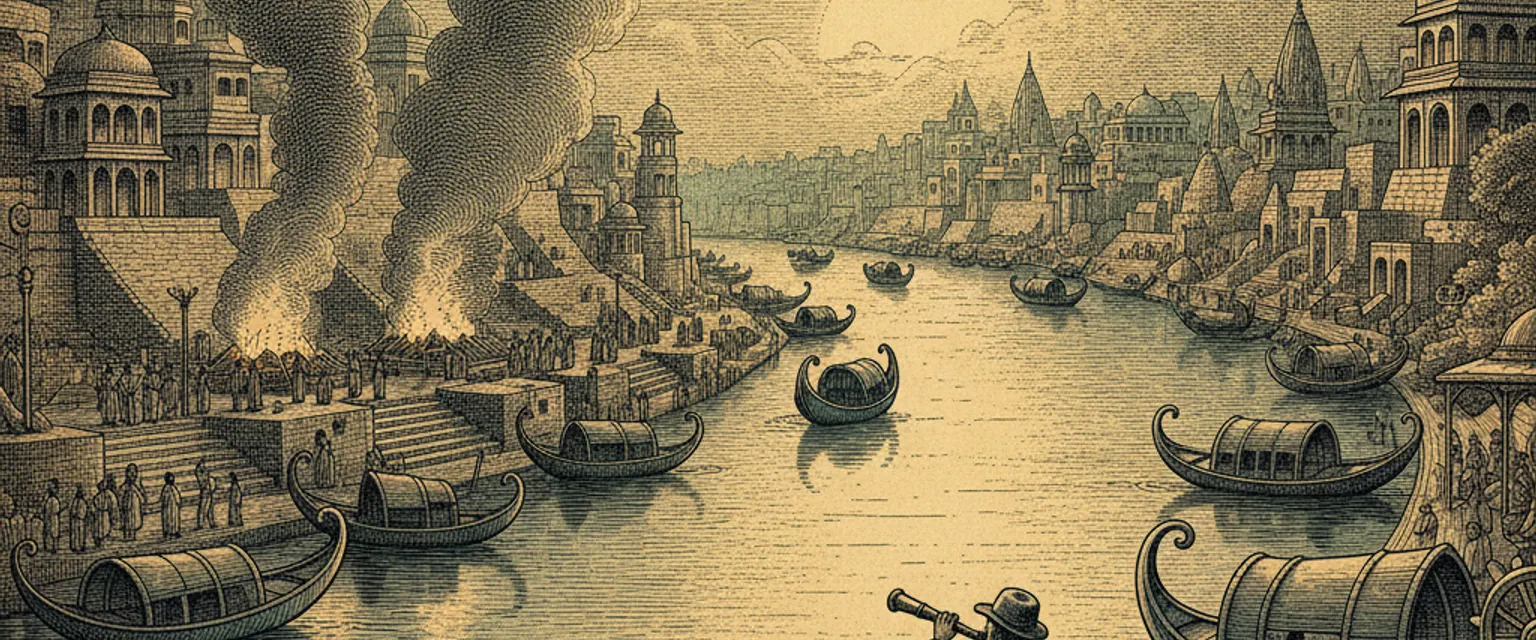
Be at the water by 5:30 a.m. Cold, dark, a bit reluctant — go anyway. The boatman poles you out as the sky goes grey then peach then gold, and the whole eastern bank catches fire with that low light, and the ghats fill with people doing their morning puja, cupping water, lighting little leaf-boats of flowers that drift past your boat like sparks. It’s quiet on the water. The city’s roar hasn’t woken up. The first time I did this I didn’t say a word for an hour, and the boatman, an older guy named Ramesh, just let me. That silence was a gift.
Drift up toward Manikarnika Ghat, the main burning ghat. This is where the cremations happen, openly, all day every day, on pyres by the river, because to be cremated here and have your ashes given to the Ganges is believed to break the cycle of rebirth. You will see it. Bodies wrapped in bright cloth, the eldest son with a shaved head, the fires, the men of the Dom community who tend them. It is not gruesome. It’s oddly tender, and dignified, and busy in the way a working place is busy.
Two absolute rules. Never photograph the cremations. Not a sneaky one, not from the boat, never. It’s grieving families, not a show. And if a “guide” attaches himself to you and walks you up to the burning ghat then demands a big “donation for the wood for poor people,” it’s a well-worn scam — a polite but firm no and walk on. Real donation, if you want to give, goes to the hospice (Mukti Bhawan), not a stranger on the steps.
Afternoon, after all that, you’ll want something gentler. Cross the river or head out to Sarnath, about 10 km away, where the Buddha gave his first sermon. It’s green and calm and ancient, the great Dhamek Stupa standing where it’s stood for 1,500 years. Deer park, a good little museum (the original Lion Capital of India, the one on the flag, lives here). After the intensity of the ghats, Sarnath is like exhaling.
Last evening, find a rooftop, order a thali and a lassi (Blue Lassi in the old town does a famous one, packed but worth it), and watch the kites — the bird and the paper kind — over the river. The the city below keeps doing what it’s done for three thousand years. You just got to watch for two days.
Varanasi is not relaxing. It’s not “nice.” It rearranges something. Definately go before you think you’re ready, because you never will be.
Take the dawn boat, keep your camera down at the burning ghat, and let the place do what it does — you don’t visit Varanasi so much as survive it, gratefully.
This article contains affiliate links marked rel="sponsored". We may earn a commission at no extra cost to you.