
[ DISCOVERY · THE DISPATCH ]
There's a Sea With No Shore in the Middle of the Atlantic and Ships Avoid It
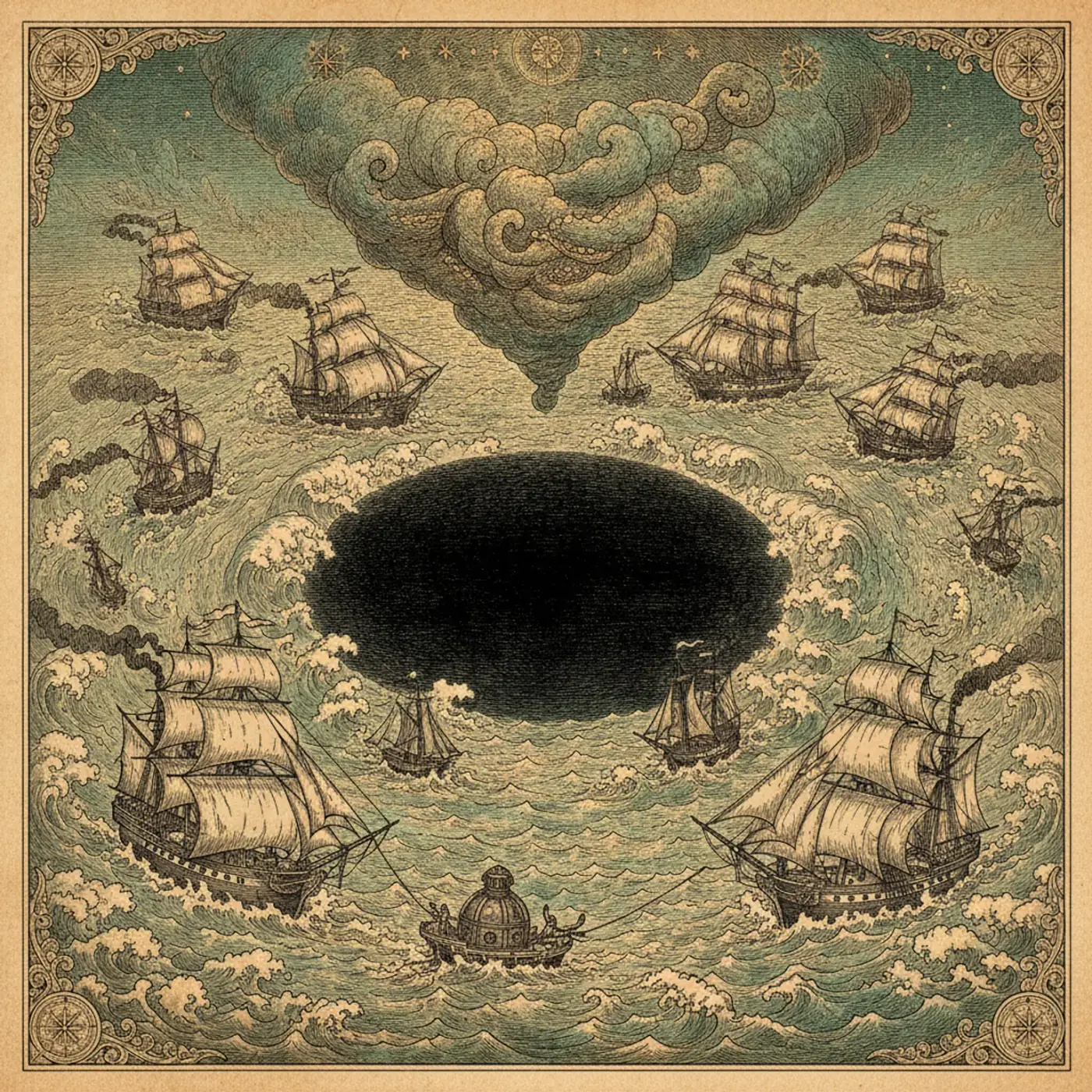
Picture a sea defined not by land but by currents — a slowly spinning oval in the middle of the Atlantic, carpeted in golden seaweed, dead calm, and steeped in shipwreck legend. It's the Sargasso, and you can sail into it from Bermuda.
Sargasso Sea travel is the kind of phrase that stops you mid-scroll, because how do you “travel” to a sea that has no shore. No coast. No country owns its edges. It’s a sea bounded entirely by ocean currents — a slow, lazy spiral of water in the middle of the North Atlantic — and I find that quietly mind-bending. Every other sea on Earth is defined by the land around it. This one is defined by water moving around water.
What it actually is
The Sargasso sits inside the North Atlantic Gyre — a great clockwise rotation of currents (the Gulf Stream on the west, the North Atlantic Current up top, and others closing the loop) that pen in a roughly oval region of unusually calm, warm, deep-blue water. Because the currents trap whatever drifts in, the surface collects vast rafts of a free-floating seaweed called Sargassum. Golden-brown, buoyant on its own little gas bladders, it never touches the bottom and never washes ashore. It just… floats there, for thousands of square kilometres, slowly spinning.
The water is some of the clearest and bluest in the whole Atlantic — visibility can run to 60 metres or more — because it’s nutrient-poor and far from any river mouth. Sailors for centuries described it with a kind of dread. Calm winds, weed everywhere, the legend of ships becalmed and tangled and lost. Columbus’s crew apparently freaked out crossing it. The whole “Bermuda Triangle” mythology overlaps the western edge.
And the eels. This is the bit that gets me. European and American eels migrate thousands of miles across the ocean to spawn here, in the Sargasso, and only here — nobody has ever actually witnessed it happening, the precise spot is still a genuine scientific mystery. Baby sea turtles ride the weed rafts as floating nurseries. The Sargassum isn’t a dead mat, it’s a living, drifting ecosystem with its own crabs, shrimp, and fish that exist nowhere else.
So how do you get there
You don’t fly to the Sargasso, obviously. You sail. And the natural launch pad is Bermuda, which sits right inside the western part of the sea — so the moment you clear Bermuda’s reefs and head out, you’re more or less in it.
There are a few ways in. The most accessible is a private or small-group sailing charter out of Bermuda — a few days out and back, a captain who knows the waters, you in the cockpit watching the weed go by and the flying fish skip off the bow. The more committed option is a longer ocean-crossing passage; Bermuda is a classic waypoint on transatlantic and US-East-Coast-to-Europe sailing routes, so crewed delivery voyages and adventure-sailing outfits pass straight through. If you’ve ever wanted to crew a real ocean passage, this is a romantic place to do it.
I did a four-day charter out of St George’s. The first morning out we hit the first big weed line — a long, ragged golden ribbon stretching to the horizon — and the captain slowed the boat and let me lean over with a net. Pulled up a clump and it was crawling: tiny crabs, a juvenile filefish the exact mottled colour of the weed, a shrimp the size of a grain of rice. A whole world in a handful of seaweed. I just sat there going through it like a kid with a rock pool, for an hour, while the boat drifted.
The honest caveats
A few. First, timing — the Atlantic hurricane season runs roughly June to November, and you do not want a small boat out in the open ocean during it. Late spring and early autumn shoulders are kinder. Talk to your skipper, watch the forecasts, build flexibility into your dates.
Second, this is real open-ocean sailing, not a harbour cruise. If you get seasick, prepare for it properly — patches, wristbands, whatever works for you — because once you’re out there, there’s no stepping off. And it can get rolly even when it looks calm. Manage your own expectations on comfort.
Third, and this is a bittersweet one: the Sargassum has been behaving strangely in recent years. Massive belts of it have been blooming and washing onto Caribbean and Gulf beaches in quantities never seen before, probably driven by nutrient runoff and warming seas. Out in the deep Sargasso itself it’s still the same drifting golden wilderness, but it’s a reminder that even a sea with no shore isn’t immune to what we’re doing to the ocean. Go with a low-impact operator. Don’t trash the very thing you came to see.
There’s something I keep coming back to about this place. Most “destinations” are points on a map you can stand on. The Sargasso is a destination made of motion — water turning slowly inside more water, a sea you can only experience by floating in the middle of it with no land in any direction. You can’t put your feet down. You just have to be carried, the way the eels and the turtles and the weed are carried, around and around the great Atlantic wheel.
Sail out of Bermuda, kill the engine in the golden weed, and let the only shoreless sea on Earth hold you for a while. Just check the hurricane forecast first.
This article contains affiliate links marked rel="sponsored". We may earn a commission at no extra cost to you.