
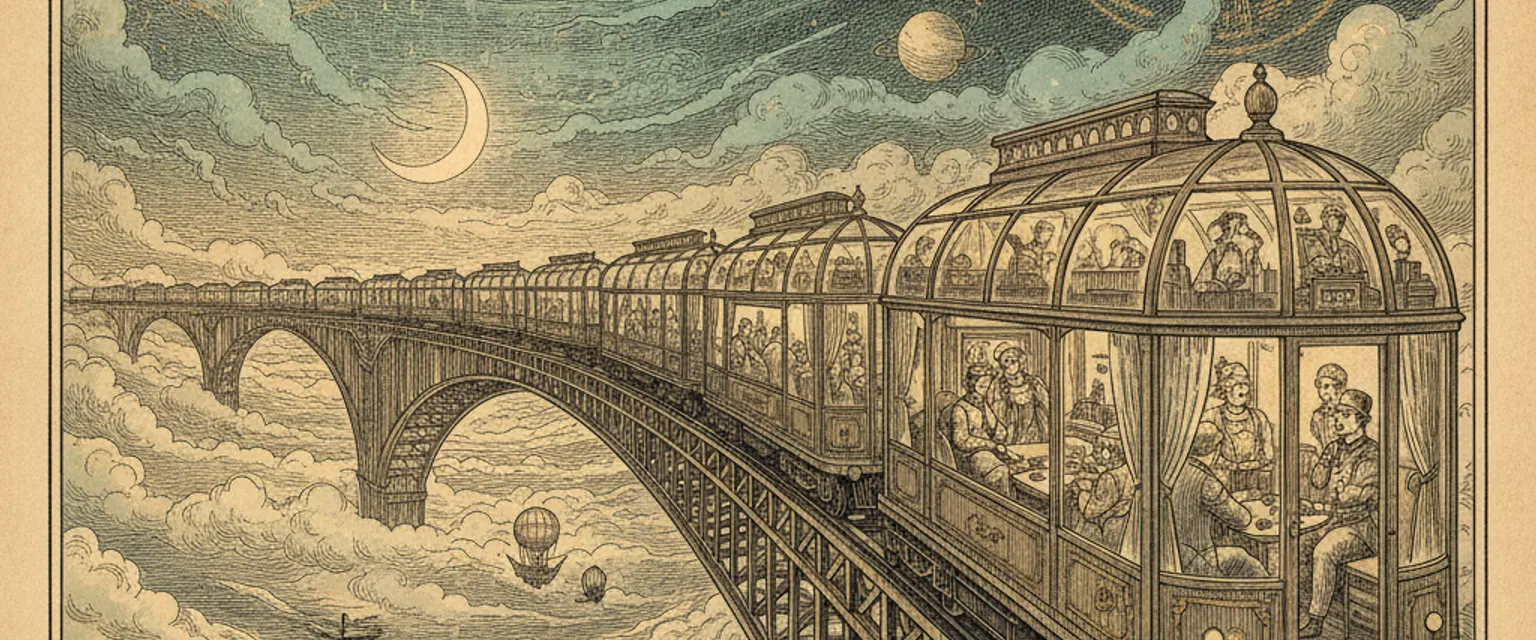
[ DISCOVERY · THE DISPATCH ]
The Stargazing Trains and Sleeper Cars That Show You the Sky, Not the Track
Stargazing trains and sky sleeper cars roll through dark-sky country with glass roofs so you can lie back and watch the stars instead of the track. Here's where they run and how to actually catch the sky.
The whole reason stargazing trains and sky sleeper cars exist is that someone, somewhere, lay in a normal train berth staring at a luggage rack and thought: what a waste of a sky. And they were right. There’s this strange tragedy to night trains — you’re moving through some of the emptiest, darkest, most star-drenched land on the planet, and the railways respond by giving you a curtain and a reading light. So a handful of trains have done the obvious, beautiful thing and put glass over your head. I’ve ridden a few. I’ve also been let down by a few. Let me tell you which is which.
The glass-roof carriage is the real magic
The best version isn’t a sleeper at all — it’s a sightseeing carriage with a roof that curves up and over into glass, so the windows don’t stop at the wall, they keep going. In daylight these are sold as scenery cars. At night, on the right stretch of line, they become observatories that happen to be doing 60mph.
I rode one across a high desert plateau and switched off my phone — properly off, in the bag, gone — and within about ten minutes my eyes adjusted and the whole carriage went quiet. The Milky Way was a smear of chalk dust right overhead, sliding slowly as we curved. Nobody spoke. A kid a few rows up whispered “is that real” to his dad, and his dad didn’t answer because I think he was crying a little. It’s that kind of thing.
The catch nobody warns you about: light pollution comes from inside
Here’s the dirty secret of stargazing trains. The enemy isn’t clouds. It’s the carriage’s own lights, reflecting off the inside of all that lovely glass and turning your window into a mirror of the aisle. You end up watching a faint reflection of a man eating crisps instead of the cosmos.
The good operators kill the interior lights for a window of time on dark stretches — a proper “lights-out” period. The bad ones leave the strip lighting blazing all night and wonder why everyone’s grumpy. Ask before you book. Genuinely. It’s the single thing that makes or breaks the whole experience.
Where these actually run
The routes worth chasing share a profile: they cross genuinely dark country, far from cities, ideally at altitude where the air’s thinner and clearer.
- High desert and plateau lines are the gold standard — dry air, no humidity haze, almost no towns for hundreds of miles. Think the empty interiors of the American West, the Australian outback, the Andean altiplano.
- Northern sleeper routes in winter add a bonus prize: aurora. A few far-north services market themselves on the chance of catching the northern lights from your berth, and when it happens it is, no exaggeration, the best thing I’ve seen from a moving vehicle.
- Scenic glass-dome day trains that also run an evening or overnight service — these are the sleeper-hunter’s secret, because you get the observatory carriage with a bed waiting at the other end.
I won’t pretend every “stargazing train” lives up to the brochure. Some are a normal train with a marketing department. But the real ones — glass roof, dark line, lights actually off — are unlike anything else in travel.
How to actually see the sky
Even on the perfect train you can blow it. So:
- Check the moon. A full moon washes out everything. You want the days around a new moon, which is the bit the romantic brochures never mention because they can’t control it.
- Book the seats away from the toilet and the bar. Those areas keep their lights on all night. You want a berth or seat in the middle of a dark carriage.
- Give your eyes twenty minutes. Real dark adaptation is slow. The sky you see after twenty patient minutes is a different sky to the one you glanced at when you boarded. Don’t keep checking your phone — one glance at a bright screen resets the whole clock.
- Dress for cold. Glass loses heat fast at night. The romance dies quickly if you’re shivering. Bring the extra layer.
There’s a particular kind of peace in being carried through the dark by something you don’t have to steer, with the whole sky doing slow turns above you. You’re not driving. You’re not navigating. You’re just lying back, warm, moving, while the universe puts on the oldest show there is. Catch it on a clear, moonless night and you’ll be insufferable about it for years. I am living proof.
New moon, lights off, layers on. Then look up and shut up. The track can look after itself.
This article contains affiliate links marked rel="sponsored". We may earn a commission at no extra cost to you.