
[ DISCOVERY · THE DISPATCH ]
The Smell-Maps of Cities: Where to Stand to Catch a Place's True Scent
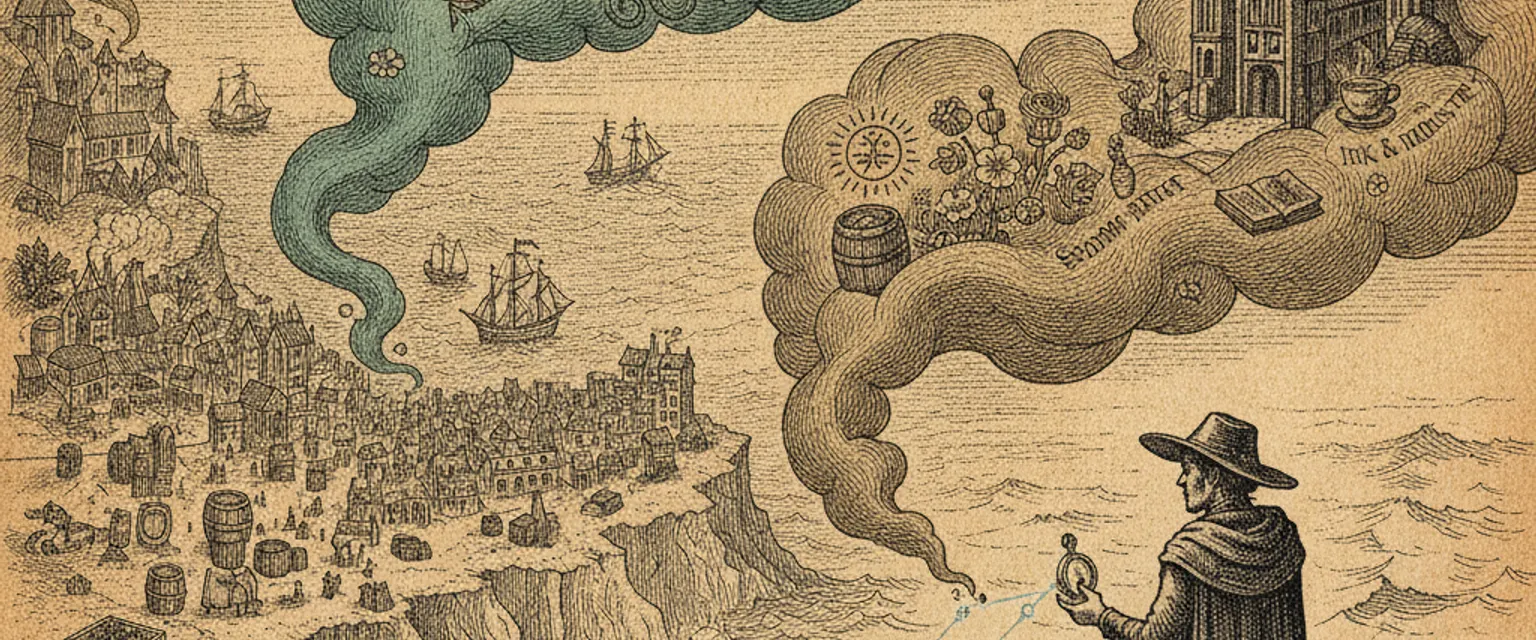
Every city has a smell-map, and almost nobody reads it. The bakery at dawn, the spice dock at noon, the rain on warm stone at dusk. Here is where to stand to catch a place's true scent before your camera ever comes out.
I think the best smelling places in cities are the ones nobody photographs, and that is exactly why I keep going back to them. You can’t post a smell. You can only stand in it.
Here’s a thing I figured out the slow way, over about fifteen years of getting lost on purpose. Every city has a smell-map laid over the street map, and it changes by the hour. Most travelers walk straight through it, eyes up, phone out, missing the whole second city that exists at nose height. And it’s the better city, honestly.
So this is my attempt at drawing that map. Not for any one place — for all of them, more or less, if you know when to stop walking.

Dawn belongs to the bakeries
You have to be a little bit insane to do this part, I won’t lie. The window is roughly 5:30 to 7am, before the city’s other smells wake up and crowd everything out. Diesel, coffee carts, the river — none of it is running yet. There’s a gap. And into that gap pours bread.
In Paris I used to stand outside a boulangerie on Rue des Martyrs (the one with the blue tile, you’ll know it) at quarter to six, and the smell came out the floor vents before the door even opened. Warm flour, a little char, that almost-caramel edge from the bottoms of the baguettes. The baker, a guy named Olivier who never once smiled at me, would prop the door at six on the dot and the whole street would just… change.
The trick is you stand near the back vents, not the front door. Bakeries push their exhaust out the side or the rear. The front is for buying. The back is for breathing.
And it’s not just France. Lisbon at dawn smells of warm custard from the pastéis ovens. Istanbul smells of simit, that sesame ring bread, the carts loading up before the ferries run. A bakery dawn is the most honest fifteen minutes a city has. Nobody’s performing yet.
Noon belongs to the spice docks and the markets
Different beast entirely. Where dawn is quiet and singular, noon is loud — a wall of competing smells that hits you like a wave and then resolves, if you give it a minute, into separate threads you can actually follow.
The old spice docks are where I’d send you first. Hamburg’s Speicherstadt still carries it faintly, ghost cardamom in the brick. But the live ones are the working markets. I got lost near the Khari Baoli spice market in Old Delhi once and spent an hour just standing at one intersection because I literally could not make my feet move — red chili so sharp in the air people around me were coughing and laughing about it, turmeric, dried ginger, something floral I never did identify. A vendor named Rakesh handed me a cup of chai and told me, in better English than my Hindi, to “stand here, not there, the wind brings it” and pointed at a specific corner. He was right. He was completely right.
That’s the noon trick. Find the corner the wind brings it to. Markets have a windward edge where everything pools. Ask a vendor. They know their own smell-map cold, they navigate by it, and most of them think it’s funny that you’d care.
Cost me nothing, that hour. The chai was free. The lesson wasn’t.
Dusk belongs to rain on warm stone
This one you can’t schedule and that’s what makes it worth it. Petrichor — the smell of rain hitting hot dry ground — is the single most universally loved scent there is, and old cities concentrate it. Limestone, cobbles, centuries of warm stone soaking up an afternoon then releasing it all at once when the first drops land.
Rome does it best. Of course Rome does it best. A summer evening, the sampietrini cobbles still radiating heat, and then a five-minute thundershower, and the whole of Trastevere exhales this green-mineral smell that I would pay actual money to bottle and nobody has ever got right. The candles and the diffusers all fail at it. Real stone, real rain, real heat. Stand in a narrow lane where the buildings trap the air.
The fragments matter here. Stand still. Eyes shut. Breathe. That’s the whole thing.

How to actually read a smell-map
Okay so here’s the practical bit, becuase I know somebody’s going to ask “but HOW.”
It’s almost embarrasingly simple. You stop walking. You shut your eyes for ninety seconds. You let the loudest smell arrive first, then wait for the quieter ones underneath it — there are always layers, the city is never just one note. You do this three times a day: dawn, noon, dusk. And you ask locals, always, because every single one of them carries a private map of where their city smells like home.
Does this make you look strange, standing on a corner with your eyes closed inhaling? Yes. Completely. Do it anyway, you’ll thank me. Nobody who travels by nose has ever come home with a boring trip.
A city you’ve only seen is a city you’ve half-visited. The other half is waiting at nose height, free, ignored, fading by the minute.
Go find the corner the wind brings it to. That’s where the real city lives.
This article contains affiliate links marked rel="sponsored". We may earn a commission at no extra cost to you.