
[ DISCOVERY · THE DISPATCH ]
The Public Baths Where the Whole City Goes to Gossip Naked
Centuries-old steam rooms that are part spa, part town square, all human. These historic public bathhouses to visit are where a city actually talks to itself, and yes, you have to get naked.
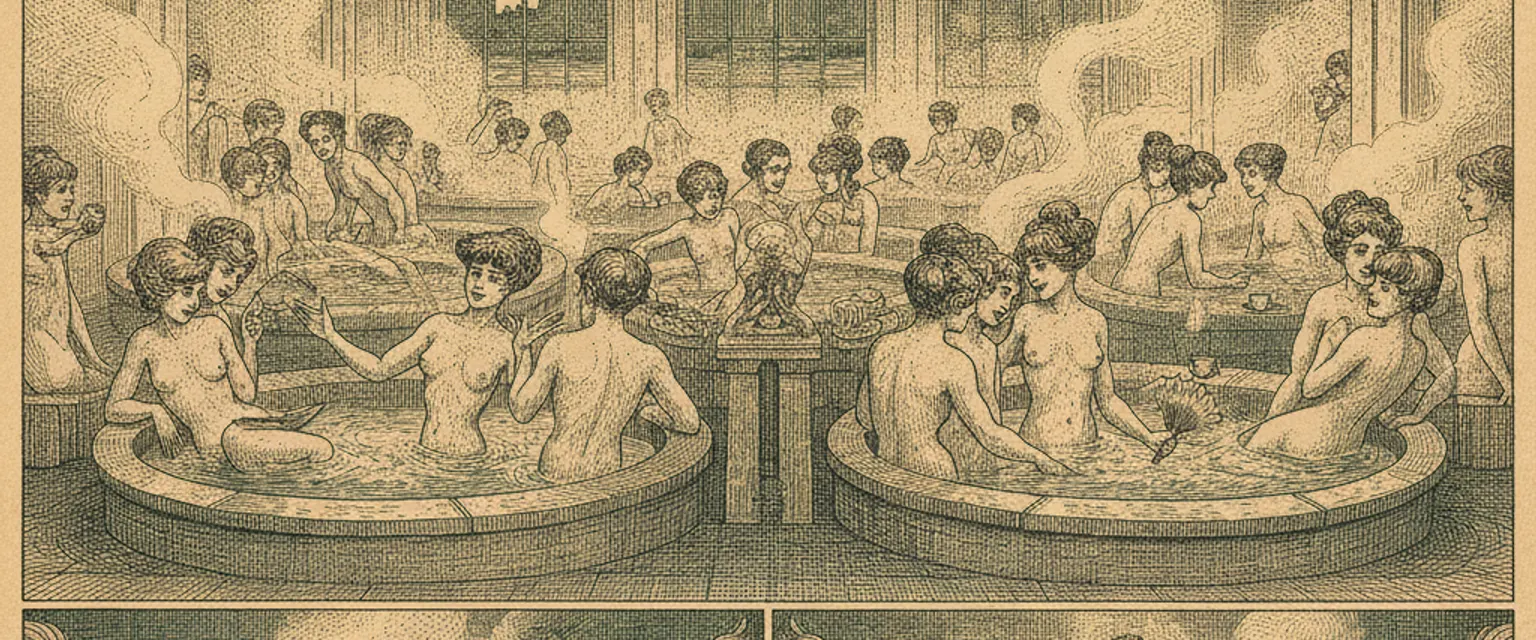
The best historic public bathhouses to visit are not spas. Let me get that out of the way. A spa is a place you go to be alone, with cucumber on your eyes, paying €90 for silence. A bathhouse is the opposite. It’s loud, it’s communal, it’s the oldest social network humans ever built, and everyone in it is naked or close to it.
The first time I went to one I was rigid with English-person panic. By the end I was the one who didn’t want to leave.

Budapest: chess, in the water, in your swimsuit
Start easy. Budapest baths are swimsuit-on, which spares the truly shy among us. Széchenyi is the big golden one everyone posts — vast outdoor pools, steam curling off the surface in winter so thick you can’t see the far end, and old men playing chess on floating boards while submerged to the chest.
That’s the image that got me. Two pensioners, deep in a thermal pool heated by a natural spring, arguing over a rook, the snow coming down on their bald heads. They’ve been doing this for decades. Same time, same opponents, same arguments. The water comes up from under the city — Budapest sits on a freak amount of thermal springs, which is why the Romans built here, then the Ottomans, then everyone.
Go to the smaller, older Rudas instead if you want the Ottoman bones of it — a 16th-century octagonal pool under a domed roof pierced with little colored glass holes that throw spots of light onto the steam. It’s genuinely beautiful. And on weekdays it’s still gendered and clothing-optional, which is the real, old version.

Istanbul: the hammam, where a stranger scrubs you like a pan
Now we escalate. The Turkish hammam is not gentle and it is not optional once you’re in it. You lie on a heated marble slab — the göbektaşı, the “belly stone” — in the middle of a domed room, sweating, until an attendant comes over, foams you up into a human cloud with a cloth they snap full of air, and then scrubs you with a kese mitt until grey rolls off you in little snakes and you have to confront how dirty you apparently were.
It’s humbling. It’s wonderful. At the Çemberlitaş Hamamı, built in 1584 by the same architect who did half of imperial Istanbul, the light falls through star-shaped holes in the dome and the marble is worn smooth in body-shaped dips from four and a half centuries of people lying exactly where you’re lying.
A man named Mehmet scrubbed me. He did not speak much English but he did, at one point, hold up the mitt to show me the evidence and shake his head slowly, like a mechanic showing you your filthy air filter. I have never felt cleaner or more thoroughly judged.
The gossip part is real — the side rooms hum with conversation, deals, complaints about sons-in-law. It’s a town square that happens to be tiled and 100% humidity.
Japan: the sento, where you wash BEFORE you get in
The Japanese rule is the one tourists break and it’s the one that matters most. You wash — completely, scrubbed, rinsed, spotless — sitting on a little stool at a low tap, BEFORE you ever get into the communal water. The bath is for soaking, not cleaning. Get in dirty and you’ll get a look that could curdle milk.
A sento is the neighborhood public bath, distinct from an onsen (which uses natural hot-spring water). The old Tokyo sento are vanishing — there were thousands, now there’s a fraction — and the surviving ones are these gorgeous time capsules with painted murals of Mount Fuji on the back wall (tradition says a bathhouse painter started it in 1912 and it just stuck) and tiny stools and a grandmother taking your coins at a high desk between the men’s and women’s sides.
I went to one in a backstreet in the Kita ward where I was the only foreigner anyone could remember. An old man, seeing me hesitate, mimed the whole sequence — wash here, rinse there, then in — with the patience of a saint. Then we sat in the scalding water in silence and he sighed in a way that meant, roughly, “yes.” I’ve thought about that sigh a lot.

The etiquette that keeps you from being the awkward one
Every bath culture has its rules and they’re not the same, which is exactly the trap. So, quickly. In Turkish and most Japanese baths, you’re fully naked — there’s no swimsuit, and wearing one marks you instantly as the nervous tourist. In Hungary it’s the reverse, swimsuit on in the big pools. Quiet voices in Japan, loud and chatty everywhere else. Wash before in Japan, no one cares as much in Budapest. When in doubt, stand at the door for thirty seconds and watch one local do the whole thing, then copy them exactly. It’s worked for me every single time.
And don’t photograph inside. Ever. Just don’t. People are naked and trusting and that’s the whole fragile magic of the place — a city, undressed, talking to itself, the way it has for a thousand years.
The thing I keep coming back for isn’t the heat or the skin or even the scrub. It’s that for an hour, a stranger’s grandfather will mime instructions at you, a man will judge your air filter, and you will sit in hot water with people who’d be invisible to you on the street. That’s not a spa day. That’s a city letting you in.
Go naked. Sit in the hot water. Let the old man sigh his approval. It’s the most human room you’ll find in any city, and it costs less than a movie ticket.
This article contains affiliate links marked rel="sponsored". We may earn a commission at no extra cost to you.