
[ ITINERARY · THE DISPATCH ]
Five Days in Jordan: Petra to Wadi Rum and the Whole Dead Sea Thing
Jordan packs more landmark-per-kilometre than almost anywhere on earth. Five days takes you from Roman ruins to Nabataean rock cities to desert camps to the world's saltiest body of water — none of it disappoints.
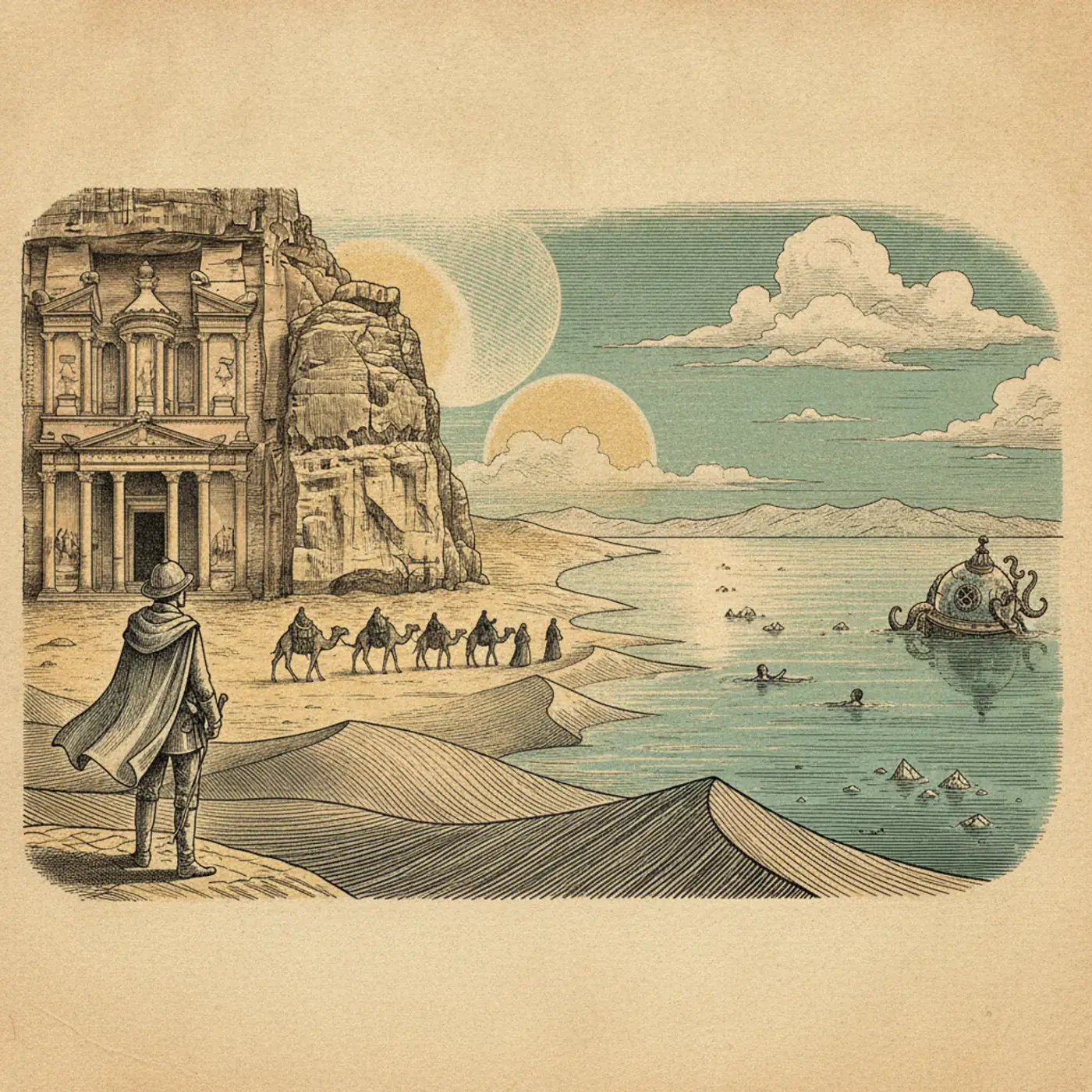
The first sight of the Treasury at Petra comes at the end of the Siq — a 1.2km slot canyon where the walls narrow to four metres and block out the sky. You walk in total shade, hearing your own footsteps, seeing the sandstone swirl in impossibly beautiful formations, and then the canyon widens slightly and there, framed between the rock walls, is a rose-red carved facade eighty-eight metres high that the Nabataean people cut directly out of a cliff face 2,000 years ago. The person in front of me audibly said “oh.” Just “oh.” As a summation of that moment, it was actually perfect.
Jordan does this. Five days catches most of the best of it.
Day 1: Amman
Fly into Queen Alia International Airport and make your way to Amman, Jordan’s capital. The city is built across a series of hills and is more interesting than its reputation suggests.
The Citadel (Jabal al-Qal’a) on the highest hill has ruins spanning 7,000 years — a Roman Temple of Hercules, a Byzantine church, an Umayyad palace, and views over the white-limestone city below. The Roman Theatre in the valley below seats 6,000 and is still used for events.
For dinner: the Rainbow Street area in the Jabal Amman neighbourhood has the best restaurant concentration in the city. Try Hashem Restaurant for a legendary falafel and hummus dinner that costs about $5 and is exactly what you want after a long flight.

Days 2–3: Petra
Drive south from Amman to Petra (3 hours). Enter via the Visitor Centre and through the Siq to the Treasury (Al-Khazneh). Then keep going.
| Day 2 at Petra | Day 3 at Petra | |
|---|---|---|
| Morning | Siq + Treasury + Street of Facades | High Place of Sacrifice hike |
| Afternoon | Royal Tombs + Colonnade Street | Little Petra + Monastery (Ad Deir) |
| Evening | Petra by Night (Mon/Wed/Thu) | Drive toward Wadi Rum |
Most day-trippers see the Treasury and go home. The Petra that reveals itself beyond that — the Street of Facades, the Royal Tombs, the Colonnade Street, the Great Temple, and ultimately the enormous Monastery (Ad Deir), reached by 800 carved steps with an interior that dwarfs the Treasury — is where the site stops being a photo stop and becomes a full civilisation.
On Day 3, do the High Place of Sacrifice: a 45-minute climb above the city to a Nabataean altar with a panoramic view. Descend via the Garden Triclinium route past more carved facades.
Petra by Night runs Monday, Wednesday, and Thursday: 2,000 candles illuminate the Siq and the Treasury while a Bedouin musician plays. It’s atmospheric rather than informative, and it’s worth the extra ticket.
Day 4: Wadi Rum
Drive 90 minutes south to Wadi Rum, the vast desert valley of pink and red sandstone that was used to film The Martian, Dune, and Lawrence of Arabia. The landscape earns every comparison to Mars — enormous monoliths rising from flat red sand, natural rock bridges, ancient inscriptions, silence.
Book a jeep tour with a Bedouin operator for the afternoon, visiting the rock bridges, the red sand dunes, and the inscriptions at Lawrence’s Spring and Khazali Canyon. Then: the overnight desert camp. Dozens of camps operate across the valley, ranging from budget tents to luxury bubble pods under glass. The key experience — eating with the family, drinking sweet tea by a fire, and sleeping in silence so complete that you hear your own breathing — is available at all price points.
The stars from Wadi Rum, with zero light pollution and low humidity, are among the most spectacular you will see anywhere on earth without specific equipment.
Day 5: Dead Sea and Departure
Drive north (3 hours) to the Dead Sea. At 430 metres below sea level, it is the lowest point on the surface of the earth and the saltiest large body of water — so salty that it’s almost impossible to sink. Floating in it is exactly as strange and funny as it looks in photographs: you sit up in the water and the water holds you there without effort, like lying in a hammock.
Spread the black mineral mud from the lakebed over yourself and rinse it off — it’s a legitimate cosmetic treatment, not just a tourist performance, and your skin will be absurdly soft afterward. The mineral content of the water makes sustained swimming painful if it gets in your eyes; get in, float, take your photograph, get out.
Fly home from Amman in the evening with mild sunburn, sand still in your shoes, and a phone full of photographs you didn’t think you were capable of taking.
Do I need a guide for Jordan? For Petra, a guide for Day 2 and self-guided Day 3 is a good split. Wadi Rum requires a Bedouin guide and jeep (non-negotiable and correct — the desert navigation is not amateur territory). Amman and the Dead Sea are easy solo.
Is Jordan safe? Yes — Jordan is one of the most stable and tourist-friendly countries in the Middle East, with a well-established tourism infrastructure and low crime.
How much does Jordan cost? Moderate by Middle Eastern standards. Jordan Pass covers most entrance fees; accommodation ranges from $30 budget to $200+ luxury. Desert camp mid-range: $80–120/person including dinner and breakfast.
This article contains affiliate links marked rel="sponsored". We may earn a commission at no extra cost to you.