
[ TIPS · THE DISPATCH ]
Choosing Travel Insurance That Actually Covers Your Camera and Your Knee
What does travel insurance actually cover? Mostly not your camera, and only sometimes your knee. The gear limits, the adventure-sport exclusions, and the one clause that genuinely matters.
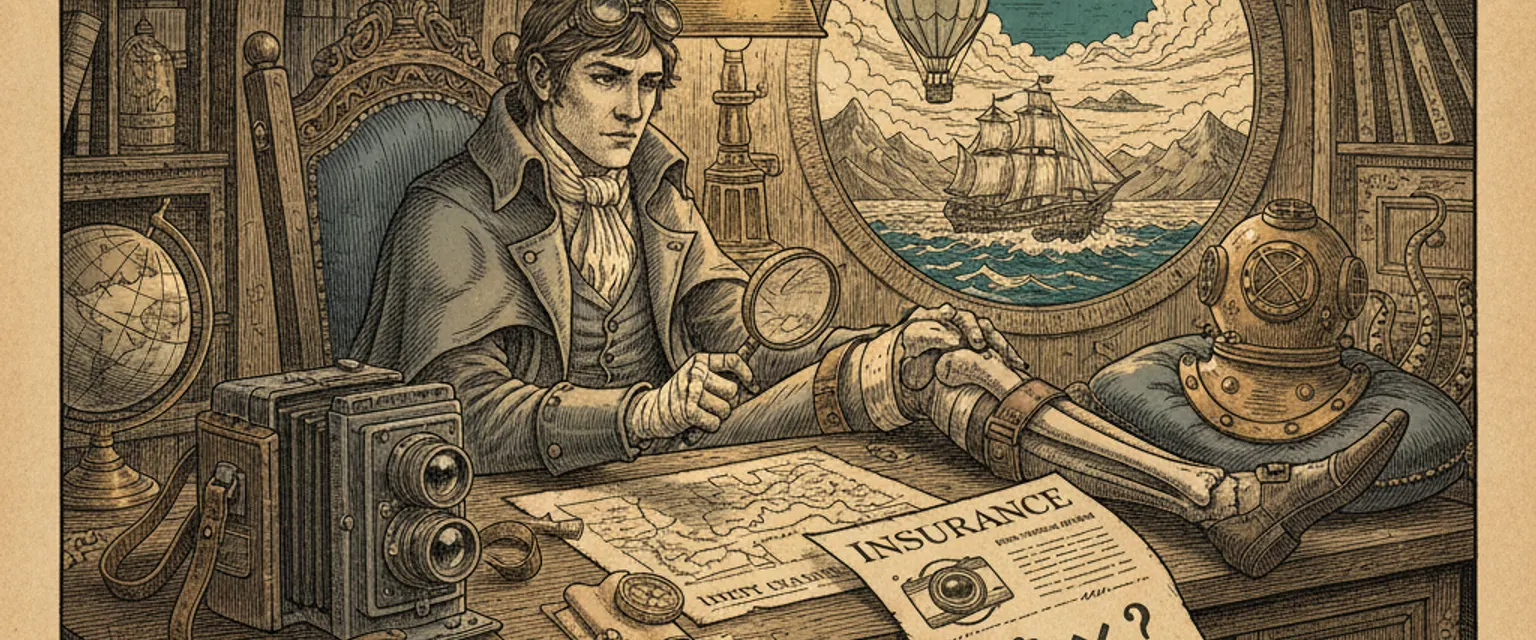
So what does travel insurance actually cover? Less than the cheerful website implies, and the gap is exactly where people get hurt — usually right after they’ve already been hurt. I learned the contours of this the expensive way, sitting in a clinic in the Alps with a knee that no longer bent the way knees bend, holding a policy I’d bought in four minutes for the price of a sandwich, slowly realising that the four-minute policy and the actual situation did not overlap nearly as much as I’d assumed.
Let me walk you through the three places these policies quietly let you down, and the one place where they’re the only thing standing between you and financial ruin.

Your camera is “valuables,” and valuables have a sad little limit
First, the gear. If you travel with anything decent — a proper camera, a laptop, a nice drone, a phone you’d cry about losing — read the single-item limit before you do anything else.
Because here’s the trap. The policy headline screams “£3,000 baggage cover!” and you think, great, my camera’s covered. It is not. Buried in the small print is a per-item limit, and it’s often something laughable like £200 or £300. So your £1,500 camera, stolen off a cafe table in one careless second, pays out the single-item cap and you eat the rest. The total baggage number is a fantasy made of socks.
The fix: for proper kit you usually need to “specify” the item — list it by name with its value, sometimes for a small extra premium. Or insure expensive gear on a separate gadget policy, or check whether your home contents insurance covers it abroad (sometimes it does, surprisingly). But do not assume the big baggage number means your camera. It doesn’t. It almost never does.
The adventure-sport exclusion that catches everyone
Now the knee. This is the one that got me, and it gets a lot of people, because the definition of “adventure” is wider and dumber than you’d ever guess.
Standard policies cover you for, roughly, lying on a beach. The moment you do anything fun, you may be uncovered — and the list of “fun” the insurers consider too risky is genuinely surprising. Skiing, obviously. But also things like a quad-bike day tour, ziplining, scuba past a shallow depth, a “via ferrata” walk, sometimes even hiking above a certain altitude, which on a normal trekking holiday is laughably easy to exceed. My knee went on a marked, popular trail that I’d have sworn was just walking. The insurer’s definition disagreed.
So before you buy, write down everything you might plausibly do — every tour you might book on a whim — and check each one is on the covered list, or buy the activity pack that adds them. It’s usually a few quid more. A few quid versus a five-figure helicopter bill is not a hard sum.
Pre-existing conditions and the honesty trap
The third quiet trap: pre-existing medical conditions. If you don’t declare something — even something old, managed, that you’ve half forgotten — and it’s deemed connected to your claim, the whole claim can be voided. Not reduced. Voided.
It feels tempting to skip the awkward medical questions to keep the premium down. Don’t. Declare everything, even the stuff that seems irrelevant, even if it bumps the price. A slightly dearer policy that actually pays is infinitely better than a cheap one that finds a reason not to. The cheap one isn’t insurance. It’s a donation.
The one clause that actually matters: medical evacuation
Right. If you ignore all of the above and remember one thing, remember this. The only part of a travel insurance policy that can save you from genuine catastrophe is the medical evacuation cover. Everything else is, frankly, convenience.
Here’s why. A stolen camera is annoying, a few hundred quid. A cancelled flight is a hassle. But getting seriously ill or badly injured somewhere with poor hospitals, and needing an air ambulance to fly you to a country that can treat you — that is the bill that ends families financially. A medical repatriation by air can run into six figures. Genuinely. People have remortgaged.
So when you compare policies, scroll past the baggage figures and find the medical and evacuation limits. You want medical cover in the millions, and explicit repatriation/evacuation cover that’s also enormous. A policy with £10m medical and full repatriation, for a couple of quid more, is the one to buy — even if its camera limit is rubbish. Because the camera is a bad day and the evacuation is a ruined life.
That’s the reorder. Most people shop travel insurance on price and baggage cover, which is exactly backwards. Shop it on medical evacuation first, declare your knee and your meds honestly, specify your camera, and tick the box for whatever daft adventure you’ve got planned. Do that and the policy will, when the awful day comes, actually be there. Mine — the four-minute one — mostly wasn’t. Don’t be me in that clinic.
Buy for the evacuation, not the baggage — and read the single-item limit before you ever pack the good camera.
This article contains affiliate links marked rel="sponsored". We may earn a commission at no extra cost to you.