
[ ITINERARY · THE DISPATCH ]
5 Days in Bhutan: Paro's Tiger's Nest, Dzongs, and the Last Himalayan Kingdom
A real five-day Bhutan plan built around Paro: the climb to Tiger's Nest, fortress dzongs, eye-watering chilli cheese, and the daily fee nobody explains well. Day by day.
Planning a Bhutan Paro 5 day itinerary is a bit different from anywhere else on earth, because you can’t just rock up. You pay a daily Sustainable Development Fee — at the time I went it was $100 a day on top of your costs — and you go through a licensed guide and driver the whole time. Sounds restrictive. It isn’t, really. It means no crowds, no touts, and a country that’s deliberately chosen not to be ruined. I came in a little cynical about the “happiest kingdom” branding. I left a convert.
Five days, based around Paro and Thimphu and Punakha, is the classic loop. Here’s how I’d run it.

Day 1: Land in Paro, Go Slow
Flying into Paro is itself an event — it’s one of the trickiest commercial landings in the world, the plane banks between mountains so close you can see prayer flags on the slopes. Only a handful of pilots are certified for it. White-knuckle stuff, and then you’re down in a green valley at 7,300 feet.
Take it easy on day one for the altitude. Visit the Rinpung Dzong, the fortress-monastery that towers over Paro, all whitewashed walls and dark timber galleries, then walk up to the National Museum in the old watchtower above it for the lay of the land and a good intro to Bhutanese Buddhism.
First dinner is your introduction to ema datshi, the national dish, which is chillies cooked as the vegetable (not the seasoning) in a melted cheese sauce. It is HOT. I’m talking properly, sweating-at-the-table hot, and weirdly addictive. Order rice to dilute the pain. You’ll be eating versions of this all week, get used to it.
Day 2: The Climb to Tiger’s Nest
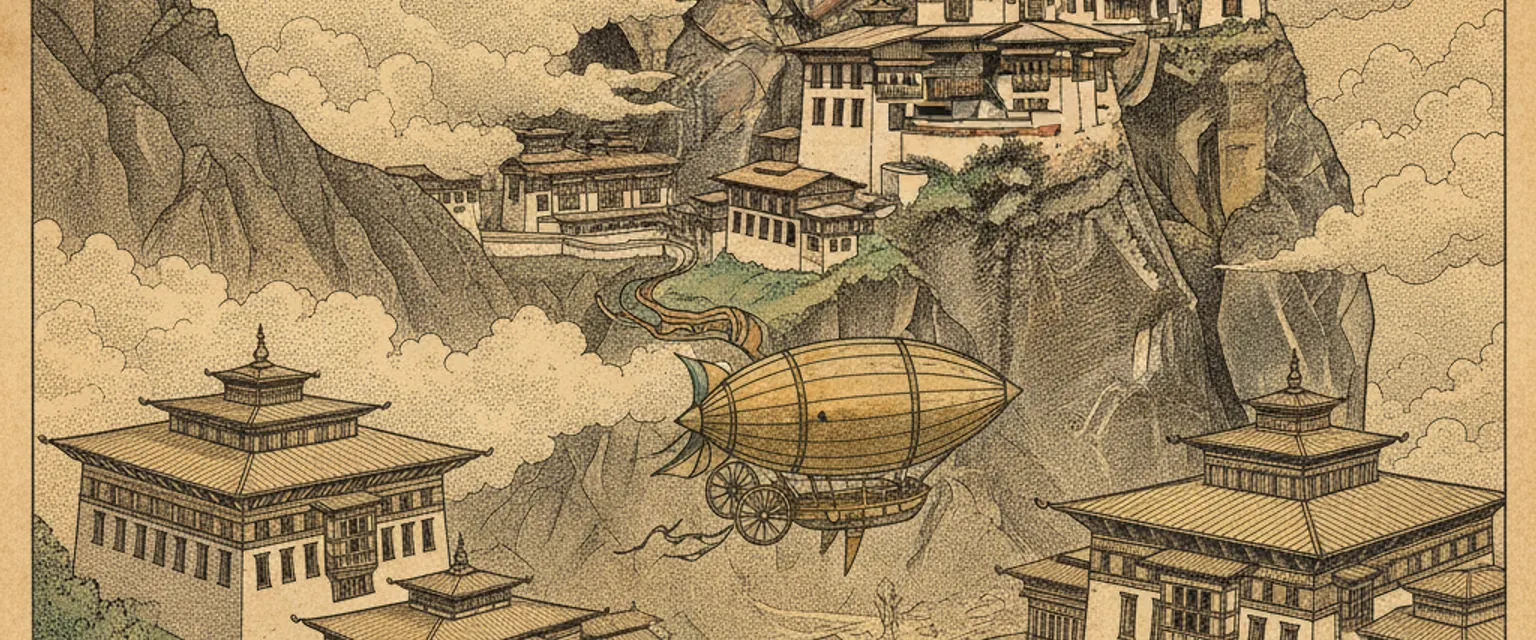
The big one. Paro Taktsang, the Tiger’s Nest, the monastery glued to a cliff 3,000 feet above the valley floor. Legend says Guru Rinpoche flew here on the back of a tigress. You, less glamorously, walk. It’s a steep, switchbacking climb of around 2–3 hours up, through pine and past fluttering flags, with a cafeteria viewpoint about halfway where most people stop for tea and a breather.
The last stretch drops down a stone staircase and back up to the monastery itself. Inside (no cameras, no phones, you check them at the gate) it’s a series of small, candle-lit shrine rooms hanging over the drop. It’s the kind of place where even loud people go quiet.
Reward yourself in the evening. You earned the ema datshi tonight.
Day 3: Drive to Thimphu, the Capital With No Traffic Lights
It’s a short, pretty drive to Thimphu, the capital, and the running joke is that it’s the only world capital with no traffic lights — they installed one once and people hated it, so a white-gloved policeman directs traffic by hand instead. Go watch him. It’s strangely lovely.
See the giant Buddha Dordenma, a 169-foot golden Buddha on a hill over the city with thousands of smaller Buddhas inside. Visit the Memorial Chorten where locals circle and pray all day, and if you’re into the quirky, the Takin Preserve — the takin is Bhutan’s national animal and looks like a goat designed by committee. Thimphu also has the only proper restaurants and shops in the country, so it’s a good evening to wander.

Day 4: Over the Dochula Pass to Punakha
Drive over the Dochula Pass at around 10,000 feet, marked by 108 little stupas (chortens) and, on a clear morning, a wall of Himalayan peaks on the horizon. Cross your fingers for the view, the cloud is fickle.
Down the other side to Punakha, warmer and lower, and the Punakha Dzong — for my money the most beautiful building in the country, sitting where two rivers meet, lit up with purple jacaranda if you time it right. To reach it you cross a suspension bridge draped in flags. There’s a longer suspension footbridge nearby too if you want a wobble. This was my favourite day of the five.
Day 5: Back to Paro and a Hot Stone Bath
Drive back to Paro and spend your last day gently. The classic Bhutanese treat is a hot stone bath — river stones heated in a fire and dropped into a wooden tub of water and artemisia leaves, hissing and steaming. After all that climbing and driving it is heaven. Most farmhouses near Paro arrange them; your guide will sort it.
Do a final wander through Paro town, buy a few hand-woven textiles or a thangka painting, and have one more plate of ema datshi for the road. Then it’s the white-knuckle flight back out.
Costs, Guides, and Getting Around
You don’t really “get around” Bhutan yourself — your licensed guide and driver handle everything, included once you’ve booked. Budget for the daily Sustainable Development Fee on top (confirm the current rate when you book, it has changed), plus your hotels and food, which your tour operator bundles. It’s not a cheap country to visit, by design. But you get a kingdom that’s kept itself, and a guide who becomes a friend by day five.
Five days is the right length for the Paro–Thimphu–Punakha loop without rushing. Add days if you want to push east into the valleys most tourists never reach.
Is Bhutan worth the daily fee? For me, yes, completely. The fee is the whole reason it’s still unspoiled. You’re not paying to see Bhutan — you’re paying for it to still be Bhutan when you get there.
This article contains affiliate links marked rel="sponsored". We may earn a commission at no extra cost to you.