
[ ITINERARY · THE DISPATCH ]
How to Do Prague in 4 Days Without Becoming a Stag Party
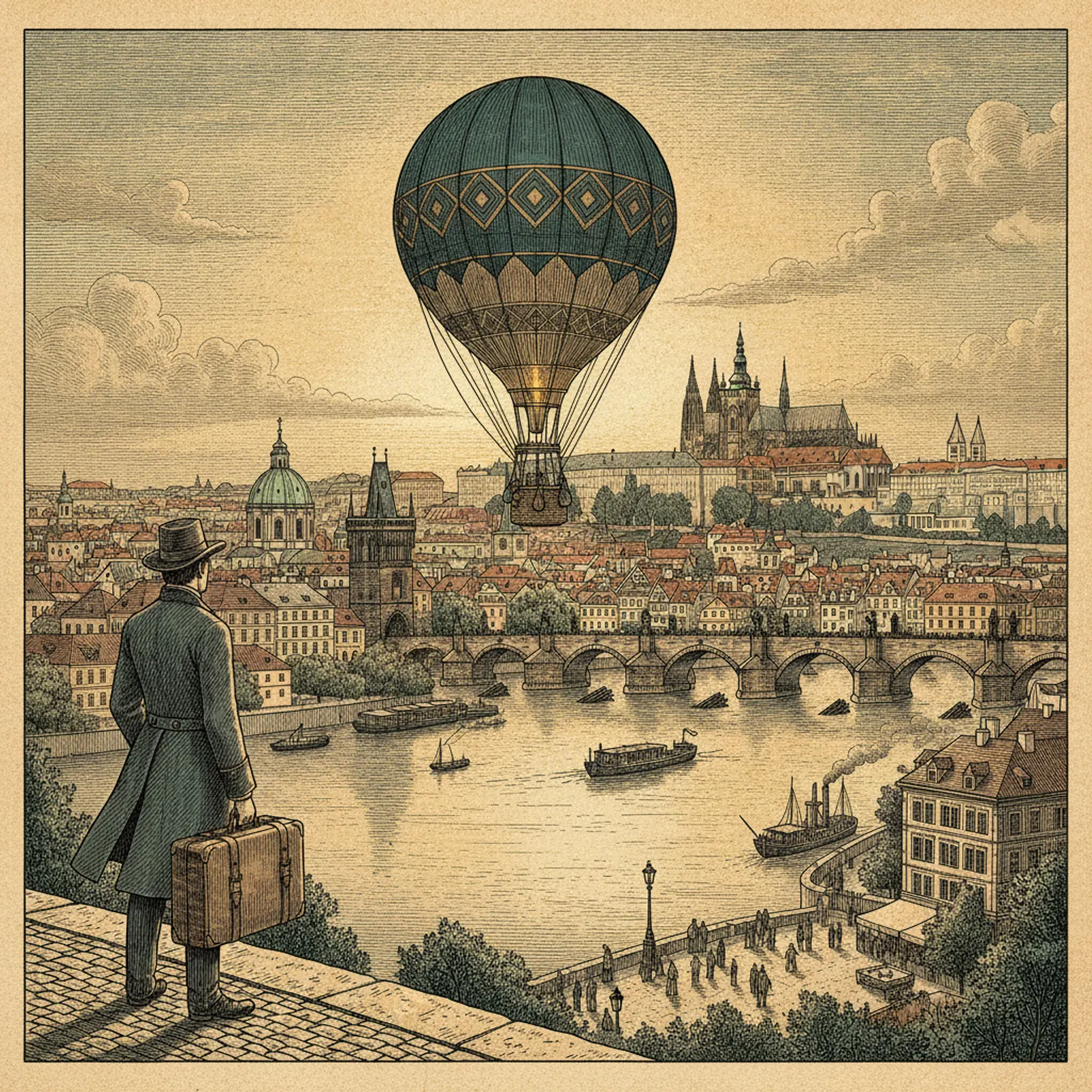
Prague is spectacular and it knows it. Four days to do the castle, the Old Town, the hidden bars, and the parts of the city that the stag parties never reach — because they can't find them.
The stag party found me at 10am on a Sunday morning outside the Astronomical Clock. They were wearing matching T-shirts and carrying small plastic cups and one of them asked me if I knew where “the absinthe bar from TikTok” was. I did not. What I did know, by that point in my four days in Prague, was that the real city — the extraordinary, complicated, beautiful real city — existed approximately three tram stops in any direction from this exact corner and that it was almost entirely unstaffed by people in matching T-shirts.
Here’s how to find it.

Day 1 — Old Town Without the Crowds
Get to the Astronomical Clock at 8am. It’s on the hour, on the hour, and the 8am performance has almost no one watching — the mechanical figures emerge, the clock does its thing, you have the square to yourself. By 10am it’s a scrum.
Walk through Old Town (Staré Město) into Josefov — the old Jewish Quarter, with its layered cemeteries where gravestones are stacked on top of each other because there wasn’t enough room to bury everyone side by side. The oldest dates from 1439. Walk through it slowly.
Lunch: Lokál on Dlouhá Street — a Czech gastropub with tank Pilsner Urquell (unpasteurised, served in a glass that’s been properly rinsed in cold water as it should be) and svíčková (beef in cream sauce with bread dumpling and cranberry). Queue or book ahead; locals eat here, which is the signal.
Evening: Letná Park beer garden, above the river — a plateau above the city with a terrace overlooking the red-roofed panorama. Cheap beer, plastic chairs, the most beautiful view in Prague, and almost no tourists. Take tram 1 or 25 to Letenské náměstí.
Day 2 — Prague Castle and Malá Strana
Arrive at Prague Castle at opening (9am). The castle complex is the largest ancient castle in the world by area and contains St Vitus Cathedral (free to enter the nave, paid for the full tour), the Old Royal Palace, and several museums. Budget three to four hours; the cathedral alone warrants an hour.
Walk down through Malá Strana (Little Quarter) on the way back — cobbled streets, baroque palaces now used as embassies, Kampa Island in the river. Café Savoy in Malá Strana for a late lunch: ornate neo-Renaissance interior, excellent open sandwiches, Czech pastries.
Charles Bridge in the late afternoon is the golden-hour photograph. It’s crowded at all hours, but 5–6pm in summer gives you decent light and slightly less density. The statues are baroque originals (mostly copies; originals in the National Museum).

Day 3 — Vinohrady, Žižkov, Local Prague
The residential neighbourhoods southeast of the centre are where Prague actually lives. Vinohrady is tree-lined, café-dense, and feels like a city that’s working on its coffee-to-population ratio with great seriousness. Žižkov, next door, is rougher-edged, has the giant Žižkov Television Tower (with a viewing platform and a café, and also crawling baby sculptures by David Černý, which is either charming or alarming depending on your tolerance for large metal infants), and some of the best dive bars in the city.
Riegrovy sady park beer garden in Vinohrady: same principle as Letná, different hill, different view, also correct. Cold beer, good people-watching, low prices.
Evening: Bar-hop through Žižkov’s Seifertova Street, then end at Výtopna (a restaurant where drinks are delivered by model trains — genuinely) for the novelty, or Hemingway Bar on Kaprova for serious cocktails in a glamorous pre-war interior.

Day 4 — Vyšehrad, Then Leave Slowly
Vyšehrad Castle, south of the centre: a promontory above the Vltava that was the city’s original fortress before Prague Castle existed. Far fewer tourists, a cemetery containing the graves of Dvořák and Smetana, and cliff-edge views of the river. Take tram 7 or 18 to Albertov.
Final lunch: Café v lese or any neighbourhood spot in Nusle below Vyšehrad. Something slow, Czech, not in a tourist zone.
Prague at a Glance
| Neighbourhood | Vibe | Best for |
|---|---|---|
| Old Town / Josefov | Touristy, beautiful, historic | Sightseeing days |
| Malá Strana | Baroque, quiet, embassy-heavy | Castle access, romantic evenings |
| Vinohrady | Leafy, local, excellent cafes | Staying, eating, not being a tourist |
| Žižkov | Scruffy, bars, real Prague | Drinking, authenticity, the TV Tower |
| Vyšehrad | Serene, historic, undervisited | Escaping, views, cemetery-appreciation |
FAQ
When is Prague not overrun? November to February is genuinely quiet and the winter markets are atmospheric. Spring and autumn are sweet spots. July–August is peak stag season.
Is Prague still cheap? Cheaper than Paris or London, more expensive than five years ago. Beer is still under €2 at a local pub. Restaurants in tourist zones will charge you accordingly.
How do I get around? Trams are the move — cheap, extensive, historic. The metro covers longer distances. Walk whenever you can; the city is designed for it.
This article contains affiliate links marked rel="sponsored". We may earn a commission at no extra cost to you.